
Catalogue Search | MBRL


Are you sure you want to remove the book from the shelf?

{{itemTitle}}
35
result(s) for
"Babbage, Frances"
Sort by:


Acts of Unsettling: An Immersive Adaptation of Berger and Mohr’s A Seventh Man
This article examines Michael Pinchbeck and Ollie Smith’s theatrical adaptation of A Seventh Man, the 1975 book by John Berger and photographer Jean Mohr studying the experience of migrant workers in Europe. Pinchbeck and Smith’s 2020 adaptation uses immersive performance strategies in dialogue with a multi-voiced, cross-disciplinary publication that itself aims to produce an immersive or ‘animated’ reader engagement. In this article, Babbage and Pinchbeck present source text and performance as examples of practice-as-research, referencing Nelson’s paradigm that establishes different modes of knowledge and points of connection- and dissension-between them. They discuss the book’s cross-disciplinarity and the attempt to reflect this in a new creative context that is spatiotemporal, embodied, social, visual, verbal and aural. The article’s theoretical context draws on writing by Barthes, Berger, Said and Sontag, applying Barthes’ notion of the studium and the punctum to reflect on the dramaturgical rendering of the source text’s ‘interruptive shocks’. Babbage and Pinchbeck argue that, in book and performance, the juxtaposition of different formal languages elicits an encounter with the material that is productively ‘unsettling’.
Journal Article

Adaptation in contemporary theatre : performing literature
\"Why are so many theatre productions adaptations of one kind of another? Why do contemporary practitioners turn so frequently to non-dramatic texts for inspiration? This study explores the fascination of novels, short stories, children's books and autobiographies for theatre makers and examines what 'becomes' of literary texts when these are filtered into contemporary practice that includes physical theatre, multimedia performance, puppetry, immersive and site-specific performance and live art. In Adaptation in Contemporary Theatre, Frances Babbage sets out a series of fresh critical perspectives on the theory of adaptation in theatre-making, focusing on meditations of prose literature within contemporary performance. Individual chapters explore the significance and impact of books as physical objects within productions; the relationship between the dramatic adaptation and literary edition; storytelling on the page and in performance; literary space and theatrical space; and prose fiction reframed as 'found text' in contemporary theatre and live art. Case studies are drawn from internationally acclaimed companies including Complicite, Elevator Repair Service, Kneehigh, Forced Entertainment, Gob Squad, Teatro Kismet and Stan's Cafe. Adaptation in Contemporary Theatre is a compelling and provocative resource for anyone interested in the potential and the challenges of using prose literature ad material for new theatrical performance. \"-- Provided by publisher.
Book

“We’re all part of the same collective, we just haven’t quite figured that out yet”: Dramaturgies of Participation in The People’s Palace of Possibility
This co-authored article examines the ways in which The People’s Palace of Possibility, a live interactive installation by The Bare Project, was reinvented in the context of COVID-19 as a postal event engaging participants individually in their local areas. We show how the adapted dramaturgy sought to address the deep disruptions instilled by the pandemic, seeking to build a dynamic, reparative structure that could tend to a shattered and isolating present. Applying perspectives from adaptation, psychology, democratic theory and dramaturgy, we argue that home, neighbourhood and online environments afforded opportunities for individual and collective engagement with political ideas, generating multiple visions of utopia.
Journal Article
Acts of Unsettling: An Immersive Adaptation of Berger and Mohr’s IA Seventh Man/I
This article examines Michael Pinchbeck and Ollie Smith's theatrical adaptation of A Seventh Man, the 1975 book by John Berger and photographer Jean Mohr studying the experience of migrant workers in Europe. Pinchbeck and Smith's 2020 adaptation uses immersive performance strategies in dialogue with a multi-voiced, cross-disciplinary publication that itself aims to produce an immersive or 'animated' reader engagement. In this article, Babbage and Pinchbeck present source text and performance as examples of practice-as-research, referencing Nelson's paradigm that establishes different modes of knowledge and points of connection- and dissension-between them. They discuss the book's cross-disciplinarity and the attempt to reflect this in a new creative context that is spatiotemporal, embodied, social, visual, verbal and aural. The article's theoretical context draws on writing by Barthes, Berger, Said and Sontag, applying Barthes' notion of the studium and the punctum to reflect on the dramaturgical rendering of the source text's 'interruptive shocks'. Babbage and Pinchbeck argue that, in book and performance, the juxtaposition of different formal languages elicits an encounter with the material that is productively 'unsettling'.
Journal Article

Richard Wainwright, the Liberals and Liberal Democrats
Richard Wainwright, the Liberals and Liberal Democrats: Unfinished Business now available in paperback, offers new research on familiar themes involving loyalties of politics, faith and locality. Richard Wainwright was a Liberal MP for seventeen years during the Party’s recovery, but his life tells us about much more than this. Wainwright grew up in prosperity, but learned from voluntary work about poverty; he refused to fight in World War Two, but saw war at its cruellest; he joined the Liberal Party when most had given up on it, but gave his fortune to it; lost a by-election but caused the only Labour loss in Harold Wilson’s landslide of 1966. He then played a key role in the fall of Jeremy Thorpe, the Lib-Lab Pact and the formation of the SDP-Liberal Alliance and the Liberal Democrats; he represented a unique Yorkshire constituency which reflected his pride and hope for society; and though he gave his life to the battle to be in the Commons, he refused a seat in the Lords. Richard Wainwright's story is central to the story of the Liberal Party and sheds light on the reasons for its survival and the state of its prospects. At the same time this book is a parable of politics for anyone who wants to represent an apparently lost cause, who wants to motivate people who have been neglected, and who wants to follow their convictions at the highest level.
eBook
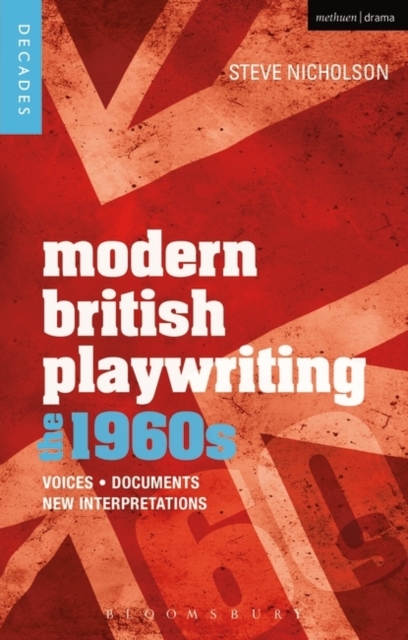
Modern British Playwriting: The 1960s
Essential for students of theatre studies, Methuen Drama’s Decades of Modern British Playwriting series provides a comprehensive survey and study of the theatre produced in each decade from the 1950s to 2009 in six volumes. Each volume features a critical analysis and reevaluation of the work of four key playwrights from that decade authored by a team of experts, together with an extensive commentary on the period. The 1960s was a decade of seismic changes in British theatre as in society at large. This important new study in Methuen Drama’s Decades of Modern British Playwriting series explores how theatre-makers responded to the changes in society. Together with a thorough survey of the theatrical activity of the decade it offers detailed reassessments of the work of four of the leading playwrights. The 1960s volume provides in-depth studies of the work of four of the major playwrights who came to prominence: Edward Bond (by Steve Nicholson), John Arden (Bill McDonnell), Harold Pinter (Jamie Andrews) and Alan Ayckbourn (Frances Babbage). It examines their work then, its legacy today, and how critical consensus has changed over time.
eBook
Re-visioning myth
‘Re-visioning myth: contemporary drama by women’ examines the diverse ways in which classical myth narratives have been reworked by women playwrights for the European stage. The first in-depth assessment of ‘re-vision’ as a phenomenon in women’s drama, this study explores the ideological and aesthetic potential of such practice and silmultaneously exposes the tensions inherent in attempts to challenge narratives that have fundamentally shaped western thought. ‘Re-visioning myth’ examines plays from the 1960s to the 21st century, providing contextualised readings of fourteen theatrical works originating from France, Italy, Germany, Iceland, the Netherlands, the U.K. and Ireland. Babbage introduces important contemporary playwrights to English speaking readers and audiences, placing these authors and their works into dialogue with others more widely known. From tracing the persistence of classical myths in contemporary culture and the significance of this in shaping gendered identities and opportunities, through to analysis of individual plays and productions, ‘Re-visioning myth’ reveals how myths have served in the theatre as ‘pretexts’ for ideological debate; have enabled exploration of the fragile borders between mythic and the everyday and how revision has been regarded, not unproblematically, as a route towards restructuring the self. Babbage also explores the intersection of re-vision within the contrasting trends of ‘in-yer face’ and postdramatic theatre, and the unique potential for myth rewriting offered by autobiographical solo performance. This will make compelling reading for anyone interested in women’s writing for the theatre or wider practices of adaptation in literature and performance.
eBook

The Play of Surface: Theater and \The Turn of the Screw\
Babbage examines Henry James' \"The Turn of the Screw\" (1898). He explores the theatricality of the novel by considering the presence of performance as a metaphor within the story and the ways James' fascination with contemporary theater pervades the work. He also discusses the altering of reception when the tale comes equipped with \"visuals,\" which is the situation with \"The Turn of the Screw\" in the form of theatrical adaptation. Babbage touches on William Archibald's 1950 theatrical version of the novel, called \"The Innocents,\" and he also discusses Jeffrey Hatcher's 1996 Portland Stage Company production of \"The Turn of the Screw.\"
Journal Article
