
Catalogue Search | MBRL


Are you sure you want to remove the book from the shelf?

{{itemTitle}}
63
result(s) for
"Badgley, Catherine"
Sort by:

Tectonics, topography, and mammalian diversity
Terrestrial vertebrates show striking changes in species richness across topographic gradients. For mammals, nearly twice as many species per unit area occur in topographically complex regions as in adjacent lowlands. The geological context of this pervasive biogeographic pattern suggests that tectonic processes have a first-order impact on regional diversity. I evaluate ecological, evolutionary, and historical influences of tectonics and topography on the regional diversity of terrestrial mammals, focusing on the hypothesis that diversification rates are higher in active versus passive tectonic settings. Ten predictions follow from this hypothesis. 1) The timing of peaks in speciation should be congruent with the timescale for tectonic episodes. 2) The rates of speciation and genetic differentiation of populations should be greater for species inhabiting topographically complex regions than spatially continuous landscapes. 3) If topographic complexity per se promotes diversification, then a cluster of young divergences should occur for montane species compared to lowland relatives. 4) Endemism in tectonically active regions should reflect origination within the region rather than range reduction from larger areas. 5) Extinction rates should differ for lineages in tectonically active regions compared to adjacent lowlands. 6) The relationship between local and regional species richness should differ between topographic settings because of higher beta diversity in topographically complex regions. 7) Species originating in topographically complex regions should colonize adjacent lowlands more often than the reverse pattern. 8) North-south mountain ranges should have higher regional species richness than east-west mountain ranges. 9) Areas with multiple mountain ranges should have higher regional species richness than comparable areas with single mountain ranges. 10) Global climate changes should affect diversification in tectonically active regions. Research addressing these topics places elevational diversity gradients into a geohistorical context and integrates data from modern biotas and the fossil record.
Journal Article

Coupled influence of tectonics, climate, and surface processes on landscape evolution in southwestern North America
The Cenozoic landscape evolution in southwestern North America is ascribed to crustal isostasy, dynamic topography, or lithosphere tectonics, but their relative contributions remain controversial. Here we reconstruct landscape history since the late Eocene by investigating the interplay between mantle convection, lithosphere dynamics, climate, and surface processes using fully coupled four-dimensional numerical models. Our quantified depth-dependent strain rate and stress history within the lithosphere, under the influence of gravitational collapse and sub-lithospheric mantle flow, show that high gravitational potential energy of a mountain chain relative to a lower Colorado Plateau can explain extension directions and stress magnitudes in the belt of metamorphic core complexes during topographic collapse. Profound lithospheric weakening through heating and partial melting, following slab rollback, promoted this extensional collapse. Landscape evolution guided northeast drainage onto the Colorado Plateau during the late Eocene-late Oligocene, south-southwest drainage reversal during the late Oligocene-middle Miocene, and southwest drainage following the late Miocene.
Cenozoic landscape evolution of southwestern North America remains debated. Here, the authors reconstruct landscape using 4-D numerical models, which can explain extensional collapse and superficial geological record for the Basin and Range Province
Journal Article

Geometric morphometrics of mandibles for dietary differentiation of Bovidae (Mammalia: Artiodactyla)
The mammalian family Bovidae has been widely studied in ecomorphological research, with important applications to paleoecological and paleohabitat reconstructions. Most studies of bovid craniomandibular features in relation to diet have used linear measurements. In this study, we conduct landmark-based geometric-morphometric analyses to evaluate whether different dietary groups can be distinguished by mandibular morphology. Our analysis includes data for 100 species of extant bovids, covering all bovid tribes and 2 dietary classifications. For the first classification with 3 feeding categories, we found that browsers (including frugivores), mixed feeders, and grazers are moderately well separated using mandibular shape. A finer dietary classification (frugivore, browser, browser–grazer intermediate, generalist, variable grazer, and obligate grazer) proved to be more useful for differentiating dietary extremes (frugivores and obligate grazers) but performed equally or less well for other groups. Notably, frugivorous bovids, which belong in tribe Cephalophini, have a distinct mandibular shape that is readily distinguished from all other dietary groups, yielding a 100% correct classification rate from jackknife cross-validation. The main differences in mandibular shape found among dietary groups are related to the functional needs of species during forage prehension and mastication. Compared with browsers, both frugivores and grazers have mandibles that are adapted for higher biomechanical demand of chewing. Additionally, frugivore mandibles are adapted for selective cropping. Our results call for more work on the feeding ecology and functional morphology of frugivores and offer an approach for reconstructing the diet of extinct bovids.
Journal Article

Organic agriculture and the global food supply
The principal objections to the proposition that organic agriculture can contribute significantly to the global food supply are low yields and insufficient quantities of organically acceptable fertilizers. We evaluated the universality of both claims. For the first claim, we compared yields of organic versus conventional or low-intensive food production for a global dataset of 293 examples and estimated the average yield ratio (organic:non-organic) of different food categories for the developed and the developing world. For most food categories, the average yield ratio was slightly <1.0 for studies in the developed world and >1.0 for studies in the developing world. With the average yield ratios, we modeled the global food supply that could be grown organically on the current agricultural land base. Model estimates indicate that organic methods could produce enough food on a global per capita basis to sustain the current human population, and potentially an even larger population, without increasing the agricultural land base. We also evaluated the amount of nitrogen potentially available from fixation by leguminous cover crops used as fertilizer. Data from temperate and tropical agroecosystems suggest that leguminous cover crops could fix enough nitrogen to replace the amount of synthetic fertilizer currently in use. These results indicate that organic agriculture has the potential to contribute quite substantially to the global food supply, while reducing the detrimental environmental impacts of conventional agriculture. Evaluation and review of this paper have raised important issues about crop rotations under organic versus conventional agriculture and the reliability of grey-literature sources. An ongoing dialogue on these subjects can be found in the Forum editorial of this issue.
Journal Article

Taphonomic information from the modern vertebrate death assemblage of Doñana National Park, Spain
Modern death assemblages provide insights about the early stages of fossilization and useful ecological information about the species inhabiting the ecosystem. We present the results of taphonomic monitoring of modern vertebrate carcasses and bones from Doñana National Park, a Mediterranean coastal ecosystem in Andalusia, Spain. Ten different habitats were surveyed. Half of them occur in active depositional environments (marshland, lake margin, river margin, beach and dunes). Most of the skeletal remains belong to land mammals larger than 5 kg in body weight (mainly wild and feral ungulates). Overall, the Doñana bone assemblage shows good preservation with little damage to the bones, partly as a consequence of the low predator pressure on large vertebrates. Assemblages from active depositional habitats differ significantly from other habitats in terms of the higher incidence of breakage and chewing marks on bones in the latter, which result from scavenging, mainly by wild boar and red fox. The lake-margin and river-margin death assemblages have high concentrations of well preserved bones that are undergoing burial and offer the greatest potential to produce fossil assemblages. The spatial distribution of species in the Doñana death assemblage generally reflects the preferred habitats of the species in life. Meadows seem to be a preferred winter habitat for male deer, given the high number of shed antlers recorded there. This study is further proof that taphonomy can provide powerful insights to better understand the ecology of modern species and to infer past and future scenarios for the fossil record.
Journal Article

Ecological changes in Miocene mammalian record show impact of prolonged climatic forcing
Geohistorical records reveal the long-term impacts of climate change on ecosystem structure. A 5-myr record of mammalian faunas from floodplain ecosystems of South Asia shows substantial change in species richness and ecological structure in relation to vegetation change as documented by stable isotopes of C and O from paleosols. Between 8.5 and 6.0 Ma, C₄ savannah replaced C₃ forest and woodland. Isotopic historical trends for 27 mammalian herbivore species, in combination with ecomorphological data from teeth, show three patterns of response. Most forest frugivores and browsers maintained their dietary habits and disappeared. Other herbivores altered their dietary habits to include increasing amounts of C₄ plants and persisted for >1 myr during the vegetation transition. The few lineages that persisted through the vegetation transition show isotopic enrichment of δ¹³C values over time. These results are evidence for long-term climatic forcing of vegetation structure and mammalian ecological diversity at the subcontinental scale.
Journal Article

Small-mammal isotope ecology tracks climate and vegetation gradients across western North America
Stable carbon, nitrogen, hydrogen and oxygen isotopes have been used to infer aspects of species ecology and environment in both modern ecosystems and the fossil record. Compared to large mammals, stable isotopic studies of small-mammal ecology are limited; however, high species and ecological diversity within small mammals presents several advantages for quantifying resource use and organism–environment interactions using stable isotopes over various spatial and temporal scales. We analyzed the isotopic composition of hair from two heteromyid rodent species, Dipodomys ordii and Perognathus parvus, from localities across western North America in order to characterize dietary variation in relation to vegetation and climatic gradients. Significant correlations between the carbon isotopic composition (δ13C) of these species and several climatic variables imply that seasonal temperature and precipitation control the composition and distribution of dietary resources (grass seeds). Our results also suggest a moisture influence on the nitrogen isotopic composition (δ15N) of heteromyid diets. Population- and species-level variation in δ13C and δ15N values record fine-scale habitat heterogeneity and significant differences in resource use between species. Using classification and regression-tree techniques, we modeled the geographic variation in heteromyid δ13Cdiet values based on 10 climatic variables and generated an isotope landscape model (‘isoscape’). The isoscape predictions for δ13Cdiet differ from expectations based on observed C4 distributions and instead indicate that D. ordii and P. parvus record seasonally abundant grass resources, with additional model deviations potentially attributed to geographic variation in dietary selection. The oxygen and hydrogen isotopic composition of D. ordii is enriched relative to local meteoric water and suggests that individuals rely on highly evaporated water sources, such as seed moisture. Based on the climatic influences on vegetation and diet documented in this study, the isotopic composition of small mammals has high potential for recording ecological responses to environmental changes over short and long time scales.
Journal Article

Diet segregation in American bison (Bison bison) of Yellowstone National Park (Wyoming, USA)
Background
Body size is a major factor in the nutritional ecology of ruminant mammals. Females, due to their smaller size and smaller rumen, have more rapid food-passage times than males and thereby require higher quality forage. Males are more efficient at converting high-fiber forage into usable energy and thus, are more concerned with quantity. American bison are sexually dimorphic and sexually segregate for the majority of their adult lives, and in Yellowstone National Park, they occur in two distinct subpopulations within the Northern and Central ranges. We used fecal nitrogen and stable isotopes of carbon and nitrogen from American bison to investigate sex-specific differences in diet composition, diet quality, and dietary breadth between the mating season and a time period spanning multiple years, and compared diet indicators for these different time periods between the Northern and Central ranges.
Results
During mating season, diet composition of male and female American bison differed significantly; females had higher quality diets, and males had greater dietary breadth. Over the multi-year period, females had higher quality diets and males, greater dietary breadth. Diet segregation for bison in the Central Range was more pronounced during the mating season than for the multi-year period and females had higher quality diets than males. Finally, diet segregation in the Northern Range was more pronounced during the multi-year period than during the mating season, and males had greater dietary breadth.
Conclusions
Female bison in Yellowstone National Park have higher quality diets than males, whereas males ingest a greater diversity of plants or plants parts, and bison from different ranges exhibited more pronounced diet segregation during different times. Collectively, our results suggest that diet segregation in bison of Yellowstone National Park is associated with sex-specific differences in nutritional demands. Altogether, our results highlight the importance of accounting for spatial and temporal heterogeneity when conducting dietary studies on wild ungulates.
Journal Article

At the foot of the Himalayas : paleontology and ecosystem dynamics of the Siwalik record
This authoritative volume brings together decades of insights from one of the longest terrestrial fossil records on the planet.
The fabled Himalayas have isolated and sheltered the Indian subcontinent for millions of years. The Siwalik sequence of sediments at their feet has been a treasure trove of visions into the past for generations of paleontologists, preserving an immense 20 million years of terrestrial ecosystems' fossil record. The Siwalik sequence reveals a unique forest wonderland of diverse animal species: from huge elephant relatives, great rhinos, and sabertooth cats, to mongooses, swamp rats, crocodiles, and catfish. Regional climate change eventually caused this forest ecosystem to unravel, as grasslands replaced the forests and established the habitats and animals of the modern ecosystems of the Indus and Ganges rivers.
In At the Foot of the Himalayas, celebrated paleontologists Catherine Badgley, Michèle Morgan, and David Pilbeam bring together a collection of world-renowned scholars to present an interdisciplinary approach to documenting and interpreting this fossil record. By investigating changes in landscape, climate, and vertebrate species diversity, their analysis reveals insights into a central question about biodiversity: which evolutionary developments were influenced by changes in climate, and which were caused by interactions among the species themselves? This groundbreaking book illuminates for the first time a mysterious and vibrant paleontological past, bringing together more than 40 years of exciting international collaborative studies that forge invaluable knowledge pathways for the ecologists, evolutionary scientists, and paleontologists of the future, and pose important questions about our fragile ecosystems in the present day.
eBook
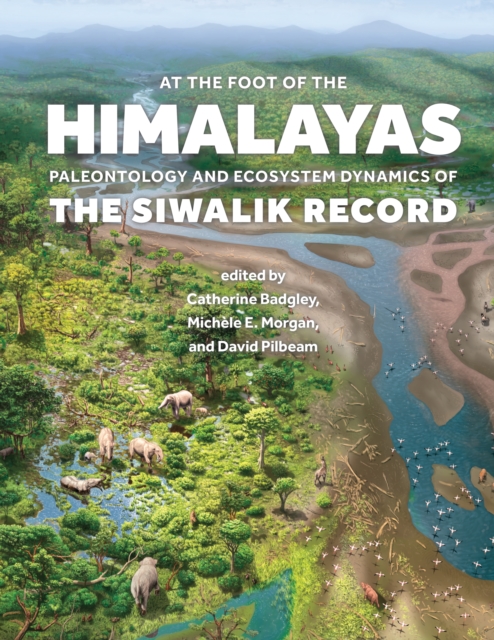
At the Foot of the Himalayas
This authoritative volume brings together decades of insights from one of the longest terrestrial fossil records on the planet.The fabled Himalayas have isolated and sheltered the Indian subcontinent for millions of years. The Siwalik sequence of sediments at their feet has been a treasure trove of visions into the past for generations of paleontologists, preserving an immense 20 million years of terrestrial ecosystems' fossil record. The Siwalik sequence reveals a unique forest wonderland of diverse animal species: from huge elephant relatives, great rhinos, and sabertooth cats, to mongooses, swamp rats, crocodiles, and catfish. Regional climate change eventually caused this forest ecosystem to unravel, as grasslands replaced the forests and established the habitats and animals of the modern ecosystems of the Indus and Ganges rivers.In At the Foot of the Himalayas, celebrated paleontologists Catherine Badgley, Michele Morgan, and David Pilbeam bring together a collection of world-renowned scholars to present an interdisciplinary approach to documenting and interpreting this fossil record. By investigating changes in landscape, climate, and vertebrate species diversity, their analysis reveals insights into a central question about biodiversity: which evolutionary developments were influenced by changes in climate, and which were caused by interactions among the species themselves? This groundbreaking book illuminates for the first time a mysterious and vibrant paleontological past, bringing together more than 40 years of exciting international collaborative studies that forge invaluable knowledge pathways for the ecologists, evolutionary scientists, and paleontologists of the future, and pose important questions about our fragile ecosystems in the present day.
eBook