
Catalogue Search | MBRL


Are you sure you want to remove the book from the shelf?

{{itemTitle}}
9
result(s) for
"Bagnall, Roger S., author"
Sort by:

Everyday writing in the graeco-roman east
Most of the everyday writing from the ancient world—that is, informal writing not intended for a long life or wide public distribution—has perished. Reinterpreting the silences and blanks of the historical record, leading papyrologist Roger S. Bagnall convincingly argues that ordinary people—from Britain to Egypt to Afghanistan—used writing in their daily lives far more extensively than has been recognized. Marshalling new and little-known evidence, including remarkable graffiti recently discovered in Smyrna, Bagnall presents a fascinating analysis of writing in different segments of society. His book offers a new picture of literacy in the ancient world in which Aramaic rivals Greek and Latin as a great international language, and in which many other local languages develop means of written expression alongside these metropolitan tongues.
eBook

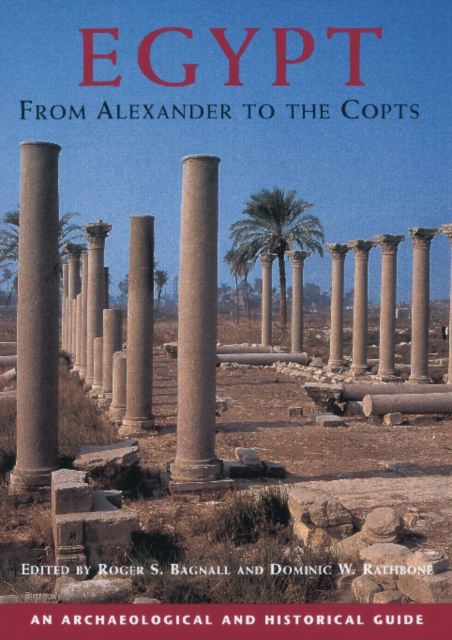
Egypt from Alexander to the Copts
After its conquest by Alexander the Great in 332 bc, Egypt was ruled for the next 300 years by the Ptolemaic dynasty founded by Ptolemy I, one of Alexander's generals. With the defeat of Cleopatra VII in 30 bc, Egypt became a province of the Roman Empire, and later of the Byzantine Empire. For a millennium it was one of the wealthiest, most populous and important lands of the multicultural Mediterranean civilization under Greek and Roman rule. The thousand years from Alexander to the Arab conquest in ad 641 are rich in archaeological interest and well documented by 50,000 papyri in Greek, Egyptian, Latin, and other languages. But travelers and others interested in the remains of this period are ill-served by most guides to Egypt, which concentrate on the pharaonic buildings. This book redresses the balance, with clear and concise descriptions related to documents and historical background that enable us to appreciate the fascinating cities, temples, tombs, villages, churches, and monasteries of the Hellenistic, Roman, and Late Antique periods. Written by a dozen leading specialists and reflecting the latest discoveries and research, it provides an expert visitor's guide to the principal cities, many off the well-worn tourist paths. It also offers a vivid picture of Egyptian society at differing economic and social levels.
eBook

Women's letters from ancient Egypt, 300 BC-AD 800
\"More than three hundred letters written in Greek and Egyptian by women in Egypt in the millennium from Alexander the Great to the Arab conquest survive on papyrus and pottery. These letters were written by women from various walks of life and shed light on critical social aspects of life in Egypt after the pharaohs. Roger S. Bagnall and Raffaella Cribiore collect the best preserved of these letters in translation and set them in their paleographic, linguistic, social, and economic contexts. As a result, Women's Letters from Ancient Egypt, 300 B.C.-A.D. 800, provides a sense that these women's habits, interests, and means of expression were a product more of their social and economic standing than of specifically gender-related concerns or behavior.\"--Jacket.
Book

Ostraka from Trimithis
This volume presents 455 inscribed pottery fragments, or ostraka, found during NYU's excavations at Amheida in the western desert of Egypt. The majority date to the Late Roman period (3rd to 4th century AD), a time of rapid social change in Egypt and the ancient Mediterranean generally. Amheida was a small administrative center, and the full publication of these brief texts illuminates the role of writing in the daily lives of its inhabitants. The subjects covered by the Amheida ostraka include the distribution of food, the administration of wells, the commercial lives of inhabitants, their education, and other aspects of life neglected in literary sources. The authors provide a full introduction to the technical aspects of terminology and chronology, while also situating this important evidence in its historical, social and regional context. Online edition available as part of the NYU Library's Ancient World Digital Library and in partnership with the Institute for the Study of the Ancient World (ISAW).
eBook

Amheida III : Ostraka from Trimithis. Volume 2, Greek texts from the 2008-2013 seasons
This is the second volume of Ostraka from the excavations Amheida (ancient Trimithis) in Egypt. It adds 491 items to the growing corpus of primary texts from the site. In addition to the catalog, the introductory sections make important contributions to understanding the role of textual practice in the life of a pre-modern small town. Issues addressed include tenancy, the administration of water, governance, the identification of individuals in the archaeological record, the management of estates, personal handwriting, and the uses of personal names. Additionally, the chapter 'Ceramic Fabrics and Shapes' by Clementina Caputo breaks new ground in the treatment of these inscribed sherds as both written text and physical object. This volume will be of interest to specialists in Roman-period Egypt as well as to scholars of literacy and writing in the ancient world and elsewhere.
Book

Amheida III
This archaeological report provides a comprehensive study of the excavations carried out at Amheida House B2 in Egypt's Dakhleh Oasis between 2005 and 2007, followed by three study seasons between 2008 and 2010. The excavations at Amheida in Egypt's western desert, begun in 2001 under the aegis of Columbia University and sponsored by NYU since 2008, are investigating all aspects of social life and material culture at the administrative center of ancient Trimithis. The excavations so far have focused on three areas of this very large site: a centrally located upper-class fourth-century AD house with wall paintings, an adjoining school, and underlying remains of a Roman bath complex; a more modest house of the third century; and the temple hill, with remains of the Temple of Thoth built in the first century AD and of earlier structures. Architectural conservation has protected and partly restored two standing funerary monuments, a mud-brick pyramid and a tower tomb, both of the Roman period.
This is the second volume of ostraka from the excavations Amheida (ancient Trimithis) in Egypt. It adds 491 items to the growing corpus of primary texts from the site. In addition to the catalog, the introductory sections make important contributions to understanding the role of textual practice in the life of a pre-modern small town. Issues addressed include tenancy, the administration of water, governance, the identification of individuals in the archaeological record, the management of estates, personal handwriting, and the uses of personal names. Additionally, the chapter \"Ceramic Fabrics and Shapes\" by Clementina Caputo breaks new ground in the treatment of these inscribed shards as both written text and physical object. This volume will be of interest to specialists in Roman-period Egypt as well as to scholars of literacy and writing in the ancient world and elsewhere.
eBook
The Hellenistic period : historical sources in translation
This book presents in translation 175 of the most revealing documents that have survived on stone and papyrus from the Hellenistic period.Presents over 150 sources in translation.Captures the political, social, economic and religious dynamism of the Hellenistic kingdoms and cities.
eBook