
Catalogue Search | MBRL


Are you sure you want to remove the book from the shelf?

{{itemTitle}}
55
result(s) for
"Balcetis, Emily"
Sort by:
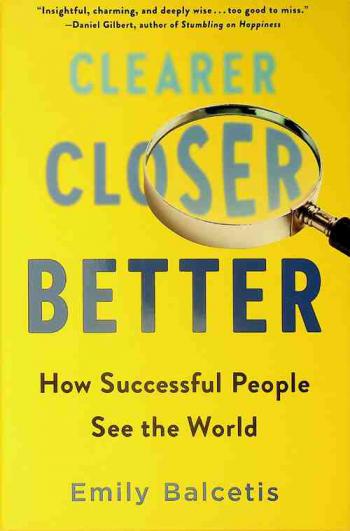
Clearer, closer, better : how successful people see the world
\"Successful people literally see the world differently. Now an award-winning scientist explains how anyone can leverage this \"perception\" gap to their advantage. When it comes to setting and meeting goals, we are often susceptible to perceptual illusions: We think we are closer or further away depending on our mindset, and we might handicap ourselves by looking only at the big picture or too long at the fine detail. But as award-winning social psychologist Emily Balcetis explains in Clearer, Closer, Better, there is great power in these misperceptions--if we know how to use them to our advantage. Drawing on her own unique research and cutting-edge discoveries in vision science, cognitive research, and motivational psychology, Balcetis gives readers an unprecedented account of the perceptual habits, routines, and practices that successful people use to set and meet their ambitions. Through case studies of entrepreneurs, athletes, artists, and celebrities--as well as her own colorful experience of trying to set and reach a goal--she brings four powerful yet largely untapped visual tactics to life:\"-- Provided by publisher.

Affective Signals of Threat Increase Perceived Proximity
Do stimuli appear to be closer when they are more threatening? We tested people's perceptions of distance to stimuli that they felt were threatening relative to perceptions of stimuli they felt were disgusting or neutral. Two studies demonstrated that stimuli that emitted affective signals of threat (e.g., an aggressive male student) were seen as physically closer than stimuli that emitted affective signals of disgust (e.g., a repulsive male student) or no affective signal. Even after controlling for the direct effects of physiological arousal, object familiarity, and intensity of the negative emotional reaction, we found that threatening stimuli appeared to be physically closer than did disgusting ones (Study 2). These findings highlight the links among biased perception, action regulation, and successful navigation of the environment.
Journal Article

Political partisanship influences perception of biracial candidates' skin tone
People tend to view members of their own political group more positively than members of a competing political group. In this article, we demonstrate that political partisanship influences people's visual representations of a biracial political candidate's skin tone. In three studies, participants rated the representativeness of photographs of a hypothetical (Study 1) or real (Barack Obama; Studies 2 and 3) biracial political candidate. Unbeknownst to participants, some of the photographs had been altered to make the candidate's skin tone either lighter or darker than it was in the original photograph. Participants whose partisanship matched that of the candidate they were evaluating consistently rated the lightened photographs as more representative of the candidate than the darkened photographs, whereas participants whose partisanship did not match that of the candidate showed the opposite pattern. For evaluations of Barack Obama, the extent to which people rated lightened photographs as representative of him was positively correlated with their stated voting intentions and reported voting behavior in the 2008 Presidential election. This effect persisted when controlling for political ideology and racial attitudes. These results suggest that people's visual representations of others are related to their own preexisting beliefs and to the decisions they make in a consequential context.
Journal Article

The Influence of Social Comparison on Visual Representation of One's Face
Can the effects of social comparison extend beyond explicit evaluation to visual self-representation--a perceptual stimulus that is objectively verifiable, unambiguous, and frequently updated? We morphed images of participants' faces with attractive and unattractive references. With access to a mirror, participants selected the morphed image they perceived as depicting their face. Participants who engaged in upward comparison with relevant attractive targets selected a less attractive morph compared to participants exposed to control images (Study 1). After downward comparison with relevant unattractive targets compared to control images, participants selected a more attractive morph (Study 2). Biased representations were not the products of cognitive accessibility of beauty constructs; comparisons did not influence representations of strangers' faces (Study 3). We discuss implications for vision, social comparison, and body image.
Journal Article
Wishful Seeing: More Desired Objects Are Seen as Closer
Although people assume that they see the surrounding environment as it truly is, we suggest that perception of the natural environment is dependent upon the internal goal states of perceivers. Five experiments demonstrated that perceivers tend to see desirable objects (i.e., those that can fulfill immediate goals—a water bottle to assuage their thirst, money they can win, a personality test providing favorable feedback) as physically closer to them than less desirable objects. Biased distance perception was revealed through verbal reports and through actions toward the object (e.g., underthrowing a beanbag at a desirable object). We suggest that seeing desirable objects as closer than less desirable objects serves the self-regulatory function of energizing the perceiver to approach objects that fulfill needs and goals.
Journal Article

Concrete Messages Increase Healthy Eating Preferences
Public health campaigns utilize messaging to encourage healthy eating. The present experimental study investigated the impact of three components of health messages on preferences for healthy foods. We exposed 1676 online, American study participants to messages that described the gains associated with eating healthy foods or the costs associated with not eating healthy foods. Messages also manipulated the degree to which they included abstract and concrete language and the temporal distance to foreshadowed outcomes. Analysis of variance statistical tests indicated that concrete rather than abstract language increased the frequency of choosing healthy over unhealthy foods when indicating food preferences. However, manipulations of proximity to outcomes and gain rather than loss frame did not affect food preferences. We discuss implications for effective public health campaigns, and economic and social cognitive theories of persuasion, and our data suggest that describing health outcomes in concrete rather than abstract terms may motivate healthier choices.
Journal Article

Wishful Seeing: How Preferences Shape Visual Perception
People assume that they perceive the world as it really is. In this article, we review research that questions this assumption and instead suggests that people see what they want to see. We discuss classic and current research demonstrating wishful seeing across two perceptual tasks, showing that people categorize ambiguous visual information and represent their environments in ways that align with their desires. Further, we outline when and how wishful seeing occurs. We suggest directions for future research in light of historical trends and contemporary revisions of the study of wishful seeing.
Journal Article

The call for ecological validity is right but missing perceptual idiosyncrasies is wrong
Although psychology has long professed that perception predicts action, the strength of the evidence supporting the statement depends on the ecological validity of the technologies and paradigms used, particularly those that track eye movements, supporting Cesario's argument. While right to call for ecological validity, Cesario's model fails to account for individual differences in visual experience perceivers have when presented with the same stimulus.
Journal Article

Social Psychology of Visual Perception
This volume takes a contemporary and novel look at how people see the world around them. We generally believe we see our surroundings and everything in it with complete accuracy. However, as the contributions to this volume argue, this assumption is wrong: people’s view of their world is cloudy at best.
Social Psychology of Visual Perception is a thorough examination of the nature and determinants of visual perception, which integrates work on social psychology and vision. It is the first broad-based volume to integrate specific sub-areas into the study of vision, including goals and wishes, sex and gender, emotions, culture, race, and age.
The volume tackles a range of engaging issues, such as what is happening in the brain when people look at attractive faces, or if the way our eyes move around influences how happy we are and could help us reduce stress. It reveals that sexual desire, our own sexual orientation, and our race affect what types of people capture our attention. It explores whether our brains and eyes work differently when we are scared or disgusted, or when we grow up in Asia rather than North America.
The multiple perspectives in the book will appeal to researchers and students in range of disciplines, including social psychology, cognition, evolutionary psychology, and neuroscience.
J. Bruner , Forward: A New Look at the New Look. E. Balcetis, G. Daniel Lassiter , Introduction. Part I. Motivation and the Social Psychology of Visual Perception. K. Pauker, N.O. Rule, N. Ambady , Ambiguity and Social Perception. D. Isaacowitz, H. Fung , Motivation Across Time and Place: What Gaze Can Tell Us About Aging and Culture. S. Duffy , S. Kitayama , Cultural Modes of Seeing Through Cultural Modes of Being: Cultural Influences on Visual Attention. E. Balcetis, D. Dunning , Wishful Seeing: Motivational Influences on Visual Perception of the Physical Environment. L. Johnston, L. Miles, N. Macrae , Male or Female?: An Investigation of Factors that Modulate the Sex-Categorization of Strangers. Part II. Neuroscience and the Social Psychology of Visual Perception. M. Weierich, L. Feldman Barrett , Affect as a Source of Visual Attention. R. Todd, A. Anderson , The Role of the Amygdala in Vision. M.P. Viggiano, T. Marzi , Context and Social Effects on Face Recognition. L.M. Oberman, P. Winkielman, V.S. Ramachandran , Embodied Simulation: A Conduit for Converting Seeing into Perceiving. Part III. Ecological Approach to the Social Psychology of Visual Perception. G.D. Lassiter, M. Lindbergh, J. Ratcliff, L. Ware, A.L. Geers , Top-down Influences on the Perception of Ongoing Behavior. K. Johnson, J. Freeman , A New Look at Person Construal: Seeing Beyond Dominance and Discreteness. J. Stefanucci , Emotional High: Emotion and the Perception of Spatial Layout. J. Montepare , \"Cue, View, Action:\" An Ecological Approach to Person Perception.
Dr. Emily Balcetis is an Assistant Professor of Psychology at New York University. She received her Ph.D. in 2006 from Cornell University in Social and Personality Psychology. Her research provides a comprehensive examination of the pervasiveness of motivational biases in visual perception and decision-making, exploring both conscious and unconscious effects using a balance between traditional and high-tech, novel techniques, paradigms, and approaches.
Dr. G. Daniel Lassiter is Professor of Psychology at Ohio University. He received his Ph.D. in 1984 from the University of Virginia, completed a two-year postdoctoral fellowship at Northwestern University, and held a visiting position at the University of Florida before arriving at his present institution in 1987. For more than two decades, he has conducted research on the mechanisms underlying people’s perceptions of the behavior of others, including investigations of the consequences of variation in the behavior-perception process for social judgment and decision-making. During this period, he developed a theoretically driven program of scholarship aimed at examining the effect of presentation format on how mock jurors evaluate confession evidence, which was one of the earliest psychologically oriented research programs on this topic.
eBook
