
Catalogue Search | MBRL


Are you sure you want to remove the book from the shelf?

{{itemTitle}}
476
result(s) for
"Ball, Howard"
Sort by:

Taking the Fight South
Taking the Fight South provides a timely and
telling reminder of the vigilance democracy requires if racial
justice is to be fully realized.
Distinguished historian and civil rights activist Howard Ball
has written dozens of books during his career, including the
landmark biography of Thurgood Marshall, A Defiant Life ,
and the critically acclaimed Murder in Mississippi ,
chronicling the Mississippi Burning killings. In Taking the
Fight South , arguably his most personal book, Ball focuses on
six years, from 1976 to 1982, when, against the advice of friends
and colleagues in New York, he and his Jewish family moved from the
Bronx to Starkville, Mississippi, where he received a tenured
position in the political science department at Mississippi State
University. For Ball, his wife, Carol, and their three young
daughters, the move represented a leap of faith, ultimately
illustrating their deep commitment toward racial justice.
Ball, with breathtaking historical authority, narrates the
experience of his family as Jewish outsiders in Mississippi, an
unfamiliar and dangerous landscape contending with the aftermath of
the civil rights struggle. Signs and natives greeted them with a
humiliating and frightening message: \"No Jews, Negroes, etc., or
dogs welcome.\" From refereeing football games, coaching soccer, and
helping young black girls integrate the segregated Girl Scout
troops in Starkville, to life-threatening calls from the KKK in the
middle of the night, from his work for the ACLU to his arguments in
the press and before a congressional committee for the extension of
the 1965 Voting Rights Act, Ball takes the reader to a precarious
time and place in the history of the South. He was briefly an
observer but quickly became an activist, confronting white racists
stubbornly holding on to a Jim Crow white supremacist past and
fighting to create a more diverse, equitable, and just society.
Ball's story is one of an imitable advocate who didn't just
observe as a passive spectator but interrupted injustice.
Taking the Fight South will join the list of required
books to read about the Black Lives Matter movement and the history
of racism in the United States. The book will also appeal to
readers interested in Judaism because of its depiction of
anti-Semitism directed toward Starkville's Jewish community,
struggling to survive in the heart of the deep and very
fundamentalist Protestant South.
eBook


First-in-human evaluation of the novel mitochondrial complex I inhibitor ASP4132 for treatment of cancer
SummaryBackground We assessed the safety, tolerability, and pharmacokinetics of mitochondrial complex 1 inhibitor ASP4132. Methods This phase I dose-escalation/dose-expansion study enrolled patients with treatment refractory advanced solid tumors to assess safety, dose-limiting toxicities (DLTs), efficacy and pharmacokinetic or oral ASP4132. Results Overall, 39 patients received ASP4132. Acceptable tolerability of ASP4132 5 mg in the first patient led to enrollment in the 10-mg dose cohort. After two DLTs at the 10-mg dose, additional patients were enrolled in the 5-mg cohort; a 7.5-mg cohort and two intermittent-dosing cohorts (ASP4132 10 mg for 3 days, then 4 days off; ASP4132 15 mg for 1 day, then 6 days off). ASP4132 5 mg was well tolerated; however, multiple DLTs such as fatigue, mental status changes, dizziness, lactic acidosis, enteritis, and posterior reversible encephalopathy syndrome were observed in higher dose cohorts (7.5-mg and intermittent 10-mg and 15-mg dose cohorts). Stable disease (+ 4 % to + 15 %) was observed in 8/39 (20.5 %) patients. ASP4132 plasma pharmacokinetics were characterized by high variability, with rapid absorption and accumulation from slow elimination. Conclusions ASP4132 showed limited clinical activity, and DLTs prohibited dose escalation. Further research is required to determine if DLTs will limit clinical activity of other mitochondrial complex I inhibitors. Clinical Trial ID (clinicaltrials.gov): NCT02383368, March 9, 2015.
Journal Article


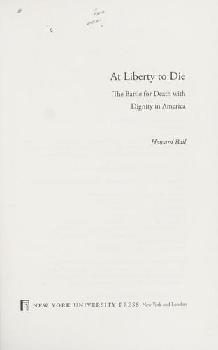
At Liberty to Die
Over the past hundred years, average life expectancy in America has nearly doubled, due largely to scientific and medical advances, but also as a consequence of safer working conditions, a heightened awareness of the importance of diet and health, and other factors. Yet while longevity is celebrated as an achievement in modern civilization, the longer people live, the more likely they are to succumb to chronic, terminal illnesses. In 1900, the average life expectancy was 47 years, with a majority of American deaths attributed to influenza, tuberculosis, pneumonia, or other diseases. In 2000, the average life expectancy was nearly 80 years, and for too many people, these long lifespans included cancer, heart failure, Lou Gehrig's disease, AIDS, or other fatal illnesses, and with them, came debilitating pain and the loss of a once-full and often independent lifestyle. In this compelling and provocative book, noted legal scholar Howard Ball poses the pressing question: is it appropriate, legally and ethically, for a competent individual to have the liberty to decide how and when to die when faced with a terminal illness? At Liberty to Die charts how, the right of a competent, terminally ill person to die on his or her own terms with the help of a doctor has come deeply embroiled in debates about the relationship between religion, civil liberties, politics, and law in American life. Exploring both the legal rulings and the media frenzies that accompanied the Terry Schiavo case and others like it, Howard Ball contends that despite raging battles in all the states where right to die legislation has been proposed, the opposition to the right to die is intractable in its stance. Combining constitutional analysis, legal history, and current events, Ball surveys the constitutional arguments that have driven the right to die debate.
eBook

A phase 1 study of oral ASP5878, a selective small-molecule inhibitor of fibroblast growth factor receptors 1–4, as a single dose and multiple doses in patients with solid malignancies
SummaryASP5878 is a selective small-molecule inhibitor of fibroblast growth factor receptors (FGFRs). This study investigated safety, tolerability, and antitumor effect of single and multiple oral doses of ASP5878 in patients with solid tumors. This phase 1, open label, first-in-human study comprised dose-escalation and dose-expansion parts. Primary objectives of the dose-escalation part were to identify the dose-limiting toxicity (DLT), maximum tolerated dose, and recommended dose of ASP5878 for the dose-expansion part. Nine dose cohorts of ASP5878 were evaluated (0.5─2 mg once daily; 2─40 mg twice daily [BID]). A single dose of ASP5878 was followed by a 2-day pharmacokinetic collection, and then either 28-day cycles of daily dosing (ASP5878 ≤ 10 mg BID) or 5-day dosing/2-day interruption (ASP5878 ≥ 20 mg BID). The primary objective of the dose-expansion part was to determine the safety of ASP5878 (16 mg BID) administered in 28-day cycles of 5-day dosing/2-day interruption in patients with urothelial carcinoma, hepatocellular carcinoma, or squamous cell lung carcinoma with FGFR genetic alterations. Safety was assessed by monitoring adverse events (AEs). Thirty-five patients were enrolled and 31 discontinued in the dose-escalation part; 51 patients were enrolled and 51 discontinued in the dose-expansion part. In the dose-escalation part, 66.7% of patients in the 20 mg BID 5-day dosing/2-day interruption group reported DLTs of hyperphosphatemia. The recommended dose for the dose-expansion part was 16 mg BID. Common AEs included retinal detachment, diarrhea, and increased alanine aminotransferase. One death occurred that was not related to ASP5878. ASP5878 was well tolerated with manageable toxicities including hyperphosphatemia.
Journal Article


First-in-human, open-label dose-escalation and dose-expansion study of the safety, pharmacokinetics, and antitumor effects of an oral ALK inhibitor ASP3026 in patients with advanced solid tumors
Background
ASP3026 is a second-generation anaplastic lymphoma kinase (ALK) inhibitor that has potent in vitro activity against crizotinib-resistant
ALK
-positive tumors. This open-label, multicenter,
first-in-human
phase I study (
NCT01284192
) assessed the safety, pharmacokinetic profile, and antitumor activity of ASP3026.
Methods
Advanced solid tumor patients received oral ASP3026 in 3 + 3 dose-escalation cohorts at doses of 25–800 mg once daily in 28-day cycles. The endpoints were to identify the maximum tolerated dose (MTD), the recommended phase II dose (RP2D), and the pharmacokinetic profile of ASP3026. A phase Ib expansion cohort enrolled patients with metastatic, crizotinib-resistant
ALK
-positive solid tumors at the RP2D, and response was evaluated by RECIST 1.1.
Results
The dose-escalation cohort enrolled 33 patients, including three crizotinib-resistant,
ALK
-positive patients, and the dose-expansion cohort enrolled another 13 crizotinib-resistant,
ALK
-positive non-small cell lung cancer (NSCLC) patients. ASP3026 demonstrated both linear pharmacokinetics and dose-proportional exposure for area under the plasma concentration–time curve and maximum concentration observed with a median terminal half-life of 35 h, supporting the daily dosing. Grade 3 rash and elevated transaminase concentrations were dose-limiting toxicities observed at 800 mg; hence, 525 mg daily was the MTD and RP2D. The most common treatment-related adverse events were nausea (38 %), fatigue (35 %), and vomiting (35 %). Among the 16 patients with crizotinib-resistant
ALK
-positive tumors (15 NSCLC, 1 neuroblastoma), eight patients achieved partial response (overall response rate 50 %; 95 % confidence interval 25–75 %) and seven patients (44 %) achieved stable disease.
Conclusions
ASP3026 was well tolerated and had therapeutic activity in patients with crizotinib-resistant
ALK
-positive advanced tumors.
Trial registration
ClinTrials.gov:
NCT01284192
Journal Article