
Catalogue Search | MBRL


Are you sure you want to remove the book from the shelf?

{{itemTitle}}
3,506
result(s) for
"Ball, John"
Sort by:


A Survey on Deep-Learning-Based LiDAR 3D Object Detection for Autonomous Driving
LiDAR is a commonly used sensor for autonomous driving to make accurate, robust, and fast decision-making when driving. The sensor is used in the perception system, especially object detection, to understand the driving environment. Although 2D object detection has succeeded during the deep-learning era, the lack of depth information limits understanding of the driving environment and object location. Three-dimensional sensors, such as LiDAR, give 3D information about the surrounding environment, which is essential for a 3D perception system. Despite the attention of the computer vision community to 3D object detection due to multiple applications in robotics and autonomous driving, there are challenges, such as scale change, sparsity, uneven distribution of LiDAR data, and occlusions. Different representations of LiDAR data and methods to minimize the effect of the sparsity of LiDAR data have been proposed. This survey presents the LiDAR-based 3D object detection and feature-extraction techniques for LiDAR data. The 3D coordinate systems differ in camera and LiDAR-based datasets and methods. Therefore, the commonly used 3D coordinate systems are summarized. Then, state-of-the-art LiDAR-based 3D object-detection methods are reviewed with a selected comparison among methods.
Journal Article

WCNN3D: Wavelet Convolutional Neural Network-Based 3D Object Detection for Autonomous Driving
Three-dimensional object detection is crucial for autonomous driving to understand the driving environment. Since the pooling operation causes information loss in the standard CNN, we designed a wavelet-multiresolution-analysis-based 3D object detection network without a pooling operation. Additionally, instead of using a single filter like the standard convolution, we used the lower-frequency and higher-frequency coefficients as a filter. These filters capture more relevant parts than a single filter, enlarging the receptive field. The model comprises a discrete wavelet transform (DWT) and an inverse wavelet transform (IWT) with skip connections to encourage feature reuse for contrasting and expanding layers. The IWT enriches the feature representation by fully recovering the lost details during the downsampling operation. Element-wise summation was used for the skip connections to decrease the computational burden. We trained the model for the Haar and Daubechies (Db4) wavelets. The two-level wavelet decomposition result shows that we can build a lightweight model without losing significant performance. The experimental results on KITTI’s BEV and 3D evaluation benchmark show that our model outperforms the PointPillars-based model by up to 14% while reducing the number of trainable parameters.
Journal Article

Emerging Trends in Autonomous Vehicle Perception: Multimodal Fusion for 3D Object Detection
The pursuit of autonomous driving relies on developing perception systems capable of making accurate, robust, and rapid decisions to interpret the driving environment effectively. Object detection is crucial for understanding the environment at these systems’ core. While 2D object detection and classification have advanced significantly with the advent of deep learning (DL) in computer vision (CV) applications, they fall short in providing essential depth information, a key element in comprehending driving environments. Consequently, 3D object detection becomes a cornerstone for autonomous driving and robotics, offering precise estimations of object locations and enhancing environmental comprehension. The CV community’s growing interest in 3D object detection is fueled by the evolution of DL models, including Convolutional Neural Networks (CNNs) and Transformer networks. Despite these advancements, challenges such as varying object scales, limited 3D sensor data, and occlusions persist in 3D object detection. To address these challenges, researchers are exploring multimodal techniques that combine information from multiple sensors, such as cameras, radar, and LiDAR, to enhance the performance of perception systems. This survey provides an exhaustive review of multimodal fusion-based 3D object detection methods, focusing on CNN and Transformer-based models. It underscores the necessity of equipping fully autonomous vehicles with diverse sensors to ensure robust and reliable operation. The survey explores the advantages and drawbacks of cameras, LiDAR, and radar sensors. Additionally, it summarizes autonomy datasets and examines the latest advancements in multimodal fusion-based methods. The survey concludes by highlighting the ongoing challenges, open issues, and potential directions for future research.
Journal Article
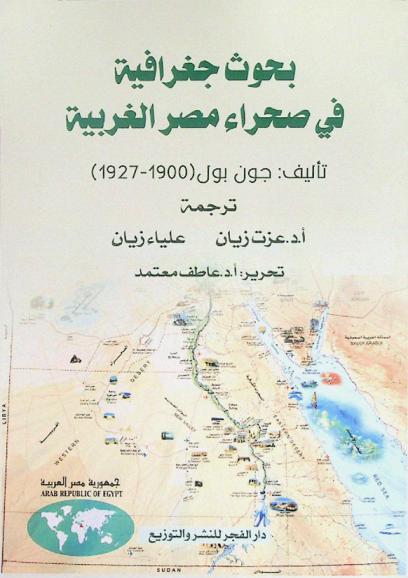
بحوث جغرافية في صحراء مصر الغربية
جمع المترجمان في هذا الكتاب عملين مهمين للجيولوجي والجغرافي الرائد جون بول يحمل العمل الأول عنوان \"إشكالات في فهم الصحراء الليبية، والذي نشر في سلسة مقالات في دورية The Geographical journal في 1927 وجدير بالذكر أن مصطلح \"الصحراء الليبية\" كان يقصد به قبل قرن من الزمن \"صحراء مصر الغربية\"، إذ كان كل ما يقع غرب وادي النيل يسمى صحراء ليبيا، ولم تكن وقتها قد نشأت دولة ليبيا الحديثة ومن ثم لم تكن هناك أية مضامين تتعلق بالحدود السياسية بين الدولتين أما العنوان الثاني فهو بحث لنفس المؤلف عن منخفض الواحات الخارجة، وفي ترجمة هذا البحث تخفف المترجمان من الفصل الثاني وعنوانه \"أساليب المسح والنتائج العامة والموضوعات الدنية التي كانت مهمة أنذاك ولم تعد بهم القارئ المعاصر اليوم كما تخفف المترجمان من الفصل الخامس وعنوانه \"جيولوجية الواحة\" بسبب التقادم، حيث كانت هذه المعلومات مفيدة في عام 1900 ولكنها لم تعد مفيدة اليوم في 2024 بعد تقدم البحث الجيولوجي وهذا الكتاب هو استكمال المشروع ترجمة أعمال جون بول بعدما نجحنا من قبل في ترجمة كتابه الأشهر مصر في كتابات الجغرافيين الكلاسيك وهو من ترجمة عاطف معتمد وعزت زبان ومراجعة أسامة حميد، وكتاب مساهمات في جغرافية مصر وهو من ترجمة عاطف معتمد وماجد فتحي وما زالت بعض أهم أعمال جون بول تنتظر الترجمة ولا سيما كتابه عن غرب سيناء، وهو قيد الترجمة.
BOOK
Off-Road Detection Analysis for Autonomous Ground Vehicles: A Review
When it comes to some essential abilities of autonomous ground vehicles (AGV), detection is one of them. In order to safely navigate through any known or unknown environment, AGV must be able to detect important elements on the path. Detection is applicable both on-road and off-road, but they are much different in each environment. The key elements of any environment that AGV must identify are the drivable pathway and whether there are any obstacles around it. Many works have been published focusing on different detection components in various ways. In this paper, a survey of the most recent advancements in AGV detection methods that are intended specifically for the off-road environment has been presented. For this, we divided the literature into three major groups: drivable ground and positive and negative obstacles. Each detection portion has been further divided into multiple categories based on the technology used, for example, single sensor-based, multiple sensor-based, and how the data has been analyzed. Furthermore, it has added critical findings in detection technology, challenges associated with detection and off-road environment, and possible future directions. Authors believe this work will help the reader in finding literature who are doing similar works.
Journal Article


Using high-resolution microscopy data to generate realistic structures for electromagnetic FDTD simulations from complex biological models
Finite-difference time-domain (FDTD) electromagnetic simulations are a computational method that has seen much success in the study of biological optics; however, such simulations are often hindered by the difficulty of faithfully replicating complex biological microstructures in the simulation space. Recently, we designed simulations to calculate the trajectory of electromagnetic light waves through realistically reconstructed retinal photoreceptors and found that cone photoreceptor mitochondria play a substantial role in shaping incoming light. In addition to vision research and ophthalmology, such simulations are broadly applicable to studies of the interaction of electromagnetic radiation with biological tissue. Here, we present our method for discretizing complex 3D models of cellular structures for use in FDTD simulations using MEEP, the MIT Electromagnetic Equation Propagation software, including subpixel smoothing at mesh boundaries. Such models can originate from experimental imaging or be constructed by hand. We also include sample code for use in MEEP. Implementation of this algorithm in new code requires understanding of 3D mathematics and may require several weeks of effort, whereas use of our sample code requires knowledge of MEEP and C++ and may take up to a few hours to prepare a model of interest for 3D FDTD simulation. In all cases, access to a facility supercomputer with parallel processing capabilities is recommended. This protocol offers a practical solution to a significant challenge in the field of computational electrodynamics and paves the way for future advancements in the study of light interaction with biological structures.
Key points
This protocol provides a detailed roadmap for scientists interested in performing FDTD computational simulations to probe the interactions of electromagnetic waves (e.g., visible light or microwave radiation) with complex structures such as organs or biological cells.
This approach converts 3D models obtained by using microscopy to a ‘discretized’ form compatible with FDTD; the model surface data are used to perform subpixel smoothing to increase simulation accuracy.
We provide a detailed roadmap for scientists interested in performing FDTD computational simulations to probe the interactions of electromagnetic waves (e.g., visible light or microwave radiation) with complex structures such as organs or biological cells.
Journal Article