
Catalogue Search | MBRL


Are you sure you want to remove the book from the shelf?

{{itemTitle}}
5
result(s) for
"Baron, Naomi S., author"
Sort by:


Always on : language in an online and mobile world
This book shows how Internet and mobile technologies — including instant messaging (IM), cell phones, multitasking, social networking Web sites, blogs, and wikis — are profoundly influencing the way we read and write, speak and listen, but not in the ways we might suppose. The book looks at language in an online and mobile world. It reveals for instance that email, IM, and text messaging have had surprisingly little impact on student writing. Electronic media has magnified the laid-back “whatever” attitude toward formal writing that young people everywhere have embraced, but it is not a cause of it. A more troubling trend, according to the book, is the myriad ways in which we block incoming IMs, camouflage ourselves on Facebook, and use ring tones or caller ID to screen incoming calls on our mobile phones. The book argues that our ability to decide who to talk to is likely to be among the most lasting influences that information and communication technology has upon the ways we communicate with one another. Moreover, as more and more people are “always on” one technology or another — whether communicating, working, or just surfing the web or playing games — we have to ask what kind of people do we become, as individuals and as family members or friends, if the relationships we form must increasingly compete for our attention with digital media?
eBook

Who wrote this? : how AI and the lure of efficiency threaten human writing
\"Would you read this book if a computer wrote it? Would you even know? And why would it matter? Today's eerily impressive artificial intelligence writing tools present us with a crucial challenge: As writers, do we unthinkingly adopt AI's time-saving advantages or do we stop to weigh what we gain and lose when heeding their siren call? To understand how AI is redefining what it means to write and think, linguist and educator Naomi Baron leads us on a journey connecting the dots between human literacy and today's technology. From nineteenth century lessons in composition, to mathematician Alan Turing's work creating a machine for deciphering war-time messages, to contemporary engines like ChatGPT, Baron gives readers a spirited overview of the emergence of both literacy and AI, and a glimpse of their possible future. As the technology becomes increasingly sophisticated and fluent, it's tempting to take the easy way out and let AI do the work for us. Baron cautions that such efficiency isn't always in our interest. As AI plies us with suggestions or full-blown text, we risk losing not just our technical skills but the power of writing as a springboard for personal reflection and unique expression. Funny, informed, and conversational, Who Wrote This? urges us as individuals and as communities to make conscious choices about the extent to which we collaborate with AI. The technology is here to stay. Baron shows us how to work with AI and how to spot where it risks diminishing the valuable cognitive and social benefits of being literate\"-- Provided by publisher.
Book

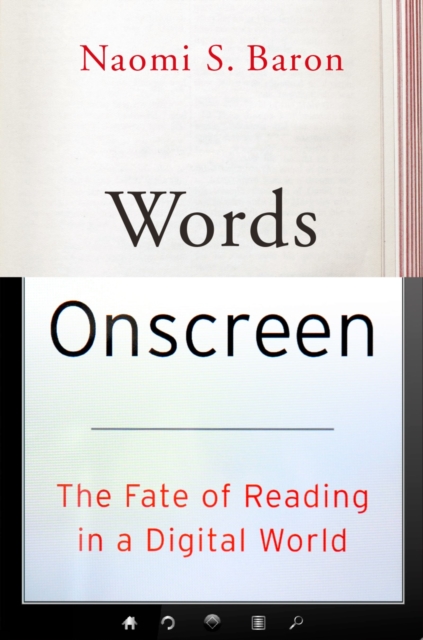
Words Onscreen
People have been reading on computer screens for several decades now, predating popularization of personal computers and widespread use of the internet. But it was the rise of eReaders and tablets that caused digital reading to explode. In 2007, Amazon introduced its first Kindle. Three years later, Apple debuted the iPad. Meanwhile, as mobile phone technology improved and smartphones proliferated, the phone became another vital reading platform. In Words Onscreen, Naomi Baron, an expert on language and technology, explores how technology is reshaping our understanding of what it means to read. Digital reading is increasingly popular. Reading onscreen has many virtues, including convenience, potential cost-savings, and the opportunity to bring free access to books and other written materials to people around the world. Yet, Baron argues, the virtues of eReading are matched with drawbacks. Users are easily distracted by other temptations on their devices, multitasking is rampant, and screens coax us to skim rather than read in-depth. What is more, if the way we read is changing, so is the way we write. In response to changing reading habits, many authors and publishers are producing shorter works and ones that don't require reflection or close reading. In her tour through the new world of eReading, Baron weights the value of reading physical print versus online text, including the question of what long-standing benefits of reading might be lost if we go overwhelmingly digital. She also probes how the internet is shifting reading from being a solitary experience to a social one, and the reasons why eReading has taken off in some countries, especially the United States and United Kingdom, but not others, like France and Japan. Reaching past the hype on both sides of the discussion, Baron draws upon her own cross-cultural studies to offer a clear-eyed and balanced analysis of the ways technology is affecting the ways we read today-and what the future might bring.
eBook