
Catalogue Search | MBRL


Are you sure you want to remove the book from the shelf?

{{itemTitle}}
30
result(s) for
"Barone, Pier Matteo"
Sort by:

Geoscientists at crime scenes : a companion to forensic geoscience
After the publication of the first Italian book on Forensic Geoscience: \"Geologia Forense\" (Di Maggio, Barone, et al. 2013, Flaccovio Ed.), the international demand to have an international version (in English language) about the new applications of this topic carried out in Italy and the possibility to apply them in international contexts encouraged us to create a new English book based on this. If forensic science is the application of technical and scientific methodologies applied to traditional categories of judicial investigations, in connection with the investigation of a crime or a social behavior, within them a special role is held by forensic geoscience, or the application of different disciplines of Earth Sciences in judicial contexts. Forensic geoscience encompasses some branches of the earth sciences such as geology, mineralogy, geochemistry, geophysics, remote sensing, soil science and archaeology, whose applications may provide a suitable or appropriate environmental interpretation of the surroundings, in the context of numerous types of offences, both criminal and civil. The environmental context can become part of the crime narrative in diverse situations: it can be the place where to hide a body or precious objects, or it may be a witness to a crime. Given the nature of many crime narratives carried out in outdoor areas, the environment, as it is not a closed system, plays a dual role, passive and active. Passive in the sense that it may be the principal repository of clues and evidence that both the victim and/or offender may have been present in a given location. Active since it can be the protagonist of the crime narrative, where, for example, it may have been abused in the design and construction phases of landfill or architectural structures, but also when it leaves proof marks on clothing and objects, such as the soil found on footwear. -- from back cover.
BOOK

Unveiling the Hidden Secrets of Bomarzo Cathedral: New Evidence from Last Ground-Penetrating Radar Survey
The Bomarzo Cathedral, also known as the Duomo di Bomarzo, is a remarkable historical and architectural masterpiece situated in Bomarzo (VT), Italy. Constructed in the 16th century under the sponsorship of the Orsini family, the cathedral’s design is a harmonious blend of Renaissance and Baroque styles. Despite enduring numerous challenges, including damage from the Italian Wars, extensive restoration efforts were undertaken to preserve its cultural legacy. Driven by a deep appreciation of the cathedral’s historical context, a ground-penetrating radar (GPR) investigation was deployed to gain insights into its foundations and potentially uncover buried remains beneath the floor and altar. The GPR investigation focused on the cathedral’s interior, specifically the central and left naves, altar, and oratory. This revealed the presence of disclosed rectangular chambers beneath the floor and altar, along with unique foundation structures. These findings, coupled with historical insights and architectural understanding, emphasize the cathedral’s cultural importance.
Journal Article
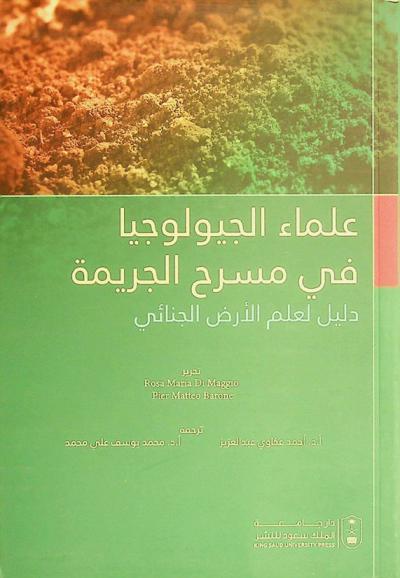
علماء الجيولوجيا في مسرح الجريمة : دليل لعلم الأرض الجنائي
يأتي هذا الكتاب ليضيف قيمة إلى المكتبة العربية من خلال الربط بين الجيولوجيا والطب والعلوم الجنائية والشرطية والقانونية في سابقة فريدة من نوعها في الأوساط العلمية حيث يركز على علم مستحدث جديد وهو \"الجيولوجيا الجنائية\"، والتي تدرس استخدام التقنيات الجيولوجية بواسطة الجيولوجيين لفك شفرات وتفسيرات دقيقة في مسرح الجريمة لمساعدة رجال الشرطة والمحققين والمحاكم الجنائية، إذ يتم ذلك من خلال تقنيات تحليل التربة والجيومورفولوجيا والاستشعار عن بعد والتصوير الجوي والبيئة والآثار وغيرها من التقنيات التي تحدد مسافة واتجاه الوصول إلى مكان وقوع الجريمة بشكل دقيق، والظروف البيئية أثناء وقوعها والكشف عن الجثث المدفونة والعمق اللازم للحفر للوصول إليها واستخراجها. ويوضح الكتاب آلية تكامل كل الأدوات الأخرى للتحقيقات الجنائية والبحث الجنائي. كما يتناول ميثاق العمل الأخلاقي للجيولوجيين العاملين في مجال مسرح الجريمة والجيولوجيا الجنائية وكذلك آلية تنمية مهاراتهم وآلية ضمان جودة هذا النوع من الأعمال البالغة الدقة والأهمية.
Book

A posteriori GPR Evaluation of Tree Stability: A Case Study in Rome (Italy)
Following the frequent and harmful collapses of trees that have plagued the municipal territory of Rome in recent years, a protocol of understanding was initiated between the Department of Environmental Protection of ROMA CAPITALE, the American University of Rome, the Research Centre for Forestry and Wood of the– Council for Agricultural Research and Economics (CREA)–, and Sensors and Software, Inc. This protocol aims to start an experimental project by conducting a series of non-destructive geophysical measurements using ground-penetrating radar (GPR) technology and assessing the effectiveness of this methodology to investigate the root system and tree trunks located along paved roads in two sample areas of the city. The test will use the GPR technique to confirm some hypothetical assumptions about tree stability based on a posteriori evaluations made by the Department of Environmental Protection of ROMA CAPITALE. All phases of this test showed the effectiveness of the method and the rapidity of the data acquisition.
Journal Article
Aventinus Minor Project: Remote Sensing for Archaeological Research in Rome (Italy)
This paper presents the results of a preliminary survey in a central urban area of Rome, Italy. The results were obtained from both desktop and remote sensing surveys. The Aventinus Minor Project (AMP) is a community archaeological excavation project focusing on an understudied area in Rome with limited modern archaeological excavation: the Aventinus Minor or Little Aventine. The remote sensing (RS) anomalies revealed by the survey illustrate that this area is potentially rich in buried structures potentially correlated with ancient visible remains (i.e., the Servian Walls and Santa Balbina church). The application of RS approaches (such as NDVI, VARI, and GPR) and the creation of a GIS platform lays the foundations for a correct and georeferenced reporting of all collected data, providing a nuanced understanding of the urban archaeology in the dense topography of Rome.
Journal Article
Remote Sensing Materials for a Preliminary Archaeological Evaluation of the Giove Countryside (Terni, Italy)
A collaboration between the American University of Rome, the Municipality of Giove, and Soprintendenza Archeologia, Belle Arti e Paesaggio dellʼUmbria has resulted in an academic project aimed at a preliminary evaluation of a particular area along the Tiber river that straddles the border between Umbria and Lazio. Archaeological prospection methods, such as Unmanned Aerial Vehicle (UAV)-based remote sensing, ground-penetrating radar (GPR), and photogrammetry, have made it possible to better study the landscape with respect to not only the changes the area has undergone recently, but also its evolution during the Roman and Medieval periods, while keeping the main communication route represented by the Tiber river as its fulcrum.
Journal Article

Forensic geophysics: ground penetrating radar (GPR) techniques and missing persons investigations
Ground penetrating radar (GPR) investigations have the potential to non-destructively detect buried or hidden targets and are therefore often used in forensic research. This study presents a particular application of GPR methods to search for a missing person in a specific subsurface environment: a natural cave. The search for missing people in Italy is a problematic and delicate task that needs improvement. Results of this study highlight not only the ability to detect both hollow and forensic targets, but also precisely locate and define their geometries. Moreover, GPR findings efficiently focus archaeological excavation and body recovery in an exact area and help to minimise time digging in erroneous places.
Journal Article
Materials for the Study of the Locus Operandi in the Search for Missing Persons in Italy
Geographic profiling, or locus operandi, is a scientific approach that has been applied to forensic investigations for several years. However, it has never been applied to a phenomenon as complex as the search for missing persons. This article presents three Italian case studies in which geographic profiling was used to narrow the areas to search for missing persons. The geographical data were mapped and processed on a geographic information system platform using computational geometry analysis. However, these disappearances occurred during the Italian lockdown period, imposed to address the COVID-19 outbreak, which made the searches slower and more complex than usual.
Journal Article

Forensic Investigations of Geohazards: The Norcia 2016 Earthquake
Earthquakes represent one of the world’s most significant hazards in terms of damage to human and animal life, and property. Earthquakes also cause many other related fatalities and damage to urban structures. This paper presents the forensic investigation of failures induced by the Norcia 2016 earthquake in Italy. The detailed geophysical field investigations were carried out at selected locations in two cities: Rome and Amelia. The places of investigation were 150 km and 90 km, respectively, from the epicenter. A ground penetrating radar (GPR) survey was carried out at the sites to highlight structural failures, and included a partially damaged urban bridge, and the cracked wall of a private house. These failures have been discussed with reference to the field measurements carried out. In both cases, the GPR radargram showed clear lesions along with their geometry and location. This forensic geoscientific analysis highlights the importance of detecting structural damage immediately after a geohazard event to help plan proper interventions, efforts to prevent human losses and help law enforcement to focus their forensic investigations.
Journal Article
When the Crime Scene Is the Road: Forensic Geoscience Indicators Applied to Road Infrastructure and Urban Greening
Common to most cities with tree-lined roads, streets, and sidewalks is damage to paved surfaces caused by the growth of roots over time. Sub-surface root growth creates potential hazards for people driving motor vehicles and pedestrian traffic. In large urban centers like Rome (Italy), roads are vital infrastructure ensuring the mobility of citizens, commercial goods, and information. This infrastructure can become a crime scene when serious injuries or deaths result from the poor monitoring and management of urban trees. Sustainable management of road infrastructure and the associated urban greening is supported by a forensic geoscientific approach. In particular, the use of the GPR (Ground Penetrating Radar) technique allows (i) to control and detect anomalies in the root architecture beneath asphalt in a non-destructive way; and (ii) to plan actions to repair and avoid the possibility of further catastrophic scenarios and need for forensic investigations.
Journal Article