
Catalogue Search | MBRL


Are you sure you want to remove the book from the shelf?

{{itemTitle}}
4
result(s) for
"Barrett, Jennifer author"
Sort by:
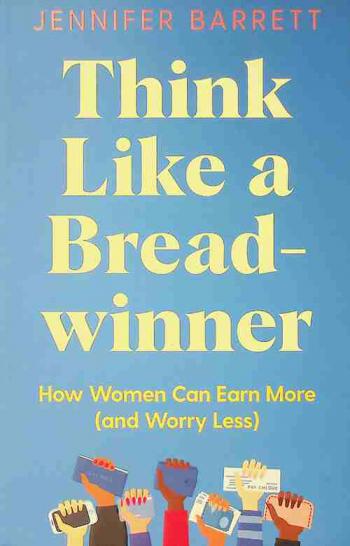
Think like a bread-winner : how women can earn more (and worry less)
\"A new kind of manifesto for the working woman, with practical guidance on building wealth as well as inspiration for harnessing the freedom and power that comes from a breadwinning mindset. Women are now the main breadwinner in one-in-four households in the UK. Yet the majority of women still aren't being brought up to think like breadwinners. In fact, they're actively discouraged - by institutional bias and subconscious beliefs - from building their own wealth, pursuing their full earning potential, and providing for themselves and others financially. The result is that women earn less, owe more, and have significantly less money saved and invested for the future than men do. And if women do end up as the main breadwinner, they've been conditioned to feel reluctant and unprepared to manage the role. In Think Like a Breadwinner, financial expert Jennifer Barrett reframes what it really means to be a breadwinner by dismantling the narrative that women don't - and shouldn't - take full financial responsibility to create the lives they want. Featuring a wide variety of case studies from women at all stages of their careers and financial lives, Barrett shares the secrets of women who already think like breadwinners. Barrett reveals not only the importance of women building their own wealth, but also the freedom and power that comes with it\"--Publisher's description.

Student Study Guide to The Ancient Greek World
The Student Study Guides are important and unique components that are available for each of the books in The World in Ancient Times series. Each of the Student Study Guides is designed to be used with the main text at school or sent home for homework assignments. The activities in the Student Study guide will help students get the most out of their history books. Each student study guide includes a chapter-by-chapter two-page lesson that uses a variety of interesting activities to help a student master history and develop important reading and study skills.
eBook

Amino acids, peptides and proteins
In an ever-increasing domain of activity Amino Acids Peptides and Proteins provides an annual compilation of the world's research effort into this important area of biological chemistry. Volume 29 provides a review of literature published during 1996. Comprising a comprehensive review of significant developments at this biology/chemistry interface each volume opens with an overview of amino acids and their applications. Work on peptides is reviewed over several chapters ranging from current trends in their synthesis and conformational and structural analysis to peptidomimetics and the discovery of peptide-related molecules in nature. The application of advanced techniques in structural elucidation is incorporated into all chapters whilst periodic chapters on metal complexes of amino acids, peptides and beta-lactams extend the scope of coverage. Efficient searching of specialist topics is facilitated by the sub-division of chapters into discrete subject areas allowing annual trends to be monitored. All researchers in the pharmaceutical and allied industries and at the biology/chemistry interface in academia will find this an indispensable reference source.
eBook
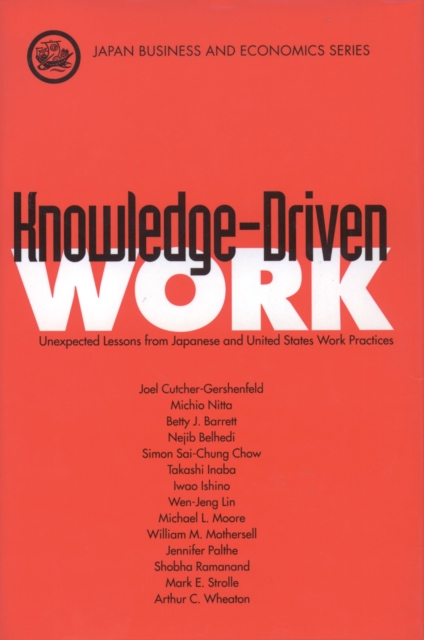
Knowledge-driven work : unexpected lessons from Japanese and United States work practices
The daily work experiences of people in almost any part of the world are shaped by workplace innovations. Despite the vast diffusion of work practices, little is known about what it means for a company in the region to identify what it sees as the best practice and then introduce these practices in another culture which are less visible than the global exchange of products and services, but more significant. This book provides us with a close up of eight Japanese affiliated manufacturing facilities operating in the United States and the beginnings of a reverse diffusion of innovation back to Japan. The key finding in this book is that massive global diffusion of work practices rests on something very fragile. This is the process by which individuals and groups of people come to new understandings that enable them to adopt new work practices. It is a process termed “virtual knowledge”, which can be found at that critical time when understandings are still in formation. Also , the book reveals how some organizations have anticipated and channeled virtual knowledge that is constantly emerging from different groups in the organization. This turns out to be the core building block for continuous improvement in operations and is central to the process of diffusion. The process is part of a much larger process of global diffusion from Japan, the United States and other nations to all parts of the world.
eBook