
Catalogue Search | MBRL


Are you sure you want to remove the book from the shelf?

{{itemTitle}}
69
result(s) for
"Barron, Caroline M"
Sort by:
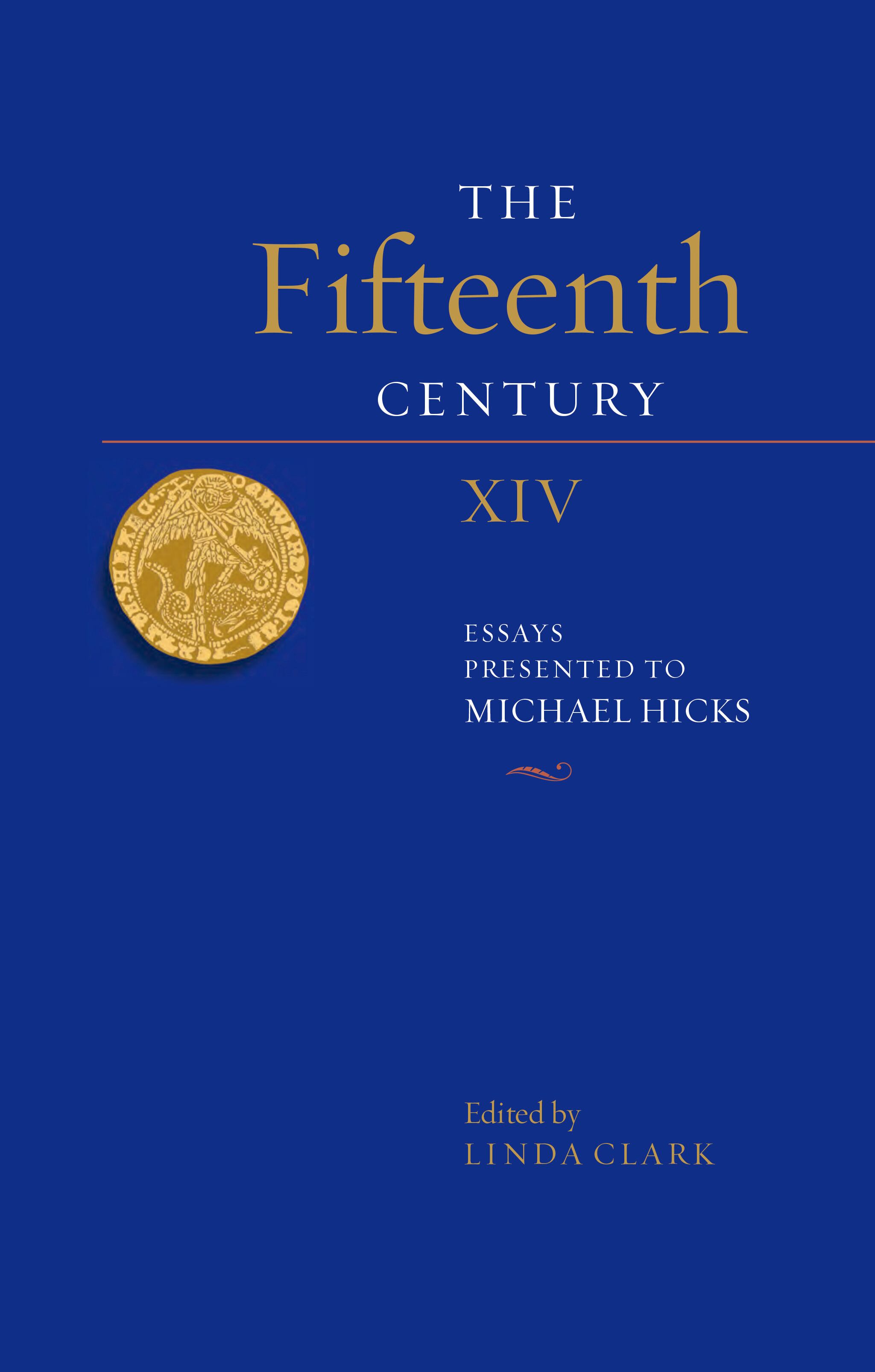
The Fifteenth Century XIV
For four decades, Michael Hicks has been a figure central to the study of fifteenth-century England. His scholarly output is remarkable both for its sheer bulk and for the diversity of the fields it covers. This extraordinary breadth is reflected by the variety of subjects covered by the papers in the present volume, offered to Professor Hicks by friends, colleagues and former students to mark his retirement from the University of Winchester. Fifteenth-century royalty, nobility and gentry, long at the heart of his own work, naturally take centre stage, but his contribution to economic and regional history, both in the early part of his career as a research fellow at the Victoria County History and more recently as director of a succession of major research projects, is also reflected in the essays presented here. The individual contributions are populated by some of the major characters of Yorkist England, many of them made household names by Professor Hicks's own writings - King Edward IV and his mistresses; the Neville earls of Warwick and Salisbury; the Stafford, Herbert, Percy, Tiptoft and de Vere earls of Devon, Pembroke, Northumberland, Worcester and Oxford - while the themes covered span the full panoply of medieval life: from treason to trade, warfare to widowhood and lordship to law enforcement. Equally broad is the papers' geographical spread, covering regions from Catalonia to Normandy, from Hampshire to Yorkshire and from Worcestershire and the Welsh marches to East Anglia. Contributors: Anne Curry, Christopher Dyer, Peter Fleming, Ralph Griffiths, John Hare, Winifred Harwood, Matthew Holford, Hannes Kleineke, Gordon McKelvie, Mark Page, Simon Payling, A.J. Pollard, James Ross, Karen Stöber, Anne F. Sutton
eBook

The Fifteenth Century X
Linda S. Clark is a distinguished scholar of fifteenth-century England, best known for her important contribution to the study of the late medieval English parliament. She has served as general editor of 'The Fifteenth Century' since 2003. This special volume in the series marks her four decades of work for the History of Parliament Trust. As is appropriate, its essays focus above all on Parliament and the personalities that served in its chambers, but they also illuminate a wider range of themes that have long concerned students of the later middle ages, including the lawlessness of the gentry and nobility, the acquisition and management of their estates, and their self-expression in pageantry and legend. Other social groups, ranging from the mercantile élite of the city of London and their Italian trading partners to England's common soldiers, also make an appearance. Several of the papers collected here have a geographical focus in London and East Anglia, but other regions are also represented. The collection thus pays tribute to the breadth of Dr Clark's contribution to the field, both in her own writing, and in her long-standing commitment to facilitate the publication of the original research of others. Contributors: A. J. Pollard, Simon Payling, Charles Moreton, Colin Richmond, J. L. Bolton, James Ross, Carole Rawcliffe, Elizabeth Danbury, Matthew Davies, Hannes Kleineke, David Grummitt, Caroline M. Barron
eBook

Medieval London Widows, 1300-1500
Medieval London Widows, 1300-1500 shows that it is possible to expand the repertoire of examples of medieval women with personalities and individuality beyond the well-known triad of Margaret Paston, Margery Kempe and the Wife of Bath. The rich documentation of London records allows these women to speak for themselves. They do so largely through their wills, which themselves exemplify the ability of widows to make choices and to order their lives.
eBook
Thomas More, the London Charterhouse and Richard III
The summer of 1535 saw the first high-profile martyrs executed for the Catholic cause in England. In March 1534 Parliament had passed the Act of Succession which recognised the validity of the king's marriage (in January 1533) to Anne Boleyn, and this was followed in November that year by the Act of Supremacy which acknowledged the king as supreme head on earth of the Church of England. Subjects were required to take oaths accepting both acts, or to suffer the penalties for treason. Thomas More, seeing the way the wind was blowing, had resigned the chancellorship in May 1532; in April 1534 he had refused to swear to the Act of Succession and was sent to the Tower, where he busied himself writing treatises on the sufferings of Christ. He likewise refused to swear to the Act of Supremacy later that year.The monks of the London Charterhouse, led by Prior John Houghton, were also facing demands that they should swear to accept both acts. At first they resisted, but then, in May 1534, led by Houghton, they reluctantly accepted the Act of Succession. But this did not save them from further pressure to conform. Houghton was visited by two other Carthusian priors, Robert Laurence from Beauvale and Augustine Webster from Axholme. The three men were arrested on 20 April 1535, together with Dr. Richard Reynolds, a brother from Syon, and taken to the Tower. On 28 April the men were tried: they refused the oath and argued that obedience to the pope was necessary to preserve the spiritual unity of the mystical body of Christ.
Book Chapter

Church music in English towns 1450–1550: an interim report
In the towns of late medieval England (where perhaps 10 per cent of the population may have lived) the parish churches were being continuously expanded, adapted and decorated. Chantry and fraternity chapels were added between the nave pillars, or at the eastern ends of the aisles and here, as well as at the high altar, masses were celebrated and prayers recited with incessant devotion by the living for the repose of the souls of those who had died. These intercessory services, together with those of the usual liturgical round which took place in the choir and in the nave, were increasingly accompanied by complex polyphonic music involving several singers, both men and boys, and the playing of organs which were becoming ubiquitous in medieval parish churches. The development of this dynamic parish music has been detected, but not much studied. In part this is the result of the failure of urban historians and musicologists to talk to each other. Historians of late medieval religion have recently been exploring the diversity and sophistication of parochial devotional practices and have reaffirmed the importance of religious guilds and chantry foundations in enriching the liturgical practices of the parish, but they have paid little attention to music, and none to the impact of church music on civic ceremonial and the legitimating processes of urban rulers. Musicologists who have worked on the music of the English church have been, until very recently, comparatively uninterested in what happened beyond the interior of the church and, in any case, more interested in the great royal and collegiate foundations from which some music has survived. The surprising conclusion is that, for both urban historians and musicologists, the connected argument that links religious ritual, broadly defined, with the spatial and social dimensions of life and work in towns barely yet exists.
Journal Article


The fifteenth century XIV
For four decades, Michael Hicks has been a figure central to the study of fifteenth-century England. His scholarly output is remarkable both for its sheer bulk and for the diversity of the fields it covers. This extraordinary breadth is reflected by the variety of subjects covered by the papers in the present volume, offered to Professor Hicks by friends, colleagues and former students to mark his retirement from the University of Winchester. Fifteenth-century royalty, nobility and gentry, long at the heart of his own work, naturally take centre stage, but his contribution to economic and regional history, both in the early part of his career as a research fellow at the Victoria County History and more recently as director of a succession of major research projects, is also reflected in the essays presented here. The individual contributions are populated by some of the major characters of Yorkist England, many of them made household names by Professor Hicks's own writings - King Edward IV and his mistresses; the Neville earls of Warwick and Salisbury; the Stafford, Herbert, Percy, Tiptoft and de Vere earls of Devon, Pembroke,Northumberland, Worcester and Oxford - while the themes covered span the full panoply of medieval life: from treason to trade, warfare to widowhood and lordship to law enforcement. Equally broad is the papers' geographical spread,covering regions from Catalonia to Normandy, from Hampshire to Yorkshire and from Worcestershire and the Welsh marches to East Anglia. Contributors: Anne Curry, Christopher Dyer, Peter Fleming, Ralph Griffiths, JohnHare, Winifred Harwood, Matthew Holford, Hannes Kleineke, Gordon McKelvie, Mark Page, Simon Payling, A.J. Pollard, James Ross, Karen Stöber, Anne F. Sutton
eBook
