
Catalogue Search | MBRL


Are you sure you want to remove the book from the shelf?

{{itemTitle}}
462
result(s) for
"Barry Posner"
Sort by:

Credibility : how leaders gain and lose it, why people demand it /
\"The first true revision of the classic book from the bestselling author of The Leadership Challenge As the world falls deeper into economic downturns and warfare, the question of credibility (how leaders gain and lose it) is more important than ever. Building on their research from The Leadership Challenge, James Kouzes and Barry Posner explore in Credibility why leadership is above all a relationship, with credibility as the cornerstone, and why leaders must \"Say what you mean and mean what you say.\" This first full revision of the book since its initial publication in 1993 features new case studies from around the world, fully updated data and research, and a streamlined format. Written by the premier leadership experts working today, Credibility: Reveals the six key disciplines that strengthen a leader's capacity for developing and sustaining credibility. Provides rich examples of real managers in action Includes updates to?the applications?and research This personal, inspiring, and genuine guide helps you understand the fundamental importance of credibility for building personal and organizational success\"--Provided by publisher.
Book

Another Look at the Impact of Personal and Organizational Values Congruency
This study re-examined the impact of personal and organizational values congruency on positive work outcomes and investigated the extent to which this relationship is affected by demographic variables. Data collection paralleled an earlier study (Posner and Schmidt, Journal of Business Ethics 12,1993, 341) and validated those findings, lending additional credibility to the continuing importance of this phenomenon. Both personal values congruence and organizational values clarity were significantly related to commitment, satisfaction, motivation, anxiety, work stress, and ethics using a cross-sectional sample of 711 managen from across the United States. Gender, educational level, and functional area did not impact these relationships, although years of experience (expressed by age, managerial experience, and hierarchical level) did make a difference.
Journal Article

The truth about leadership : the no-fads, heart-of-the-matter facts you need to know
\"A fresh look at what it means to lead from two of the biggest names in leadership In these turbulent times, when the very foundations of organizations and societies are shaken, leaders need to move beyond pessimistic predictions, trendy fads, and simplistic solutions. They need to turn to what's real and what's proven. In their engaging, personal, and bold new book, Kouzes and Posner reveal ten time-tested truths that show what every leader must know, the questions they must be prepared to answer, and the real-world issues they will likely face. Based on thirty years of research, more than one million responses to Kouzes and Posner's leadership assessment, and the questions people most want leaders to answer. Explores the fundamental, enduring truths of leadership that hold constant regardless of context or circumstance-leaders make a difference, credibility, values, trust, leading by example, heart, and more. Shows emerging leaders what they need to know to be effective; fans of The Leadership Challenge will find a dynamic new look at the real challenges leaders face today. Drawing from cases spanning three generations of leaders from around the world, this is a book leaders can use to do their real and necessary work-bringing about the essential changes that will renew organizations and communities.\"-- Provided by publisher.
Book
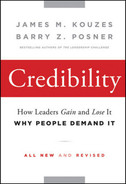
Credibility
The first true revision of the classic book from the bestselling authors of The Leadership Challenge As the world falls deeper into economic downturns and warfare, the question of credibility (how leaders gain and lose it) is more important than ever.
eBook

Leadership in higher education : practices that make a difference
\"Authors of the classic bestseller The Leadership Challenge (over 2.5 million copies sold) bring their expertise to higher education, offering five practices that can make anyone an exemplary leader. Drawing on the same vital research that formed the foundation of their classic bestseller The Leadership Challenge, Jim Kouzes and Barry Posner offer higher education professionals a set of leadership skills and practices that are available to everyone, not just a charismatic few. Kouzes and Posner identify Five Practices of Exemplary Leadership
Book

Influence of managers’ mindset on leadership behavior
Purpose
The purpose of this paper is to focus on exploring the link between managers’ mindset (fixed vs growth) and their choice of leadership behaviors.
Design/methodology/approach
The sample was drawn from a proprietary database provided by a global organization that offers 360-degree online leadership surveys. Individuals in management positions provided an assessment of their mindset orientation as well as how often they engaged in various leadership behaviors.
Findings
Growth-minded managers consistently displayed more frequent use of leadership behaviors than did their fixed mindset counterparts; and this relationship was independent of demographic or organizational factors.
Research limitations/implications
The findings are consistent with previous mindset research but prominently extend those results to managers in corporate settings; and supports previous research regarding the limited influence of demographic and organizational factors on both mindset and leadership.
Practical implications
Managers’ mindsets influence how much they engage in various leadership behaviors, and improving leadership competencies is more likely to occur when managers hold a growth mindset that abilities can be developed through effort as compared to fixed mindset managers who believe that abilities are inherent and unchangeable. The mindset of managers is predictive of the behavioral choices they make about exercising leadership, and has practical significance since studies have shown that managers are generally more effective in direct relationship to how often they are seen as engaging in leadership.
Originality/value
This study extends the significance of mindset from the educational to the corporate environment, using a robust sample of managers, and finding that the relationship between mindset and leadership is independent of various demographic and organizational characteristics.
Journal Article


Investigating the reliability and validity of the leadership practices inventory
This review explains the origins of the Leadership Practices Inventory (LPI) as an empirical instrument to measure The Five Practices of Exemplary Leadership framework, a major transformational leadership model. The essential psychometric properties of the LPI are investigated using both the LPI normative database, with nearly 2.8 million respondents, as well as reviewing pertinent findings of several hundred studies conducted worldwide by scholars utilizing the LPI in their research. Issues of both reliability and validity are considered, with the conclusion that the LPI is quite robust and applicable across a variety of settings and populations.
Journal Article

When learning how to lead, an exploratory look at role models
PurposeThe purpose of this study is to identify who people indicate are their role models for learning how to lead and explore how demographic characteristics may affect these choices.Design/methodology/approachA global online survey, involving over 34,000 respondents, indicated, from a list of 14 possibilities, the role model category from whom they learned to lead. Respondents indicated their age, gender, ethnicity, nationality, educational level, hierarchical level and job function. Chi-square analysis was used to identify how these factors may have affected the choice of role models distribution.FindingsFamily member (parents, siblings and other family outside of the immediate family) was found to be the most important role model category when it came to learning how to lead. Ranked second was immediate supervisor/manager. The rank order in terms of frequency of role model choices was not substantially different across demographic characteristics, though there were statistically significant differences regarding the relative importance of the various role model categories by demographics.Research limitations/implicationsThe results offer plentiful opportunities for future scholars to delve more into both the nature and actions of role models, in keeping with social learning theory. Future scholars can investigate the nature of people's relationships with leadership role models, especially conceptualizing why and how various demographic factors affect how people learn to lead.Practical implicationsUnderstanding who people have as role models for what they have learned about leadership can provide important insights for those responsible for leadership development. Similarly, individuals who are in role model “positions” (e.g. parents, teachers, managers) can be more aware of how their behaviors have implications for how their audience learns what effective leadership looks like in action.Originality/valueThis study addressed a relatively unexplored area in the leadership literature, namely within what category of role model have people found to be most important in helping them learn to lead. The large and diverse sample, across a multitude of demographic characteristics, strengthens the generalizability of the findings.
Journal Article