
Catalogue Search | MBRL


Are you sure you want to remove the book from the shelf?

{{itemTitle}}
26
result(s) for
"Bates, Robert H., author"
Sort by:


Markets and states in tropical Africa
Following independence, most countries in Africa sought to develop, but their governments pursued policies that actually undermined their rural economies. Examining the origins of Africa's \"growth tragedy,\" Markets and States in Tropical Africa has for decades shaped the thinking of practitioners and scholars alike. Robert H. Bates's analysis now faces a challenge, however: the revival of economic growth on the continent. In this edition, Bates provides a new preface and chapter that address the seeds of Africa's recovery and discuss the significance of the continent's success for the arguments of this classic work.
eBook


The Nationalization of Politics
In an in-depth comparative and long-term analysis, first published in 2004, Daniele Caramani studies the macro-historical process of the nationalization of politics. Using a great wealth of data on single constituencies in seventeen West European countries, he reconstructs the territorial structures of electoral support for political parties, as well as their evolution since the mid-nineteenth century from highly fragmented politics in the early stages toward nation-wide alignments. Caramani provides a multi-pronged empirical analysis through time, across countries, and between party families. The inclusion in the analysis of all the most important social and political cleavages - class, state-church, rural-urban, ethno-linguistic and religious - allows him to assess the nationalizing impact of the class cleavage that emerged from national and industrial revolutions, and the resistance of preindustrial cultural factors to national integration. Institutional and socio-economic factors are combined with actor-centered patterns and differences between national types of territorial configurations of the vote.
eBook

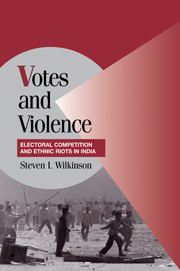
Votes and Violence
Why do ethnic riots break out when and where they do? Why do some governments try to prevent ethnic riots while others do nothing or even participate in the violence? In this book, Steven I. Wilkinson uses collected data on Hindu-Muslim riots, socio-economic factors and competitive politics in India to test his theory that riots are fomented in order to win elections and that governments decide whether to stop them or not based on the likely electoral cost of doing so. He finds that electoral factors account for most of the state-level variation in Hindu-Muslim riots: explaining for example why riots took place in Gujarat in 2002 but not in many other states where militants tried to foment violence. The general electoral theory he develops for India is extended to Ireland, Malaysia and Romania as Wilkinson shows that similar political factors motivate ethnic violence in many different countries.
eBook

Crucibles of Political Loyalty
This book, first published in 2006, investigates one of the oldest paradoxes in political science: why do mass political loyalties persist even amid prolonged social upheaval and disruptive economic development. Drawing on extensive archival research and an original database of election results, this book explores the paradox of political persistence by examining Hungary's often tortuous path from pre- to post-communism. Wittenberg reframes the theoretical debate, and then demonstrates how despite the many depredations of communism, the Roman Catholic and Calvinist Churches transmitted loyalties to parties of the Right. Contrary to conventional wisdom, Church resistance occurred not from above, but from below. Hemmed in and harassed by communist party cadres, parish priests and pastors employed a variety of ingenious tactics to ensure the continued survival of local church institutions. These institutions insulated their adherents from pressures to assimilate into the surrounding socialist milieu. Ultimately this led to political continuity between pre- and post-communism.
eBook

Democracy Derailed in Russia
Why has democracy failed to take root in Russia? After shedding the shackles of Soviet rule, some countries in the postcommunist region undertook lasting democratization. Yet Russia did not. Russia experienced dramatic political breakthroughs in the late 1980s and early 1990s, but it subsequently failed to maintain progress toward democracy. In this 2005 book, M. Steven Fish offers an explanation for the direction of regime change in post-Soviet Russia. Relying on cross-national comparative analysis as well as on in-depth field research in Russia, Fish shows that Russia's failure to democratize has three causes: too much economic reliance on oil, too little economic liberalization, and too weak a national legislature. Fish's explanation challenges others that have attributed Russia's political travails to history, political culture, or to 'shock therapy' in economic policy. The book offers a theoretically original and empirically rigorous explanation for one of the most pressing political problems of our time.
eBook
Sustaining Abundance
The ultimate goal of environmental policy is reducing pollution. Attention to environmental problems in the social sciences has brought some bold generalizations about causes of good results, but almost no systematic cross-national studies that flesh out major theoretical arguments and test those claims with data. This study makes a seminal contribution to that effort in two ways. First, by taking environmental outcomes over the last thirty years as the central dependent variable, it provides a basis for evaluating national performance in reducing environmental problems. Second, by developing a data set including performance in a number of countries and elaborating on major explanations of environmental performance found in the literature, this study provides the most rigorous available analysis of the determinants of environmental performance. In so doing, it challenges what is probably the conventional wisdom in the social sciences.
eBook

Age in the Welfare State
This book asks why some countries devote the lion's share of their social policy resources to the elderly, while others have a more balanced repertoire of social spending. Far from being the outcome of demands for welfare spending by powerful age-based groups in society, the 'age' of welfare is an unintended consequence of the way that social programs are set up. The way that politicians use welfare state spending to compete for votes, along either programmatic or particularistic lines, locks these early institutional choices into place. So while society is changing - aging, divorcing, moving in and out of the labor force over the life course in new ways - social policies do not evolve to catch up. The result, in occupational welfare states like Italy, the United States, and Japan, is social spending that favors the elderly and leaves working-aged adults and children largely to fend for themselves.
eBook