
Catalogue Search | MBRL


Are you sure you want to remove the book from the shelf?

{{itemTitle}}
18
result(s) for
"Battis, Jes"
Sort by:

No Crime to Be Bashful
This essay will discuss the role of social anxiety in the work of Margaret Cavendish, with a particular emphasis on blushing, speechlessness, and what we would now call introversion. The bashfulness that she presents in her work as a “crimeless defect,” I will argue, is both a form of transgressive modesty and a reaction against environmental sensitivity. In plays such as Lady Contemplation, The Presence, and Love’s Adventures, Cavendish is interested in staging various failures of communication.
Journal Article
Homofiles
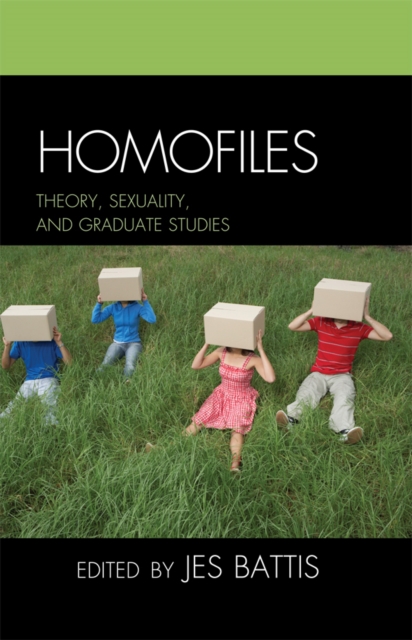
Homofiles: Theory, Sexuality, and Graduate Studies, edited by Jes Battis, collects the work of gay, lesbian, and transgender graduate students who are pursuing studies across the humanities. The contributors' essays address the various relationships between sexuality and scholarship within their respective programs, and present arguments on topics ranging from queer literature to police brutality. This is the first anthology to specifically explore the role of queer and transgender intellectuals-in-training within the academy, and the contributors both analyze and challenge the structures of academia that they are working in as cultural critics.
eBook

Supernatural youth
Supernatural Youth: The Rise of the Teen Hero in Literature and Popular Culture, edited by Jes Battis, addresses the role of adolescence in fantastic media, adventure stories, cinema, and television aimed at youth. The goal of this volume is to analyze the ways in which young heroic protagonists are presented in such popular literary and visual texts. Supernatural Youth surveys a variety of sources whose young protagonists are placed in heroic positions, whether by magic, technology, prophecy, or other forces beyond their control. Series examined include Harry Potter, Buffy the Vampire Slayer, Veronica Mars, and Sabrina the Teenage Witch. Supernatural Youth, edited by Jes Battis, is essential for educators who work in the fields of English, media studies, women's studies, LGBT studies, and sociology, as well as undergraduate students who are interested in popular culture.
eBook

Delany's Queer Markets: Nevèrÿon and the Texture of Capital
This article addresses the connection between queerness and capital within Samuel R.Delany's Nevèryön Sequence, looking particularly at the volumes Neveryóna and Return To Nevèryön. By mobilizing Marxist concepts (such as the commodity fetish) within his depiction of a fantastic Iron Age economy, Delany deliberately \"queers\" Marx's notion of primitive accumulation. Tracing the connections Delany draws between lived queer sexuality and the interpellation of subjects within the capitalist market system, this essay examines how the series' LGBT characters are subjected by and through the circuits of global capital.
Journal Article
\I am the molten heart of the world\: Language and Metamorphosis in Diane Duane's \Young Wizards\ Series
This essay reads the books of Diane Duane's Young Wizards series as novels of sexual and gender metamorphosis, looking particularly at magic within Duane's work as a linguistic instrument for sculpting bodies. It argues that YA novels in particular represent adolescent turmoil through narratives of wizardry and marvellous transformation, with Duane's work occupying a significantly feminist position.
Journal Article

Your Tax Dollars at Work: The State of Queer Youth Studies
Scholars will admit that the gay memoir-particularly of the Edmund White variety-\"had its place\" in the development of LGBT literature, but what about teens writing now about their experiences of homophobia versus their attempts at community building? Every day I try my best to identify as a queer man who's never entirely sure where his politics lie, who's not completely certain what he wants to \"do\" with this cultural capital, but who knows that there's something heinously wrong with a world where fifteen-year-old Lawrence King gets shot in the head in Oxnard, California, for admitting that he has a crush on his classmate; a world where the murders of LGBT youth go largely unreported unless a celebrity such as Ellen DeGeneres takes an interest in them. There's something so, so wrong when I actually find myself reading Perez Hilton for current gay analysis, rather than GLQ or The Advocate, because I feel so few people in the academy actually care anymore about addressing the intersections between race, sexuality, and youth.
Journal Article

GAZING UPON SAURON: HOBBITS, ELVES, AND THE QUEERING OF THE POSTCOLONIAL OPTIC
J. R. R. Tolkien's hobbits are (post)colonial subjects, but in just many ways they are something different--hybrid figures who tease the edges of any essentialist reading, who slippage eludes the critical eye. To look at them, to position them within a visual filed of interpretation, is to expose The Lord of the Rings as a text that hinges upon viewing: looks given, looks returned, looks frustrated, and looks denied. Whether it is Sauron's roaming eye, the imperial gaze of the Elves, or Shelob's hungry, mindless stare, the hobbits must negotiate an increasingly complex system of looks that seek to either subject, disembody, or distort them.
Journal Article

\Dangling inside the word she\: Confusion and gender vertigo in Anne Carson's Autobiography of Red
Battis discusses the irresolute queerness of the book \"Autobiography of Red\" by Anne Carson. The text is written by Carson about Geryon, who in turn is a mutation of the character that Stesichoros drew from existing Greek mythologies. It defies canonical notions of what a book is by providing the reader with a melange of poetic fragments, palinodes, systems of logic, monologues and interviews.
Journal Article

Queer spellings: Magic and melancholy in fantasy-fiction
This dissertation explores the connection between magic and melancholia in queer fantasy-fiction, looking broadly at what makes the entire fantasy genre in some fundamental sense \"queer.\" Synthesizing and applying psychoanalytical theories on mourning and melancholia from Sigmund Freud to Judith Butler, I examine how LGBT-identified characters within literary and visual media by Samuel Delany, Mercedes Lackey, Chaz Brenchley, Lynn Flewelling, J. R. R. Tolkien, Joss Whedon, and others, negotiate their subjectivities and erotic lives through the melancholic incorporation and manipulation of supernatural forces. In so doing, I contend that fantasy, as a category of generic production and gender inscription, reveals an extremely provocative connection between queerness, mourning, and the supernatural. Arguing that magic and melancholia emerge from similar spaces of psychoanalytic \"lack,\" I position the linguistic and gestural acts of wizardry and spellcasting—the root of all fantastic formulations and fabulations—as performative acts designed to bridge an impossible gap in signification. Keywords. queer, fantasy, science-fiction, melancholy, magic, witchcraft.
Dissertation