
Catalogue Search | MBRL


Are you sure you want to remove the book from the shelf?

{{itemTitle}}
168
result(s) for
"Bauwens, Luc"
Sort by:
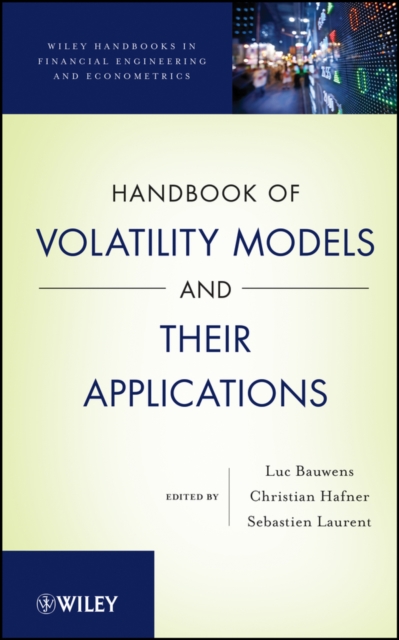
Handbook of volatility models and their applications
\"The main purpose of this handbook is to illustrate the mathematically fundamental implementation of various volatility models in the banking and financial industries, both at home and abroad, through use of real-world, time-sensitive applications. Conceived and written by over two-dozen experts in the field, the focus is to cohesively demonstrate how 'volatile' certain statistical decision-making techniques can be when solving a range of financial problems. By using examples derived from consulting projects, current research and course instruction, each chapter in the book offers a systematic understanding of the recent advances in volatility modeling related to real-world situations. Every effort is made to present a balanced treatment between theory and practice, as well as to showcase how accuracy and efficiency in implementing various methods can be used as indispensable tools in assessing volatility rates. Unique to the book is in-depth coverage of GARCH-family models, contagion, and model comparisons between different volatility models. To by-pass tedious computation, software illustrations are presented in an assortment of packages, ranging from R, C++, EXCEL-VBA, Minitab, to JMP/SAS\"--Proporcionado por la editorial.
eBook

Multivariate GARCH models: a survey
This paper surveys the most important developments in multivariate ARCH‐type modelling. It reviews the model specifications and inference methods, and identifies likely directions of future research. Copyright © 2006 John Wiley & Sons, Ltd.
Journal Article

State-space models on the Stiefel manifold with a new approach to nonlinear filtering
We develop novel multivariate state-space models wherein the latent states evolve on the Stiefel manifold and follow a conditional matrix Langevin distribution. The latent states correspond to time-varying reduced rank parameter matrices, like the loadings in dynamic factor models and the parameters of cointegrating relations in vector error-correction models. The corresponding nonlinear filtering algorithms are developed and evaluated by means of simulation experiments.
Journal Article

Theory and inference for a Markov switching GARCH model
We develop a Markov-switching GARCH model (MS-GARCH) wherein the conditional mean and variance switch in time from one GARCH process to another. The switching is governed by a hidden Markov chain. We provide sufficient conditions for geometric ergodicity and existence of moments of the process. Because of path dependence, maximum likelihood estimation is not feasible. By enlarging the parameter space to include the state variables, Bayesian estimation using a Gibbs sampling algorithm is feasible. We illustrate the model on S&P500 daily returns.
Journal Article

Modeling the Dependence of Conditional Correlations on Market Volatility
Several models have been developed to capture the dynamics of the conditional correlations between time series of financial returns and several studies have shown that the market volatility is a major determinant of the correlations. We extend some models to include explicitly the dependence of the correlations on the market volatility. The models differ by the way-linear or nonlinear, direct or indirect-in which the volatility influences the correlations. Using a wide set of models with two measures of market volatility on two datasets, we find that for some models, the empirical results support to some extent the statistical significance and the economic significance of the volatility effect on the correlations, but the presence of the volatility effect does not improve the forecasting performance of the extended models. Supplementary materials for this article are available online.
Journal Article

Forecasting Comparison of Long Term Component Dynamic Models for Realized Covariance Matrices
Novel model specifications that include a time-varying long-run component in the dynamics of realized covariance matrices are proposed. The modelling framework allows the secular component to enter the model either additively or as a multiplicative factor, and to be specified parametrically, using a MIDAS filter, or non-parametrically. Estimation is performed by maximizing a Wishart quasi-likelihood function. The one-step ahead forecasting performance is assessed by means of three approaches: model confidence sets, minimum variance portfolios and Value-at-Risk. The results show that the proposed models outperform benchmarks incorporating a constant long-run component both in and out-of-sample.
JEL: C13, C32, C58 / KEY WORDS: Realized Covariance, Component Dynamic Models, MIDAS, Minimum Variance Portfolio, Model Confidence Set, Value-at-Risk.
RÉSUMÉ. Des spécifications nouvelles sont proposées afin de modéliser la dynamique de matrices de covariance, en incluant une composante de long terme qui varie au cours du temps. La composante séculaire peut apparaître de façon additive ou multiplicative, et elle peut ětre paramétrique, avec une filtre MIDAS, ou non-paramétrique. L'estimation est faite en maximisant une fonction de quasi-vraisemblance de type Wishart. La performance des modèles pour la prévision est évaluée par trois approches: l'ensemble de confiance des modèles, l'analyse de portefeuilles de variance minimale, et celle de la valeur à risque (VaR). Les résultats indiquent que les modèles proposés surpassent ceux à composante de long terme constante, à la fois au cours et en dehors de la période d'estimation.
Journal Article
A New Approach to Volatility Modeling: The Factorial Hidden Markov Volatility Model
A new process-the factorial hidden Markov volatility (FHMV) model-is proposed to model financial returns or realized variances. Its dynamics are driven by a latent volatility process specified as a product of three components: a Markov chain controlling volatility persistence, an independent discrete process capable of generating jumps in the volatility, and a predictable (data-driven) process capturing the leverage effect. An economic interpretation is attached to each one of these components. Moreover, the Markov chain and jump components allow volatility to switch abruptly between thousands of states, and the transition matrix of the model is structured to generate a high degree of volatility persistence. An empirical study on six financial time series shows that the FHMV process compares favorably to state-of-the-art volatility models in terms of in-sample fit and out-of-sample forecasting performance over time horizons ranging from 1 to 100 days. Supplementary materials for this article are available online.
Journal Article
A New Class of Multivariate Skew Densities, With Application to Generalized Autoregressive Conditional Heteroscedasticity Models
We propose a practical and flexible method to introduce skewness in multivariate symmetric distributions. Applying this procedure to the multivariate Student density leads to a \"multivariate skew-Student\" density in which each marginal has a specific asymmetry coefficient. Combined with a multivariate generalized autoregressive conditional heteroscedasticity model, this new family of distributions is found to be more useful than its symmetric counterpart for modeling stock returns and especially for forecasting the value-at-risk of portfolios.
Journal Article
MULTIVARIATE VOLATILITY MODELING OF ELECTRICITY FUTURES
We model the dynamic volatility and correlation structure of electricity futures of the European Energy Exchange index. We use a new multiplicative dynamic conditional correlation (mDCC) model to separate long-run from short-run components. We allow for smooth changes in the unconditional volatilities and correlations through a multiplicative component that we estimate nonparametrically. For the short-run dynamics, we use a GJR-GARCH model for the conditional variances and augmented DCC models for the conditional correlations. We also introduce exogenous variables to account for congestion and delivery date effects in short-term conditional variances. We find different correlation dynamics for long-and short-term contracts and the new model achieves higher forecasting performance compared \\to a standard DCC model.
Journal Article

Handbook of volatility models and their applications
\"The main purpose of this handbook is to illustrate the mathematically fundamental implementation of various volatility models in the banking and financial industries, both at home and abroad, through use of real-world, time-sensitive applications. Conceived and written by over two-dozen experts in the field, the focus is to cohesively demonstrate how 'volatile' certain statistical decision-making techniques can be when solving a range of financial problems. By using examples derived from consulting projects, current research and course instruction, each chapter in the book offers a systematic understanding of the recent advances in volatility modeling related to real-world situations. Every effort is made to present a balanced treatment between theory and practice, as well as to showcase how accuracy and efficiency in implementing various methods can be used as indispensable tools in assessing volatility rates. Unique to the book is in-depth coverage of GARCH-family models, contagion, and model comparisons between different volatility models. To by-pass tedious computation, software illustrations are presented in an assortment of packages, ranging from R, C++, EXCEL-VBA, Minitab, to JMP/SAS\"--
Book