
Catalogue Search | MBRL


Are you sure you want to remove the book from the shelf?

{{itemTitle}}
162
result(s) for
"Becker, Ron"
Sort by:

Juba this, Juba that
An adaptation of the \"traditional 'juba' hand-clapping games [which] originated in Nigeria. The many rhymes and clapping patterns were remembered and passed along as a way of preserving something comforting and familiar from home. In North America, the games were often transformed into work songs by African-American slaves. Juba this, Juba that was among the most popular of these chants and is still a favorite with children today\"--Dust jacket flap.
Book

Gay TV and Straight America
After decades of silence on the subject of homosexuality, television in the 1990s saw a striking increase in programming that incorporated and, in many cases, centered on gay material. In shows including Friends, Seinfeld, Party of Five, Homicide, Suddenly Susan, The Commish, Ellen, Will & Grace, and others, gay characters were introduced, references to homosexuality became commonplace, and issues of gay and lesbian relationships were explored, often in explicit detail.
In Gay TV and Straight America, Ron Becker draws on a wide range of political and cultural indicators to explain this sudden upsurge of gay material on prime-time network television. Bringing together analysis of relevant Supreme Court rulings, media coverage of gay rights battles, debates about multiculturalism, concerns over political correctness, and much more, Becker's assessment helps us understand how and why televised gayness was constructed by a specific culture of tastemakers during the decade.
On one hand the evidence points to network business strategies that embraced gay material as a valuable tool for targeting a quality audience of well-educated, upscale adults looking for something \"edgy\" to watch. But, Becker also argues that the increase of gay material in the public eye creates growing mainstream anxiety in reaction to the seemingly civil public conversation about equal rights.
In today's cultural climate where controversies rage over issues of gay marriage yet millions of viewers tune in weekly to programs like Queer Eye for the Straight Guy, this book offers valuable insight to the complex condition of America's sexual politics.
eBook


Saturday Night Live and American TV
For over 35 years, \"Live from New York, it's Saturday Night!\" has greeted late night-TV viewers looking for the best in sketch comedy and popular music. SNL is the variety show that launched the careers of a mass of comedians including Dan Aykroyd, Chevy Chase, Chris Farley, Will Ferrell, Tina Fey, Amy Poehler, and Adam Sandler, among others. Week after week, SNL has produced unforgettable sketches and provocative political satire, adapting to changing times while staying true to its original vision of performing timely topical humor. With essays that address issues ranging from race and gender to authorship and comedic performance, \"Saturday Night Live\" and American TV follows the history of this 36-time Emmy-winning show and its place in the shifting social and media landscape of American television.
eBook

Introduction to Communication Studies
This revised edition of a now classic text includes a new introduction by Henry Jenkins, explaining ‘Why Fiske Still Matters’ for today’s students, followed by a discussion between former Fiske students Ron Becker, Elana Levine, Darrell Newton and Pamela Wilson on the theme of ‘Structuralism and Semiotics, Fiske-Style’. Both underline the continuing relevance of this foundational text in communication studies.
How can we study communication? What are the main theories and methods of approach?
This classic text provides a lucid, accessible introduction to the main authorities in the field of communication studies, aimed at students coming to the subject for the first time. It outlines a range of methods of analysing examples of communication, and describes the theories underpinning them. Thus armed, the reader will be able to tease out the latent cultural meanings in such apparently simple communications as news photos or popular TV programmes, and to see them with new eyes.
@contents: Selected Contents: List of plates Acknowledgements Why Fiske Still Matters Henry Jenkins Structuralism and Semiotics, Fiske-Style Ron Becker, Elana Levine, Darrell Newton and Pamela Wilson Notes on Contributors General Editor’s Preface Author’s note INTRODUCTION: WHAT IS COMMUNICATION? Chapter 1 COMMUNICATION THEORY Chapter 2 OTHER MODELS Chapter 3 COMMUNICATION, MEANING, AND SIGNS Chapter 4 CODES Chapter 5 SIGNIFICATION Chapter 6 SEMIOTIC METHODS AND APPLICATIONS Chapter 7 STRUCTURALIST THEORY AND APPLICATIONS Chapter 8 EMPIRICAL METHODS Chapter 9 IDEOLOGY AND MEANINGS CONCLUSION References Bibliography Further reading Books recommended for additional reading Index
John Fiske is Professor Emeritus in the Department of Communication Arts at the University of Wisconsin-Madison, USA.
eBook
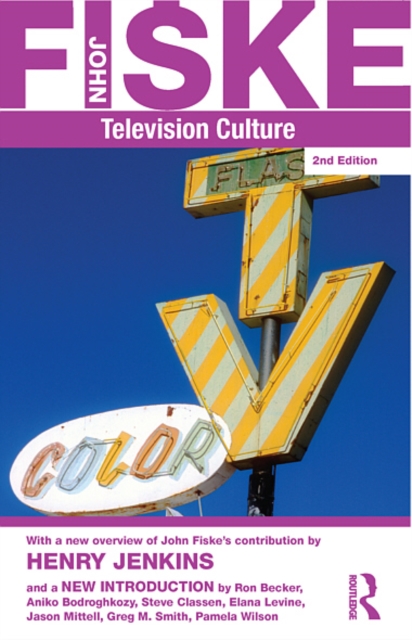
Television Culture
This revised edition of a now classic text includes a new introduction by Henry Jenkins, explaining 'Why Fiske Still Matters' for today's students, followed by a discussion between former Fiske students Ron Becker, Aniko Bodroghkozy, Steve Classen, Elana Levine, Jason Mittell, Greg Smith and Pam Wilson on 'John Fiske and Television Culture'. Both underline the continuing relevance of this foundational text in the study of contemporary media and popular culture.Television is unique in its ability to produce so much pleasure and so many meanings for such a wide variety of people. In this book, John Fiske looks at television's role as an agent of popular culture, and goes on to consider the relationship between this cultural dimension and television's status as a commodity of the cultural industries that are deeply inscribed with capitalism. He makes use of detailed textual analysis and audience studies to show how television is absorbed into social experience, and thus made into popular culture. Audiences, Fiske argues, are productive, discriminating, and televisually literate.Television Culture provides a comprehensive introduction for students to an integral topic on all communication and media studies courses.
eBook