
Catalogue Search | MBRL


Are you sure you want to remove the book from the shelf?

{{itemTitle}}
66
result(s) for
"Beeching, Kate"
Sort by:

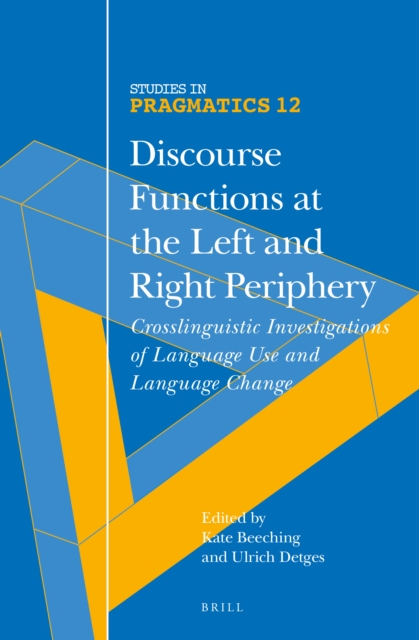
Discourse functions at the left and right periphery : crosslinguistic investigations of language use and language change
This volume tests the hypothesis that elements at the left periphery of discourse units have mainly subjective and discourse-structuring functions, whereas at the right periphery, such elements play an intersubjective or modalising role.
eBook
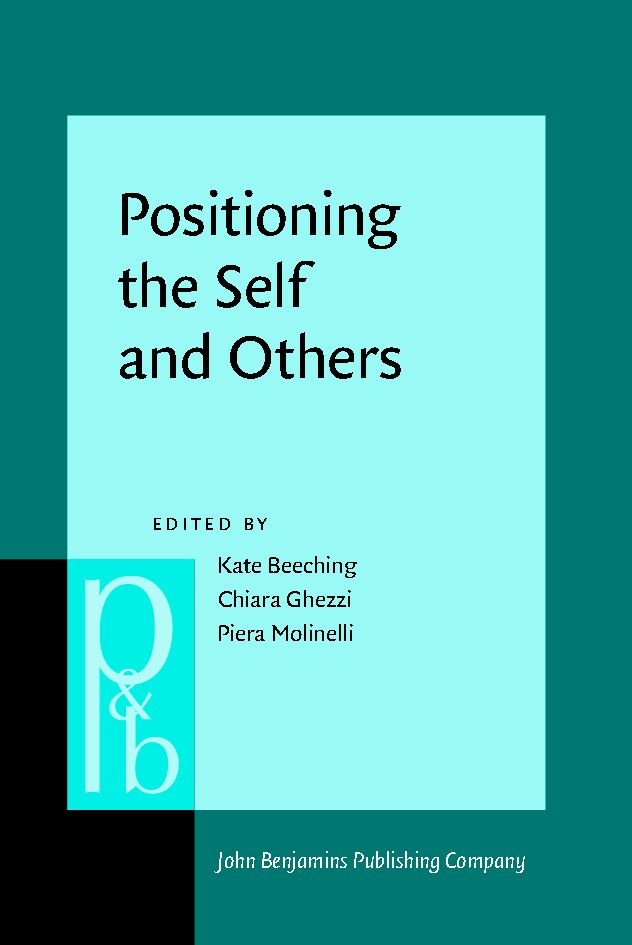
Positioning the self and others : linguistic perspectives
Though positioning has been addressed in social psychology and in identity construction, less attention has been paid to the specific linguistic markers which are drawn upon in discourse to position the self and other(s). This volume focusses on address terms, pragmatic markers, code switching/choice and orthography, the indexicalities of which are explored in different communicative activities. The volume is unusual in: i) the range of languages which are covered: Bergamasco, Brazilian Portuguese, English, Finnish, French, Georgian, Greek, Italian, Latin, Russian, Spanish and Swedish; ii) the inclusion of different communicative settings and text-types: workplace emails, everyday and institutional conversations, interviews, migrant narratives, radio phone-ins, dyadic and group settings, road-signs, service encounters; iii) its consideration of both synchronic and diachronic factors; iv) its mix of theoretical and methodological approaches.The volume illustrates some of the linguistic means speakers draw on to position themselves and others and hopes to stimulate further research studies in this vein.
eBook
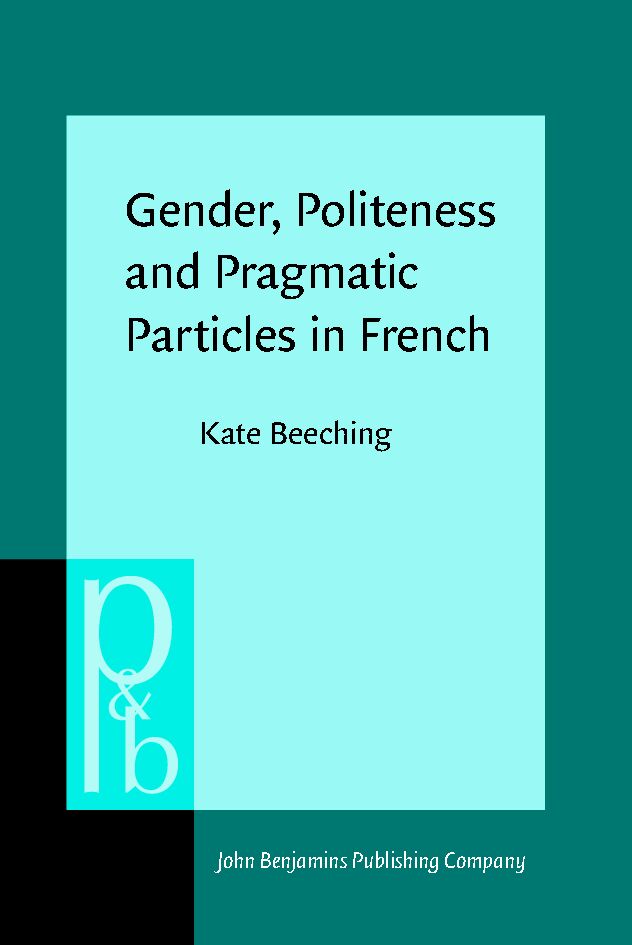
Gender, Politeness and Pragmatic Particles in French
This study aims to investigate politeness in women's and men's speech, with a particular focus on the use of c'est-à-dire, enfin, hein and quoi in contemporary spoken French. Politeness is defined as going beyond the notion of the face-threatening act, englobing both everyday ideas of politeness and the creation of sociability in face-to-face interaction.The pragmatic particles studied are demonstrated to serve both psycholinguistic and sociolinguistic purposes: they lubricate reformulation and contribute to both sociability and social indexation.The study, which combines qualitative and quantitative analysis, is based on a corpus of spontaneous spoken French, comprising 155,000 words, 95 interviews and subjects ranging in age from 7 to 88 years. The sample contains speakers from a broader range of educational backgrounds than is often the case: a butcher, a video-salesman and a toiletteur canin rub shoulders with counter assistants, teachers and doctors.
eBook

Each pɚson does it thεː way: Rhoticity variation and the community grammar
This paper examines individual differences in constraints on linguistic variation in light of Labov's (2007) proposal that adult change (diffusion) disrupts systems of constraints and Tamminga, MacKenzie, and Embick's (2016) typology of constraints. It is shown that, in pooling data from multiple speakers, some of the complexity in structured community variation may be overlooked. Data on rhoticity from speakers of Bristol English are compared to 34 previous studies of rhoticity in varieties of English around the world. Constraints found to be consistent across varieties are also found to be consistent across speakers of Bristol English, whereas those that differ between varieties also differ between individuals, implying that only those which differ are truly part of the grammar, and that these are indeed disrupted by diffusion.
Journal Article
Politeness-induced semantic change: The case of quand même
This article contributes to a growing body of theory that posits
language-external, social factors as a primary motor in diachronic change.
Politeness theory and the use of variationist approaches enable us to
posit, and test, the hypothesis of a type of pragmaticalization, which I
call Politeness-Induced Semantic Change (PISC). Historical data on
quand même are presented that give tentative credence to
such a model. Moeschler and de Spengler's (1981) and Waltereit's (2001) speech-act theoretic analyses of quand
même are reinterpreted within the framework of politeness
theory and sociopragmatics. The ensuing corpus investigation of the
grammaticalization and pragmatico-semantic evolution of quand
même from 1500–2000 highlights the fact that not only the
innovation but also the propagation of a new form–function
configuration depend on social factors; politeness theory may have
explanatory power in capturing the ever-changing social patterning of
linguistic features and the conditions that favor the spread of
innovation.I wish to acknowledge the very
helpful and detailed comments of Maj-Britt Mosegaard Hansen and anonymous
reviewers from Language Variation and Change on a draft version
of this article. Remaining inadequacies are, of course, entirely my own. I
also recognize a debt of gratitude to the Research Committee of the
Faculty of Humanities, Languages and Social Sciences of the University of
the West of England, Bristol, who granted me the research leave required
to complete the article.
Journal Article

Covariation of the Discourse Markers bon, c'est-a-dire, enfin, hein, quand meme, quoi, and si vous voulez: A Question of Identity?
This article takes a sociolinguistic approach to the study of the co-variation of a set of frequently occurring markers in three corpora of spoken French, dated 1968, 1988 & 2002. A Factor Analysis yields three Factors, labelled \"Normal/Deferent,\" \"Modern/ Camaraderie\" & \"Tradition/Formality.\" The most recent corpus, & in particular its youngest speakers, have higher rates of \"Modern/Camaraderie\" & lower rates of \"Tradition/Formality.\" The Factor \"Modern/Camaraderie,\" interestingly, combines diachronic developments of two sorts, however; the spread of the sociolinguistically stigmatized quoi & the more intralinguistically-motivated spread of bon. The gradual pragmaticalisation of the latter allows it to be used in a greater number of contexts & thus increase in frequency. Frequency rates of these Factors correlate to a greater extent with the generation of the speaker than with educational background, sex or age per se. This suggests not only that modes of politeness are shifting but that speakers identify more closely with their own generation than with those of a similar educational background. Tables, Figures, References. Adapted from the source document
Journal Article
La co-variation des marqueurs discursifs \bon, c'est-à-dire, enfin, hein, quand même, quoi et si vous voulez\ : une question d'identité ?
This article takes a sociolinguistic approach to the study of the co-variation of a set of frequently occurring markers in three corpora of spoken French, dated 1968, 1988 and 2002. A Factor Analysis yields three Factors, labelled \"Normal/Deferent\", \"Modern/Camaraderie\" and \"Tradition/Formality\". The most recent corpus, and in particular its youngest speakers, have higher rates of \"Modern/Camaraderie\" and lower rates of \"Tradition/Formality\". The Factor \"Modern/Camaraderie\", interestingly, combines diachronic developments of two sorts, however ; the spread of the sociolinguistically stigmatised quoi and the more intralinguistically-motivated spread of bon. The gradual pragmaticalisation of the latter allows it to be used in a greater number of contexts and thus increase in frequency. Frequency rates of these Factors correlate to a greater extent with the generation of the speaker than with educational background, sex or age perse. This suggests not only that modes of politeness are shifting but that speakers identify more closely with their own generation than with those of a similar educational background.
Journal Article
La co-variation des marqueurs discursifs bon, c'est-à-dire, enfin, hein, quand même, quoi et si vous voulez : une question d'identité ?
This article takes a sociolinguistic approach to the study of the co-variation of a set of frequently occurring markers in three corpora of spoken French, dated 1968, 1988 and 2002. A Factor Analysis yields three Factors, labelled “Normal/Deferent”, “Modern/ Camaraderie” and “Tradition/Formality”. The most recent corpus, and in particular its youngest speakers, have higher rates of “Modern/Camaraderie” and lower rates of “Tradition/Formality”. The Factor “Modern/Camaraderie”, interestingly, combines diachronic developments of two sorts, however ; the spread of the sociolinguistically stigmatised quoi and the more intralinguistically-motivated spread of bon . The gradual pragmaticalisation of the latter allows it to be used in a greater number of contexts and thus increase in frequency. Frequency rates of these Factors correlate to a greater extent with the generation of the speaker than with educational background, sex or age per se. This suggests not only that modes of politeness are shifting but that speakers identify more closely with their own generation than with those of a similar educational background.
Journal Article