
Catalogue Search | MBRL


Are you sure you want to remove the book from the shelf?

{{itemTitle}}
18
result(s) for
"Bel i Queralt, Germa"
Sort by:


Plurinational states and infrastructures
Mature economies tend to invest less in new construction and more in maintenance and management. This is particularly important in the case of Spain, which in addition to being a mature economypresents a huge excess capacity in all interurban modes, and particularly in the radial corridors. The key to a reorganisation of the infrastructure policy in a hypothetical state that recognises itself as multinational is the transfer of management to units forming the federation; in some cases, ownership should be transferred as well. In this regard, this paper presents a new model of infrastructure policy for a different Spain, and it does so by taking advantage of lessons taught from other infrastructure policies widely applied in parts of Europe and the US.
Journal Article

Privatization, regulation and airport pricing: an empirical analysis for Europe
This paper examines factors determining airport charges. Using data for 100 large airports in Europe, we find that they charge higher prices when they move more passengers. Additionally, competition from other transport modes and nearby airports imposes some discipline on the pricing behavior of airports. Low-cost carriers and airlines with a high market share seem to have a stronger countervailing power. We also find that private airports not regulated charge higher prices than public or regulated airports. Finally, the regulation mechanism does not seem to influence substantially the level of airport charges.
Journal Article
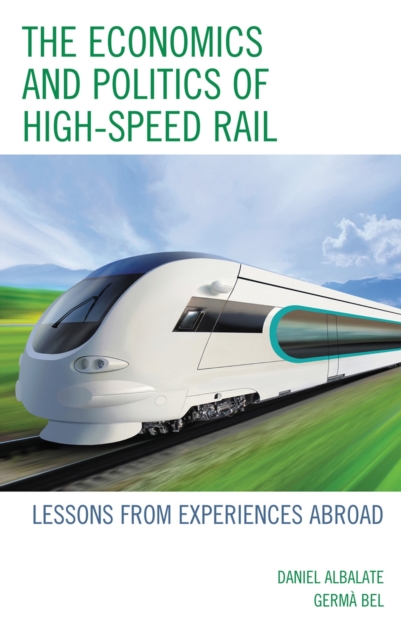
The Economics and Politics of High-Speed Rail
The technological revolution linked to high speed rail (HSR) has been accompanied by myths and claims about its contribution to society and the economy. Although HSR is unquestionably a technological advance that has become a symbol of modernity, this review and analysis of the international experiences shows that the conditions necessary to have a positive impact, economically, socially and environmentally, are enormously restrictive. The Economics and Politics of High Speed Rail: Lessons from Experiences Abroad, by Daniel Albalate and Germà Bel, introduces the main questions policy makers and scholars should examine when considering and studying HSR implementation, with particular emphasis on the US’s recent interest in this technology and possible application in California. Albalate and Bel then review the experiences of the most significant implementations of HSR around the globe. This in-depth international perspective includes chapters on the pioneers of HSR (Japan and France), the European followers (Germany, Spain and Italy), as well as Asian experiences in China, Taiwan, and Korea. Albalate and Bel’s study provides a clear distinction between the myths and realities associated with this transportation innovation. Among the most relevant findings, this study highlights how HSR projects that do not satisfy highly restrictive conditions—on mobility patterns, measured costs, and economically rational designs—that make it desirable have been the source of huge financial debacles and the economic failure of HSR in most cases, which result in unfortunate consequences for taxpayers. The Economics and Politics of High Speed Rail is a rigorous investigation of the economic and political challenges and ramifications of implementing new public transportation technology.
eBook

Estat plurinacional i infraestructures
Les economies madures tendeixen a invertir menys en nova construcció i molt més en manteniment i gestió. Això és particularment important en el cas d'Espanya, que -a més de ser una economia madura- presenta un gran excés de capacitat general en tots els modes interurbans, i particularment en els corredors radials. El punt clau en una reorganització de la política d'infraestructures en un hipotètic estat que es reconegui a sí mateix com plurinacional és la transferència de la gestió a les unitats integrants de la federació, i en alguns casos també de la titularitat. En aquesta línia, en aquest treball es presenta un nou model de política d'infraestructures per a una Espanya diferent, que aprèn de les experiències i lliçons de fórmules ja aplicades a parts d'Europa i els EUA.
Journal Article


INTERMODAL COMPETITION ON INTER-URBAN RAIL
Intermodal competition through time costs of travel shows to be a great source of pressure on inter-urban rail demand. Competition of road inter-urban transport against inter-urban rail is specially intense when low and medium distance journeys are involved. Contrariwise, air travel does not compete against interurban rail in such distances, but it does when the journeys imply long distances. In this paper we specify, and empirically estimate, an explanatory model for intermodal competition on inter-urban rail. The results obtained through the empirical analysis confirm the explanatory power of changes in time costs, and clearly show: (1) the need to introduce the impact of changes in the time costs when studying the demand for interurban travel too, and (2) the necessity to study the demand for inter-urban rail travel in a disintegrated way.
Journal Article