
Catalogue Search | MBRL


Are you sure you want to remove the book from the shelf?

{{itemTitle}}
51
result(s) for
"Benczes, Réka"
Sort by:
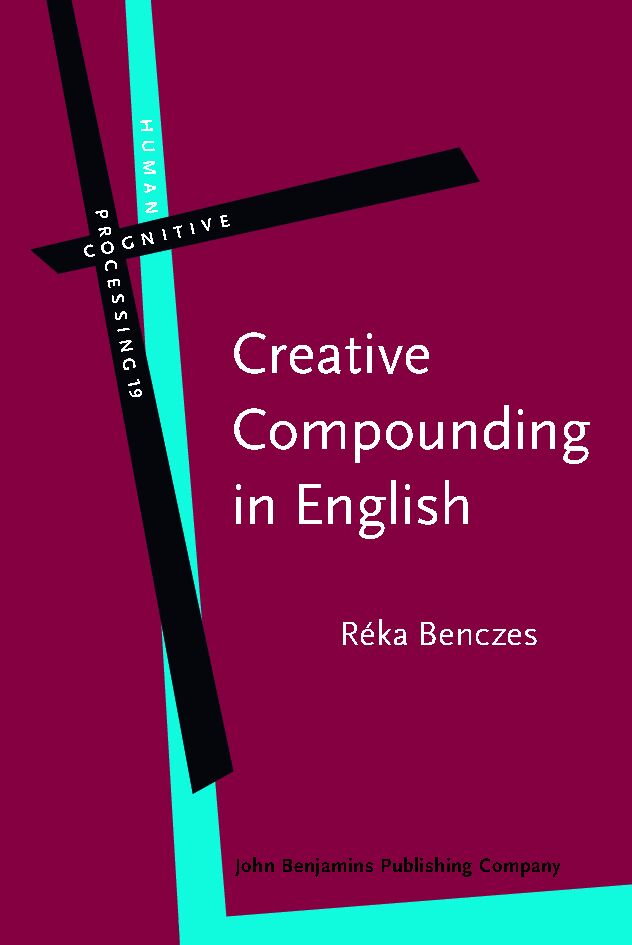
Creative compounding in English : the semantics of metaphorical and metonymical noun-noun combinations
Metaphorical and metonymical compounds - novel and lexicalised ones alike - are remarkably abundant in language. Yet how can we be sure that when using an expression such as land fishing in order to speak about metal detecting, the referent will be immediately understood even if the hearer had not been previously familiar with the compound? Accordingly, this book sets out to explore whether the semantics of metaphorical and metonymical noun-noun combinations can be systematically analysed within a theoretical framework, where systematicity pertains to regularities in both the cognitive processes and the products of these processes, that is, the compounds themselves. Backed up by recent psycholinguistic evidence, the book convincingly demonstrates that such compounds are not semantically opaque as it has been formerly claimed: they can in fact be analysed and accounted for within a cognitive linguistic framework, by the combined application of metaphor, metonymy, blending, profile determinacy and schema theory; and represent the creative and associative word formation processes that we regularly apply in everyday language.
eBook

Repetitions which are not repetitions: the non-redundant nature of tautological compounds
In English morphological literature, the term ‘tautological compound’ has been typically used to refer to two distinct – but closely related – phenomena: (1) compounds composed of a hyponym and a superordinate term (such as oak tree ); and/or (2) compounds based upon two synonymous units (such as subject matter ). Such combinations are one of the quirkiest – and least researched – phenomena of English compounding. Their oddity can be attributed to two main factors. First, as their name, ‘tautological compound’ implies, at face value such combinations can be considered as prime examples of the redundancy of language. Second, they do not follow normal compound-forming rules in the sense that both constituents can function as the semantic head (as opposed to ‘normal’ English compounds, which follow the Right-Hand Head Rule). Perhaps it is the quirkiness of tautological compounds that accounts for the fact that not much has been said about them in traditional accounts of compounding, which typically relegate them to a marginal area of the English language. However, there is more to tautological compounds than meets the eye. What the present study wishes to demonstrate is that the term ‘tautological compound’ is a misnomer, as such combinations are far from being tautological or redundant in their meaning. Accordingly, the article first clarifies the notion of tautological compound, and then aims to give an account of the various roles that such combinations play in language, thereby demonstrating their non-tautological and non-redundant nature – in order to assign this much-neglected category to its proper, well-deserved place within English word formation.
Journal Article

Palatal is for happiness, plosive is for sadness: evidence for stochastic relationships between phoneme classes and sentiment polarity in Hungarian
The past couple of decades have seen a substantial increase in linguistic research that highlights the non-arbitrariness of language, as manifested in motivated sound–meaning correspondences. Yet one of the challenges of such studies is that there is a relative paucity of data-driven analyses, especially in the case of languages other than English, such as Hungarian, even though the proportion of at least partially motivated words in Hungarian vocabulary is substantial. We address this gap by investigating the relationship between Hungarian phoneme classes and positive/negative sentiment based on 3,023 word forms retrieved from the Hungarian Sentiment Lexicon. Our results indicate that positive polarity word forms tend to contain more vowels, front vowels, continuants, fricatives, palatals, and sibilants. On the other hand, negative sentiment polarity words tend to have more rounded vowels, plosives, and dorsal consonants. While our analysis provides strong evidence for a set of non-arbitrary form–meaning relationships, effect sizes also reveal that such associations tend to be fairly weak tendencies, and therefore sentiment polarity cannot be derived from the relative frequencies of phoneme classes in a deterministic fashion.
Journal Article
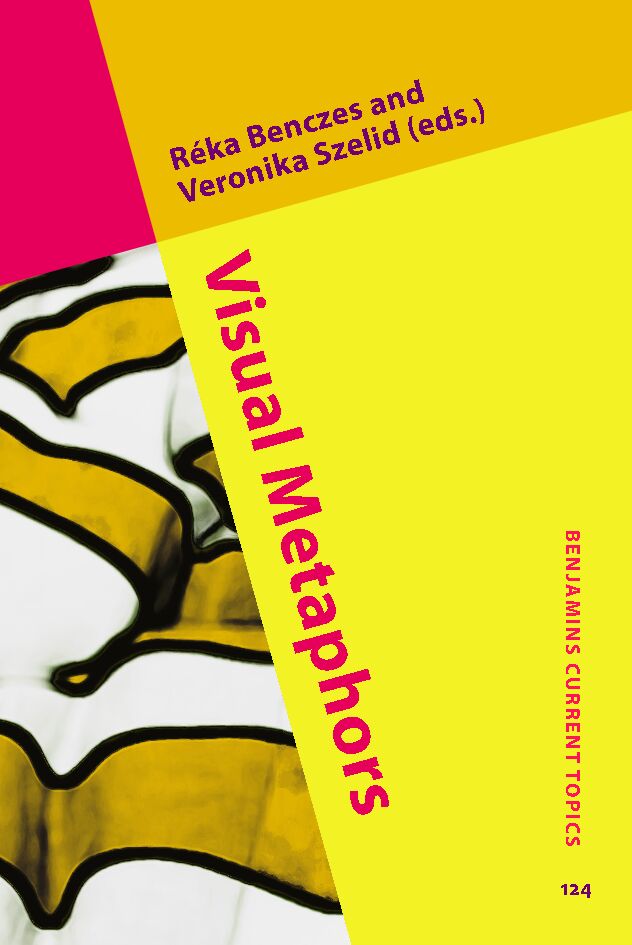
Visual Metaphors
The interplay of metaphorical/metonymical text and imagery is not necessarily (and not usually) straightforward and raises complex theoretical and methodological questions. The eleven chapters in this collection address a wide range of such challenges. Originally published as special issue of Cognitive Linguistic Studies 7:1 (2020).
eBook

The name of the game: Rhyme and alliteration in multi-word expressions
While the Saussurean notion of the arbitrary sign has been a constant in linguistic theorizing, the past few decades have seen a substantial increase in linguistic research that downplays arbitrariness and highlights motivation as an organizing principle in language. Form does carry meaning for language users, and speakers in everyday acts of communication routinely show an interest in and enthusiasm for linguistic form. The paper outlines the extent and role that form-to-form motivational processes, in particular rhyme and alliteration, play in English multi-word expressions such as binomials, idioms, proverbs and slogans, and suggests that such devices serve a variety of purposes: reinforcing the meaning by virtue of repetition, enhancing the acceptability of novel constructions and creating an impression of enhanced truthfulness. At the same time, using alliteration and rhyme in multi-word units is simply enjoyable - the roots of which go all the way back to oral culture.
Journal Article

From financial support package via rescue aid to bailout: Framing the management of the Greek sovereign debt crisis
In the spring of 2010 Greece officially turned to the EU for help in order to prevent itself from a sovereign default. However, the Treaty on European Union explicitly prohibits any member state to ask for a so-called bailout (i.e., financial assistance) from the other member states or the EU itself. Thus, overnight the Greek financial crisis became a linguistic one as well: how to communicate the notion of financial assistance without implying one? In light of this conundrum, the paper investigates how leading European and American newspapers have communicated the financial assistance by looking at the rather diverse expressions used for the notion of “bailout” that appeared in select articles published on the pivotal dates of the crisis management process. We hypothesized that as the Greek crisis developed, multiple and alternating frames were used in communicating the news on crisis management through the lexical choices the journalists used. The data justified the hypotheses: while the first phase was dominated by the RELIEF frame, this was eventually superseded by the BAILOUT frame by 2 May, the day the deal was finally struck. At the same time, the BUSINESS TRANSACTION frame never appeared as the most significant conceptualisation, implying that journalists were reluctant to view the deal between the two (eventually, three) parties as the result of a rational horizontal relationship between “buyer” and “seller” or between “debtor” and “creditor”.
Journal Article
From financial support package via rescue aid to bailout: Framing the management of the Greek sovereign debt crisis1
In the spring of 2010 Greece officially turned to the EU for help in order to prevent itself from a sovereign default. However, the Treaty on European Union explicitly prohibits any member state to ask for a so-called bailout (i.e., financial assistance) from the other member states or the EU itself. Thus, overnight the Greek financial crisis became a linguistic one as well: how to communicate the notion of financial assistance without implying one? In light of this conundrum, the paper investigates how leading European and American newspapers have communicated the financial assistance by looking at the rather diverse expressions used for the notion of “bailout” that appeared in select articles published on the pivotal dates of the crisis management process. We hypothesized that as the Greek crisis developed, multiple and alternating frames were used in communicating the news on crisis management through the lexical choices the journalists used. The data justified the hypotheses: while the first phase was dominated by the RELIEF frame, this was eventually superseded by the BAILOUT frame by 2 May, the day the deal was finally struck. At the same time, the BUSINESS TRANSACTION frame never appeared as the most significant conceptualisation, implying that journalists were reluctant to view the deal between the two (eventually, three) parties as the result of a rational horizontal relationship between “buyer” and “seller” or between “debtor” and “creditor”.
Journal Article
Life is a battlefield: Conceptualizations of life among Hungarian Adults
This study attempts to investigate how Hungarians think about life. By applying a nationwide representative survey of Hungarian adults, we wished to answer the following two research questions: a) what are the major metaphorical conceptualizations of life among Hungarians?; and b) what factors, such as socio-economic status and basic value orientations, might influence the prevalence for the metaphors used to talk about life? Our results suggest that there are considerable generational differences: while the negative mindset (in the form of more negative metaphors) is still common within the older generation, there is a shift towards a more positive and more “American” conceptualization of life among younger people in Hungary.
Journal Article
Repetitions which are not repetitions: the non-redundant nature of tautological compounds1
In English morphological literature, the term ‘tautological compound’ has been typically used to refer to two distinct – but closely related – phenomena: (1) compounds composed of a hyponym and a superordinate term (such as oak tree); and/or (2) compounds based upon two synonymous units (such as subject matter). Such combinations are one of the quirkiest – and least researched – phenomena of English compounding. Their oddity can be attributed to two main factors. First, as their name, ‘tautological compound’ implies, at face value such combinations can be considered as prime examples of the redundancy of language. Second, they do not follow normal compound-forming rules in the sense that both constituents can function as the semantic head (as opposed to ‘normal’ English compounds, which follow the Right-Hand Head Rule). Perhaps it is the quirkiness of tautological compounds that accounts for the fact that not much has been said about them in traditional accounts of compounding, which typically relegate them to a marginal area of the English language. However, there is more to tautological compounds than meets the eye. What the present study wishes to demonstrate is that the term ‘tautological compound’ is a misnomer, as such combinations are far from being tautological or redundant in their meaning. Accordingly, the article first clarifies the notion of tautological compound, and then aims to give an account of the various roles that such combinations play in language, thereby demonstrating their non-tautological and non-redundant nature – in order to assign this much-neglected category to its proper, well-deserved place within English word formation.
Journal Article