
Catalogue Search | MBRL


Are you sure you want to remove the book from the shelf?

{{itemTitle}}
708
result(s) for
"Benoit, William"
Sort by:

Presidential campaigns in the age of social media : Clinton and Trump
\"This book offers content analyses of candidate campaign messages from the primary and the general election. The chapters examine both new (Twitter, Facebook) and traditional (TV spots, debates, speeches) media employed in this contest. This allows comparison of campaign phases (primary versus general), candidates (Republican primary and Democratic primary candidates; general election candidates), and message forms. The results are compared with data from analyses of previous presidential campaigns\"-- Provided by publisher.
Book

Accounts, Excuses, and Apologies
Proposes a theory and case studies on repairing a damaged or threatened image or reputation.
In our constantly plugged-in and connected world, image is everything. People, groups, organizations, and countries frequently come under suspicion of wrongdoing and sometimes require defense. Accounts, Excuses, and Apologies describes the image-repair strategies that may be used to help defuse these threats.
The Third Edition of this classic book builds on theories for rehabilitating a damaged reputation by adding two new forms of denial: straw denial (appearing to deny an accusation by sidestepping it) and deflecting attention (trying to get the audience to focus on something other than the accusations against you). Five contexts for image repair are examined: corporate, political, sports/entertainment, international, and third party (when one person or organization tries to repair the image of another). The book's case studies include current instances of reputation repair, including Vladimir Putin on Ukraine and President Joe Biden on Afghanistan; Southwest Airlines on flight cancellations; Kobe Bryant on accusations of rape; and Donald Trump on the January 6 hearings.
eBook
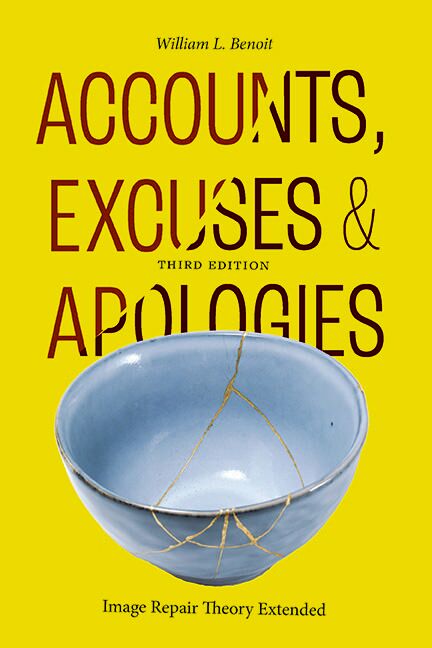
Accounts, Excuses, and Apologies, Third Edition
In our constantly plugged-in and connected world, image is
everything. People, groups, organizations, and countries frequently
come under suspicion of wrongdoing and sometimes require defense.
Accounts, Excuses, and Apologies describes the
image-repair strategies that may be used to help defuse these
threats. The Third Edition of this classic book builds on theories
for rehabilitating a damaged reputation by adding two new forms of
denial: straw denial (appearing to deny an accusation by
sidestepping it) and deflecting attention (trying to get the
audience to focus on something other than the accusations against
you). Five contexts for image repair are examined: corporate,
political, sports/entertainment, international, and third party
(when one person or organization tries to repair the image of
another). The book's case studies include current instances of
reputation repair, including Vladimir Putin on Ukraine and
President Joe Biden on Afghanistan; Southwest Airlines on flight
cancellations; Kobe Bryant on accusations of rape; and Donald Trump
on the January 6 hearings.
eBook

A Functional Analysis of Political Television Advertisements
A Functional Analysis of Political Television Advertisements examines theory and research on election advertisements.William Benoit employs the Functional Theory of Political Campaign Discourse to understand the nature or content of television spots in election campaigns.
eBook
Political election debates
Political debates are an important facet of modern election campaigns. How politicians frame an argument, how the audience perceives it, and how the media decides to display it are key components in analyzing the outcome of a political debate, and ultimately, an election. Drawing mainly on the functional theory of political campaign discourse, William L. Benoit examines a wide variety of debates not only in the United States but across the globe. Because each phase of election offers new challenges, specific attention is paid to how primary versus general and incumbency influence the content of political leaders’ debate practices. Specifically, the book delves into the history and nature of debates in various United States elections, including presidential, vice presidential, senatorial, gubernatorial, and mayoral candidates. Also examined are debates ranging from the United Kingdom to South Korea to Australia. Benoit also employs the issues ownership theory and functional federalism theory as a deeper part of the analysis. This book offers a critical examination and comprehensive overview of election debate theory.
eBook

Issue Ownership and Presidential Campaigning, 1952-2000
Performance issues, such as the conduct of government officials, the state of the economy, or the country's status and security among other nations, are not automatically owned by a single party, but can provide an advantage to a candidate when events, official behavior, and policy successes and failures allow the candidate to claim credit for good times or blame the opposition for bad times. Here, Petrocik et al examine presidential elections from 1952 through 2000 using the issue-ownership formulation. Details are presented.
Journal Article

GWAK: gravitational-wave anomalous knowledge with recurrent autoencoders
Matched-filtering detection techniques for gravitational-wave (GW) signals in ground-based interferometers rely on having well-modeled templates of the GW emission. Such techniques have been traditionally used in searches for compact binary coalescences (CBCs), and have been employed in all known GW detections so far. However, interesting science cases aside from compact mergers do not yet have accurate enough modeling to make matched filtering possible, including core-collapse supernovae and sources where stochasticity may be involved. Therefore the development of techniques to identify sources of these types is of significant interest. In this paper, we present a method of anomaly detection based on deep recurrent autoencoders to enhance the search region to unmodeled transients. We use a semi-supervised strategy that we name ‘Gravitational Wave Anomalous Knowledge’ (GWAK). While the semi-supervised approach to this problem entails a potential reduction in accuracy compared to fully supervised methods, it offers a generalizability advantage by enhancing the reach of experimental sensitivity beyond the constraints of pre-defined signal templates. We construct a low-dimensional embedded space using the GWAK method, capturing the physical signatures of distinct signals on each axis of the space. By introducing signal priors that capture some of the salient features of GW signals, we allow for the recovery of sensitivity even when an unmodeled anomaly is encountered. We show that regions of the GWAK space can identify CBCs, detector glitches and also a variety of unmodeled astrophysical sources.
Journal Article

Functional Theory and Political Discourse: Televised Debates in Israel and the United States
This study applied functional theory, developed for political campaigns in the United States, to six televised debates in Israel and compared debates in both countries. In both countries, acclaims were the most common function, followed by attacks and then defenses. Policy was addressed more often than character. Incumbent candidates in both countries acclaimed significantly more and attacked less than the challengers. Incumbents used past deeds significantly more often to acclaim—and less to attack—than the challengers. The similarities discovered suggest that candidates for elective political office may employ common discursive practices that transcend national borders.
Journal Article

Campaigning on the Internet: 2008 Presidential General Election Candidate Webpages
The Internet is becoming an increasingly important component of political campaigns. This study employed content analysis to apply Functional Theory and Issue Ownership Theory to Obama's and McCain's presidential candidate webpages in the 2008 campaign. Acclaims (92%) were more common than attacks (98%); defenses did not occur in this sample. Policy (82%) was addressed more than character (18%). When discussing policy, these candidates addressed future plans most frequently, followed by general goals and then past deeds; on character, candidates discussed ideals, then personal qualities, and then leadership ability. This study shows that as candidates use the Internet to reach voters, their webpages conform to theoretical expectations.
Journal Article

Topic of presidential campaign discourse and election outcome
Research employing Functional Theory has generated considerable data on the nature of political, and primarily presidential, campaign discourse. This study investigates the relationship of the topic of presidential campaign discourse-the proportion of utterances focusing on policy and character-and election outcome. Employing a large sample of multiple presidential message forms (television spots, debates, speeches) from presidential campaigns spanning 1948-2000, the study presents evidence that presidential candidates who discuss policy more frequently (and character less) than their opponents are more likely to win elections. It appears that many citizens primarily view the presidency as an institution that implements policy and vote accordingly. This finding, that discussion of policy issues is important to election outcome, has implications for candidates, scholars, and those who cover political campaigns.
Journal Article