
Catalogue Search | MBRL


Are you sure you want to remove the book from the shelf?

{{itemTitle}}
53
result(s) for
"Bently, Lionel"
Sort by:

THE PAST, PRESENT AND FUTURE OF THE CAMBRIDGE LAW JOURNAL
This introductory essay reviews the history of the Journal, divided into two stages: the period from 1921 to 1953; and that from 1954 to today. It examines the changing institutional arrangements, personnel, as well as some of the highlights in the content of the Journal. If there is a theme, it is that the Journal was established by and developed its reputation because of the efforts of many of the outstanding scholars at Cambridge who over the decades offered the outputs of their talents to the Journal; and that the Journal has used that reputation more and more to attract the scholars outside Cambridge – indeed from all over the world. Whatever the aims of those who established the Cambridge Law Journal in 1921, and without much self-consciousness, the Journal incrementally acquired the status and practices of a learned journal. Finally, the essay reflects on the future, in particular the challenges of digitisation, open access and inclusivity.
Journal Article

Privilege and Property
What can and can’t be copied is a matter of law, but also of aesthetics, culture, and economics. The act of copying, and the creation and transaction of rights relating to it, evokes fundamental notions of communication and censorship, of authorship and ownership—of privilege and property. This volume conceives a new history of copyright law that has its roots in a wide range of norms and practices. The essays reach back to the very material world of craftsmanship and mechanical inventions of Renaissance Italy where, in 1469, the German master printer Johannes of Speyer obtained a five-year exclusive privilege to print in Venice and its dominions. Along the intellectual journey that follows, we encounter John Milton who, in 1644 accused the English parliament of having been deceived by the ‘fraud of some old patentees and monopolizers in the trade of bookselling’ (i.e. the London Stationers’ Company). Later revisionary essays investigate the regulation of the printing press in the North American colonies as a provincial and somewhat crude version of European precedents, and how, in the revolutionary France of 1789, the subtle balance that the royal decrees had established between the interests of the author, the bookseller, and the public, was shattered by the abolition of the privilege system. Some of the essays also address the specific evolution of rights associated with the visual and performing arts. The volume is a companion to the digital archive Primary Sources on Copyright (1450-1900), funded by the UK Arts and Humanities Research Council (AHRC). Privilege and Property is recommended in the Times Higher Education Textbook Guide (November, 2010).
eBook
WHAT IS “INTELLECTUAL PROPERTY”?
THERE has been a dramatic, though largely unnoticed, shift in the function of the concept of intellectual property over the last forty or so years. In 1981, when Professor Cornish authored the first edition of his pioneering textbook on intellectual property, he spent a little time explaining that \"intellectual property\" was a category of distinct laws (copyright, patents, trade marks, designs etc.) that had developed somewhat by analogy with the general legal rules of property in tangible movables: 'Intellectual Property: Patents, Copyright Trade Marks and Allied Rights' (London, 1981) ix, 3-4. In this context, the gathering together of these fields was as much for educational convenience as anything else: certainly, there was little sense that the various regimes shared a single coherent framework. As Cornish explained, \"[t]he various aspects of the subject differ in purpose and in detailed rule. Nonetheless there is good sense in studying them together\".
Journal Article
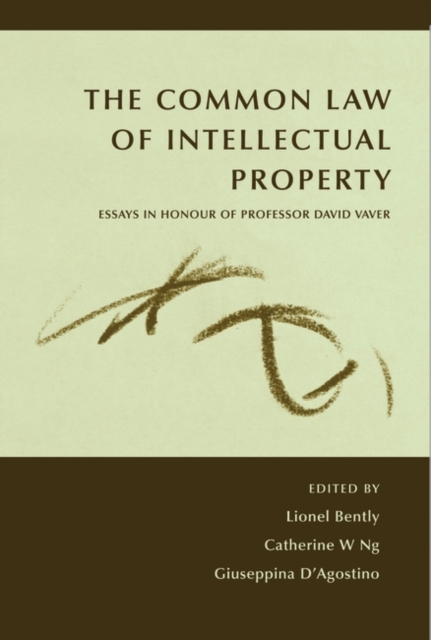
The Common Law of Intellectual Property
This collection of essays was written in honour of David Vaver, who recently retired as Professor of Intellectual Property and Information Technology Law and Director of the Oxford Intellectual Property Research Centre at the University of Oxford. The essays, written by some of the world’s leading academics, practitioners and judges in the field of intellectual property law, take as their starting point the common assumption that the patent, copyright and trade mark laws within members of the ‘common law family’ (Australia, Canada, Israel, Singapore, South Africa, the United Kingdom, the United States, and so on) share some sort of common tradition. The contributors examine, in relation to particular topics, the extent to which such a shared view of the field exists in the face of other forces that are producing divergence. The essays discuss, inter alia, issues concerning court practices, the medical treatment exception, non-obviousness and sufficiency in patent law, originality and exceptions in copyright law, unfair competition law, and cross-border goodwill and dilution in trade mark law.
eBook

The Confusion, Uncertainty, and Dissatisfaction with the Legal Protection of Newspaper and Periodical Titles in Nineteenth-Century England
As Victorian newspapers and periodicals proliferated and competition became increasingly fierce, proprietors recognised the importance and value of titles. This paper explores the legal protection available for these titles. It charts a period of uncertainty when the courts debated whether protection for titles was best understood as part of copyright law or as falling within the fast-evolving rules relating to the protection of trade marks. As legal clarity emerged deeming that titles could be protected by rules analogous to trade marks, publishers were faced with unpredictability as to precisely how those rules would be applied in the context of newspapers and periodicals. Reforms were suggested, but calls for a system of registering titles were unsuccessful.
Journal Article

Drassinower's Vision of Copyright
[...]Drassinower rarely offers abstract philosophical propositions. If a similar work (or even one that is virtually identical) comes from a different source, it is an independent act of communication or speech, distinct from but entitled to equal treatment with the earlier act of authorship. Because copyright law concerns \"communicative acts,\" for Drassinower one inherent limitation on the scope of copyright protection is that it cannot reach acts that do not have a communicative dimension.14 For this reason, mere copying is not prohibited, which Drassinower seeks to illustrate via the U.S. Supreme Court decision in Baker v. Seiden.\\nS.
Journal Article
Copyright and Piracy
An understanding of the changing nature of the law and practice of copyright infringement is a task too big for lawyers alone; it requires additional inputs from economists, historians, technologists, sociologists, cultural theorists and criminologists. Where is the boundary to be drawn between illegal imitation and legal inspiration? Would the answer be different for creators, artists and experts from different disciplines or fields? How have concepts of copyright infringement altered over time and how do such changes relate, if at all, to the cultural norms operating amongst creators in different fields? With such an approach, one might perhaps begin to address the vital and overarching question of whether strong copyright laws, rigorously enforced, impede rather than promote creativity. And what can be done to avoid any such adverse consequences, while maintaining the effectiveness of copyright as an incentive-mechanism for those who need it?
eBook

The Work of Authorship
What fresh perspectives can viewing copyright law through a humanities' looking glass bring to key notions of tomorrow's copyright law? Technological and economic concerns have long been the drivers of debate about copyright. But diverse disciplines in the humanities - including literary studies, aesthetics, film studies, and the philosophy of art - have a great deal to offer if we wish to establish a more nuanced and useful conception of copyright and authorship. This volume brings together scholars from a range of disciplines to explore the challenges inherent in translating aesthetics and creativity studies to concepts of copyright, especially as longstanding approaches are troubled by the rise of the digital.
eBook
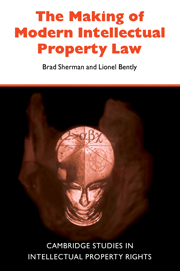
The Making of Modern Intellectual Property Law
One of the common themes in recent public debate has been the law's inability to accommodate the new ways of creating, distributing and replicating intellectual products. In this book the authors argue that in order to understand many of the problems currently confronting the law, it is necessary to understand its past. This is its first detailed historical account. In this book the authors explore two related themes. First, they explain why intellectual property law came to take its now familiar shape with sub-categories of patents, copyright, designs and trade marks. Secondly, the authors set out to explain how it is that the law grants property status to intangibles. In doing so they explore the rise and fall of creativity as an organising concept in intellectual property law, the mimetic nature of intellectual property law and the important role that the registration process plays in shaping intangible property.
eBook

The Making of Modern Intellectual Property Law
This book is the first detailed historical account of why intellectual property law with its sub-categories of patents, copyright, designs and trade marks took the shape that it did over the course of the nineteenth century. The authors also discuss ways in which the law grants property status to intangibles.
eBook