
Catalogue Search | MBRL


Are you sure you want to remove the book from the shelf?

{{itemTitle}}
72
result(s) for
"Beswick, Kim"
Sort by:


Teachers' beliefs about school mathematics and mathematicians' mathematics and their relationship to practice
There is broad acceptance that mathematics teachers' beliefs about the nature of mathematics influence the ways in which they teach the subject. It is also recognised that mathematics as practised in typical school classrooms is different from the mathematical activity of mathematicians. This paper presents case studies of two secondary mathematics teachers, one experienced and the other relatively new to teaching, and considers their beliefs about the nature of mathematics, as a discipline and as a school subject. Possible origins and future developments of the structures of their belief systems are discussed along with implications of such structures for their practice. It is suggested that beliefs about mathematics can usefully be considered in terms of a matrix that accommodates the possibility of differing views of school mathematics and the discipline.
Journal Article

Developing mathematics teachers' 21st century competence for teaching in STEM contexts
Teachers are increasingly being called upon to teach in ways that develop 21st century learning skills in their students. Various frameworks for 21st century learning have been proposed and while they differ, all agree on four components for development-creativity, collaboration, communication and critical thinking. Both individually and together, STEM subject areas contribute to the development and enactment of these skills through inquiry-based approaches to learning. Although integrated approaches to teaching the STEM disciplines afford enhanced opportunities to develop these skills, they rely on teachers having expertise in at least one and ideally more than one of the relevant underpinning disciplines. At a time when many countries are experiencing shortages of adequately qualified teachers of mathematics and some science disciplines, this presents an especially difficult challenge. Similarly, if teachers are to facilitate their students' 21st century competence they need to have this competence themselves-a fact that appears to have been largely ignored to date. In this paper we present a framework that enables novice teachers (novice to teaching in general, teaching a STEM discipline, or teaching integrated STEM) to think in detail about what they need to know, find out, or think about as they plan for teaching, enact teaching, and reflect on teaching. As well as explicating the complexity of the knowledge of teachers of individual and integrated STEM disciplines, the framework highlights the importance of teachers' own 21st century skills. Finally, we suggest ways in which teachers might use or adapt the framework to assist their students to develop their own 21st century competence. [Author abstract]
Journal Article

Mathematics teacher educator knowledge : What do we know and where to from here?
The knowledge that mathematics teacher educators need has attracted limited but increasing attention in recent years. The papers in this special issue build on emerging themes from that work and raise additional questions that contribute towards a future research agenda in the field. Several of the articles develop conceptualisations of teacher knowledge to apply to mathematics teacher educators, introducing new aspects and drawing attention to unique characteristics of mathematics teacher educators in the process. To some extent the questions these papers raise reflect similar questions in mathematics education more generally but for which the implications for mathematics teacher educators warrant attention. In this paper we review the articles in this special issue and use them as a springboard to examine contemporary developments in the field and posit ways forward for research on mathematics teacher educators' knowledge. [Author abstract]
Journal Article
Teaching teachers to teach Boris : a framework for mathematics teacher educator pedagogical content knowledge
The notion of pedagogical content knowledge (PCK) was posited in the context of school teaching and the knowledge used by teachers teaching school students. It has been examined for a number of discipline areas, notably mathematics. There are, however, other teaching contexts, including those of teacher educators, whose students are pre-service teachers (PSTs). The content these teacher educators teach is not subject discipline knowledge (or not solely), but the PCK for teaching a subject discipline. What knowledge do teacher educators use as they teach PCK? This paper presents a framework for the PCK required of mathematics teacher educators as they work to develop PSTs' PCK for teaching mathematics. The framework builds on existing research into PCK and categorises aspects of the work of teacher education. The framework's usefulness is examined by studying the PCK used by the first author in building PSTs' understanding of mathematics teacher PCK. [Author abstract]
Journal Article

Building STEM in Schools: An Australian Cross-case Analysis
The Principals as STEM Leaders (PASL) project was an Australian Government-funded national research and professional learning programme for principals, aimed at building STEM leadership capacity. The project involved cluster-based delivery of six learning modules and generation of case studies outlining schools' different approaches to STEM education and STEM leadership. This article analyses factors contributing to the development of four contrasting schools' STEM profiles, identifying the unique approaches and leadership strategies each adopted in designing STEM curriculum for meeting the learning needs of their diverse students. It positions these schools' endeavours within the broader PASL professional learning programme, adding to the limited body of empirical work detailing different approaches schools take to the "STEM challenge," which, for most, presents a disruptive innovation to traditional curriculum and structures. The vital role of school leaders in communicating a clear, evidence-based vision for STEM and also "walking the talk" and being highly engaged in STEM programmes, was a common feature across the cases. This built relational trust, and a strong whole-of-school commitment to and understanding of STEM, to some extent mitigating the challenges of rigid curriculum and external assessment requirements. The study highlights the complex interaction of professional learning, leadership, curriculum design, pedagogy, and school culture in establishing innovative STEM programmes in schools.
Journal Article
Assistance of students with mathematical learning difficulties : how can research support practice?
When looking at teaching and learning processes in mathematics education students with mathematical learning difficulties or disabilities are of great interest. To approach the question of how research can support practice to assist these students one has to clarify the group or groups of students that we are talking about. The following contribution firstly concentrates on the problem of labelling the group of students having mathematical difficulties as there does not exist a single definition. This problem might be put down to the different roots of mathematics education on the one hand and special education on the other hand. Research results with respect to concepts and models for instruction are multifaceted based on the specific content and mathematical topics as well as the underlying view of mathematics. Taking into account inclusive education, a closer orientation to mathematical education can be identified and the potential of selected teaching and learning concepts can be illustrated. Beyond this, the role of the teacher, their attitudes and beliefs and the corresponding teacher education programs are discussed. [Author abstract]
Journal Article

Teachers' beliefs related to secondary school completion : associations with socio-educational advantage and school level
This research used the responses of 187 Tasmanian teachers to a questionnaire comprising 52-Likert-type items, two multiple-choice items, and two open-response items to investigate differences in teachers' beliefs about aspects of schooling related to students' secondary school completion. Exploratory factor analysis of responses to the Likert-type items identified 3 factors underpinning teachers' responses. These were (1) Student and parent aspirations, (2) Teacher and school quality and support, and (3) Expectations for continuing education. Two-way ANOVAs showed that primary school teachers scored higher on average than secondary teachers for student and parent aspirations, and that there was an interaction between level of schooling and Index of Community Socio-Educational Advantage (ICSEA) for this factor. Descriptive statistics were used to compare responses to the multiple-choice items of teachers at different levels of ICSEA and schooling. Open-response items were categorised in two ways (1) as related to pastoral, academic, or engagement matters, and (2) as negative or positive in relation to each of students, parents, and teachers. The results highlighted less academic and more pastorally focussed cultures in Year 7-10 schools compared with Year 11-12 schools and relatively low expectations for university study across the levels of schooling. The findings implicate teachers' beliefs about students and their families as crucial to influencing educational aspirations and attainment. [Author abstract]
Journal Article

International Handbook of Mathematics Teacher Education
This fourth volume addresses teacher educators' knowledge, learning and practice with teachers/instructors of mathematics. It provides practical, professional and theoretical perspectives of different approaches/activities/programmes to promote effective teacher education practice, with valuable implications for research.
eBook
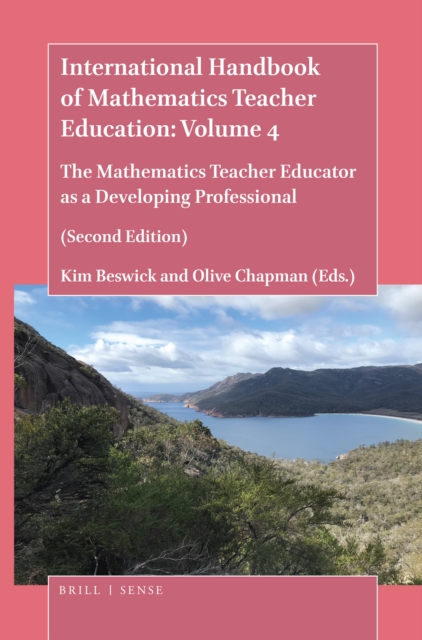
The mathematics teacher educator as a developing professional
\"This second edition of the International Handbook of Mathematics Teacher Education builds on and extends the topics/ideas in the first edition while maintaining the themes for each of the volumes. Collectively, the authors looked back beyond and within the last 10 years to establish the state-of-the-art and continuing and new trends in mathematics teacher and mathematics teacher educator education, and looked forward regarding possible avenues for teachers, teacher educators, researchers, and policy makers to consider to enhance and/or further investigate mathematics teacher and teacher educator learning and practice, in particular. The volume editors provide introductions to each volume that highlight the subthemes used to group related chapters, which offer meaningful lenses to see important connections within and across chapters. Readers can also use these subthemes to make connections across the four volumes, which, although presen
eBook