
Catalogue Search | MBRL


Are you sure you want to remove the book from the shelf?

{{itemTitle}}
106
result(s) for
"Bezanson, Kate"
Sort by:

Gender, the State, and Social Reproduction
Policies implemented in the mid to late 1990s in Ontario by Mike Harris’s Conservative government have had undeniable repercussions for the population of that province. Kate Bezanson’s Gender, the State, and Social Reproduction is the first study to consider the implications of those policies for gender relations – that is, how women and men, families, and households coped with these changes, and how division of labour and standards of living were affected. Bezanson also considers implications of neo-liberalism more generally, for the lives of people living under such regimes.
Beginning with an outline of the restructuring experiment which took place under the Conservative government between 1995 and 2000, Bezanson shows how this process dramatically altered the scope of the welfare state, labour market protections and conditions, and the capacity for people to manage and plan their own lives. She combines this detailed investigation of the changes introduced by Harris with data collected in in-depth interviews of selected Ontario households, in order to examine how neo-liberalism affects daily lives, particularly of low income people, and especially of women. Ultimately, Bezanson finds that the neo-liberal restructuring of Ontario in the 1990s consolidated a gender regime that was highly unsustainable for poor households, many of which were lead by women. A controversial and illuminating study, Gender, the State, and Social Reproduction crosses the disciplines of politics, history, gender studies, and sociology.
eBook

Social Reproduction
Contributors include Sedef Arat-Koç (Ryerson), Kate Bezanson (Brock), Susan Braedley, (PhD candidate, York), Barbara Cameron (York), Marcia Cohen (Canadian Centre for Policy Alternatives, BC), Marjorie Griffin Cohen (Simon Fraser), Bonnie Fox (Toronto), Meg Luxton (York), Leah F. Vosko (York), and Alice de Wolff (Toronto-based researcher and activist).
eBook
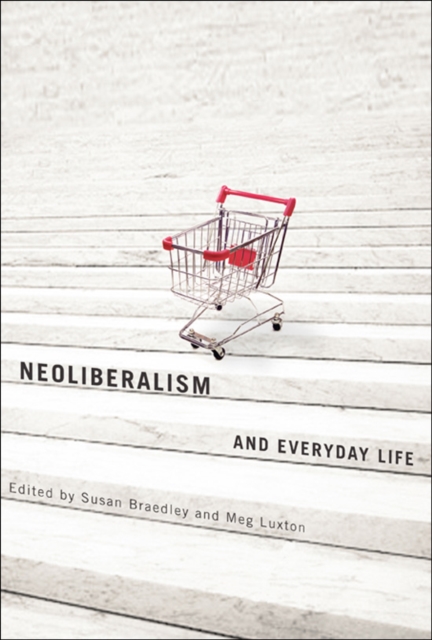
Neoliberalism and everyday life
Illuminating the ways in which neoliberal policies - such as the deregulation of economies and the transfer of governmental responsibilities to the private sector - have been implemented on a global scale, the contributors show how neoliberalism has seeped into our social and political fabric and affected our daily lives. Drawing attention to the most visible elements of neoliberalism in business, government, and personal life, reveal the ways in which policies designed to ensure market expansion also inevitably expand social inequalities of gender, race, class, and ability. Using a variety of methods, contributors discuss a range of topics, including globalization, privatization, health care, and the welfare state. An intelligent and informative collection that explains and challenges neoliberal policies, Neoliberalism and Everyday Life is an important assessment of a political system that makes profit easier and people's lives more difficult.
eBook


Gender and the Limits of Social Capital
Dans cet article, l'auteure examine l'intensification de l'intérêt envers le concept de capital social dans la politique publique au Canada et considère que ce concept est assez prometteur, en même temps qu'il entraînera des problèmes considérables, pour les femmes. Elle explique les paramètres du concept de capital social et tente de l'approfondir à l'aide de questions féministes essentielles sur l'économie politique. Cette approche jette les bases de la tâche primordiale d'associer un sexe au capital social, de telle sorte que les résultats des politiques dans le contexte canadien n'augmentent pas le fardeau du travail social et de prestation de soins de groupes déjà surcharges. This paper considers the rise in Canadian public policy interest in the concept of social capital, and suggests that the concept holds some promise, along with considerable problems, for women. It elucidates the parameters of the concept of social capital and attempts to deepen it with critical feminist political economy questions. It begins the crucial task of gendering social capital so that policy outcomes in the Canadian context do not increase the burden of social and caring work onto already overburdened groups.
Journal Article

Social Reproduction
Contributors include Sedef Arat-Koç (Ryerson), Kate Bezanson (Brock), Susan Braedley, (PhD candidate, York), Barbara Cameron (York), Marcia Cohen (Canadian Centre for Policy Alternatives, BC), Marjorie Griffin Cohen (Simon Fraser), Bonnie Fox (Toronto), Meg Luxton (York), Leah F. Vosko (York), and Alice de Wolff (Toronto-based researcher and activist).
eBook


Return of the Nightwatchman State?
On the tail of the global financial crisis of 2008, Canadians reelected Stephen Harper’s Conservatives to parliamentary office with a majority in the spring of 2011, in effect continuing Conservative rule since 2006. Although the economic crisis struck Canada with comparatively less force than it did the United States or some European Union nations, it worsened and multiplied existing poverty and disadvantage and cleared the terrain for a series of changes in federal scope and spending. In the Canadian case, and especially in a climate of economic uncertainty, the Conservative government’s project of open federalism laid the foundation for a
Book Chapter
Interactive Effects of Social Policy Change on Households
As participants tried to manage their incomes in an increasingly insecure labour market and social transfer environment, they had to contend with the erosion of the complementary supports of the welfare state. This chapter explores the new demands placed on household participants by investigating the interactions between insecure incomes, new or rising costs, and decreased access to social services. It shows that the need for social services, when cut, eliminated, or simply not provided, does not disappear but its provision is often shifted onto the work of women in households, who may or may not have the time and energy
Book Chapter
Coping Strategies of Low-Income Households
Despite a booming economy in the mid to late 1990s, the Ontario case study reveals that many household incomes and supports from market and state sources decreased with provincial government restructuring. This compromised the sustainability of household-based coping strategies along with household cohesion. It also undermined the capacity of women with children to form and maintain autonomous households, without having to enter into marriage or other relationships in order to survive.¹ The presumption in neo-liberal, state-level social policy is that the family/household will internalize and harmonize for its members the conflicts of income insecurity and insufficient welfare state supports. However,
Book Chapter