
Catalogue Search | MBRL


Are you sure you want to remove the book from the shelf?

{{itemTitle}}
20
result(s) for
"Bhacker, M. Reda"
Sort by:


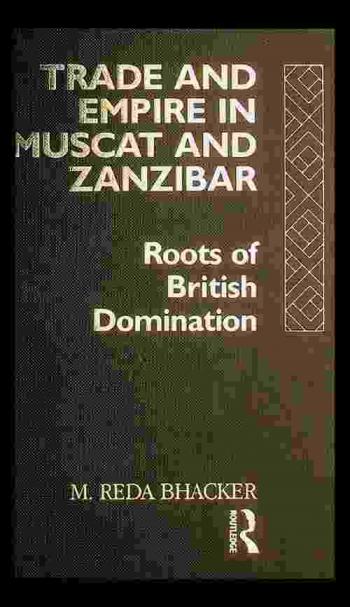
Trade and Empire in Muscat and Zanzibar
M. Reda Bhacker looks at the role of Oman in the Indian Ocean prior to British domination of the region. Omani merchant communities played a crucial part in the development of commercial activity throughout the territories they held in the eighteenth and nineteenth centuries, especially between Muscat and Zanzibar, using long established trade networks. They were also largely responsible for the integration of the commerce of the Indian Ocean into the nascent global capitalist system.
The author, himself a member of an important Omani merchant family, looks in detail at the complex relationship between the merchant community and Oman's rulers, first the Ya'ariba and then the Albusaidis. He analyses the tribal and religious dynamics of Omani politics both in Arabia, where he looks especially at the Wahhabi/Saudi threat, and in Oman's sprawling `empire', with particular reference to Zanzibar where the Omani ruler Sa'id b Sultan had his court from 1840. His aim is to consider all Oman's overseas territories as a single entity, without the usual misleading compartmentalisation of African and Arab history.
Dr Bhacker finds that despite their prestige and influence in the region neither the merchant communities nor the government were able to respond to Britain's determined onslaught. Bhacker traces the local and regional factors that allowed Britain to destroy Oman's largely commercial challenge and to emerge by the end of the nineteenth century as the commercially and politically dominant power in the region.
eBook


Family strife and foreign intervention: causes in the separation of Zanzibar from Oman: a reappraisal
The nineteenth-century rise of Zanzibar under the ruling Albusaidi Dynasty of Oman owed its origins primarily to the solid foundations of commercial activity laid down in Muscat in the preceding century. In the subsequent development of the Omani economy, in Omani territories in both Arabia and Africa where the dictates of the Omani political/tribal system did not allow for any centralization of authority, local communities and tribal groups resisted the domination of the Albusaidi rulers as they strove to bring under their own control the benefits of burgeoning trade. The opposition of the major Omani groups in East Africa, the Mazāri‘a of Mombasa and the Banū Nabhān of Pate, to the Albusaidis and the eventual success of the Omani rulers in dismantling and neutralizing this opposition are fairly well documented. However, the sustained challenge of Hilāl b. Sa‘īd to the reign of his father Sa‘īd b. Sulṭān, the Albusaidi ruler of Oman and Zanzibar and their dependencies from 1806 to 1856, has hitherto been neglected, despite the fact that Hilāl's resistance in East Africa was the greatest internal threat to Sa‘īd after that posed by the Mazāri'a and had dire consequences for the subsequent course of Oman's history. The conflict between father and son set in train a course of events that led inexorably to the 1861 British-sponsored dismemberment of Oman into two Sultanates, one in Arabia and the other in East Africa.
Journal Article
The suppression of Omani interests in the Gulf and the Albusaidi move to Zanzibar
THE QASIMI AND UTBI THREAT TO OMANI COMMERCE
Following the elimination of a number of prominent Ya’ariba leaders in
1816 Said b Sultan succeeded in reasserting his authority in Oman.
Although he had not yet won back the powerful al-Jabri over to his side,
he turned his attention to avenging the humiliation he had suffered at the
hands of the Qasimis a year before in 1815. His blockade of Ras-alKhayma for a period of four months in 1816 did not, however, enable
him even to retake Khawr Fakkan from them. No sooner had he returned
to Muscat than he prepared for yet another expedition under the guidance
of Shaykh Muhammad b Khalaf al-Shî’î, this time against Bahrain where
the Al-Khalîfa of the Utbis (‘Utûb) had ceased paying the transit tax and
the annual tribute due to Muscat.1
Book Chapter
The emergence of British policy towards Oman: 1798–1804
It was as early as 1624, at a time when the maritime outlets of the Indian
Ocean were under Portuguese control, that Muscat came to the fore and
started to feature in the commercial policies of the English East India
Company.1 Since merchants from the coastal settlements of Oman have
traded with ports on the Indian continent from time immemorial it is
hardly surprising that the English Company, based in Surat on the western
coast of India, should have soon come into contact with these ‘local’
merchants. Nor is it unusual that this company, with time, attempted to
forge alliances with these local merchants and their rulers in its struggle
to compete for the available trade with other European powers, mainly
the Portuguese and the Dutch.2 Prominent among the local merchants,
as already indicated, were Banyans from Gujarat who resided and traded
at Muscat in the early seventeenth century. But there were also Omani
merchants who lived in Surat and who were heavily involved in this
early commercial activity.3
Book Chapter
British policy towards Oman under the first Wahhabi threat: 1804–14
The political maelstrom into which Oman was plunged following Sultan
b Ahmad’s death in November 1804 accorded the tribal leaders in East
Africa a further opportunity to dissociate themselves from the Albusaid.
With Oman overrun by the Wahhabis and with no recognised Aibusaidi
successor the dominant Omani group in East Africa, the Mazaria of
Mombasa, did in fact try to expand their realm in the Lamu Archipelago.
But before turning to the situation in Africa we will first examine the
events in Arabia.
Book Chapter
The ‘Omani’ and the ‘Indian’ roles in the nineteenth-century commercial expansion
One of the difficulties faced by researchers in the nineteenth century
history of Zanzibar is the paucity of source material available before the
arrival of the Europeans and the North Americans. Apart from oral
traditions, Zanzibari written sources for that period are virtually nonexistent. As late as 1859 the British consul Rigby, in his attempt to unravel
the convoluted relationships of the Omani rulers with other members of
the Albusaid, let alone those with their Arab, Swahili, Indian or African
followers, was lamenting:Everything is arranged verbally in open Durbar; Arabs have a great
aversion to writing; no records of any sort are kept at Zanzibar, the
most important affairs are settled…without any written proceedings.1
Book Chapter
Post-1856 succession dispute and British intervention
None of the four principal sons of Said b Sultan-Thuwaynî and Turkî
in Oman, Majid and Barghash in East Africa-were uterine brothers.
The jealousy, treachery and hatred, the seeds of which had been sown by
the machinations and intrigues conducted in the corridors of power of
the harim (wives and concubines) by their respective mothers on their
behalf for Said b Sultan’s favours, added a further dimension to the
tradition of internecine feuding so engrained in the psyche of the Omani
tribal people. When Hilal, the eldest son [born c.1817], fell into disfavour
in 1844,1 his aunt Khurshîd, the Malabari woman, succeeded in her
designs to have her son Khalid [born c.1819]2 appointed ‘to be ruler
over all our possessions on the continent of Africa’.3
Book Chapter