
Catalogue Search | MBRL


Are you sure you want to remove the book from the shelf?

{{itemTitle}}
23
result(s) for
"Bickham, Troy O."
Sort by:
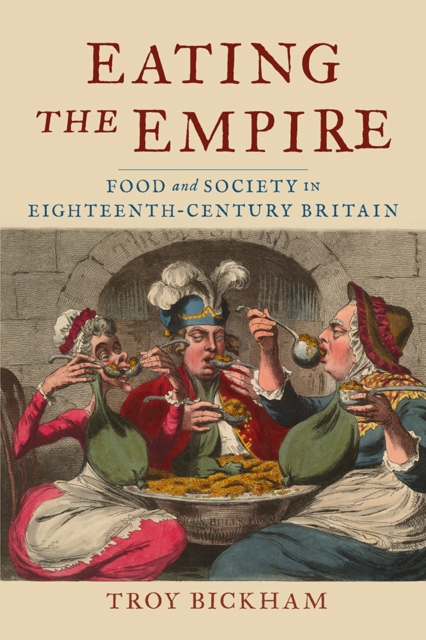
Eating the empire : food and society in eighteenth-century Britain
When students gathered in a London coffeehouse and smoked tobacco; when Yorkshire women sipped sugar-infused tea; or when a Glasgow family ate a bowl of Indian curry, were they aware of the mechanisms of imperial rule and trade that made such goods readily available? In Eating the Empire, Troy Bickham unfolds the extraordinary role that food played in shaping Britain during the long eighteenth century (circa 1660-1837), when such foreign goods as coffee, tea, and sugar went from rare luxuries to some of the most ubiquitous commodities in Britain-reaching even the poorest and remotest of households. Bickham reveals how trade in the empire's edibles underpinned the emerging consumer economy, fomenting the rise of modern retailing, visual advertising, and consumer credit, and, via taxes, financed the military and civil bureaucracy that secured, governed, and spread the British Empire.
eBook

The weight of vengeance : the United States, the British empire, and the War of 1812
By placing the War of 1812 in a global context, Troy Bickham narrates America's bid for postcolonial sovereignty and Britain's attempt to block it, a conflict that put the fate of North America and Britain's global supremacy on the line.
eBook
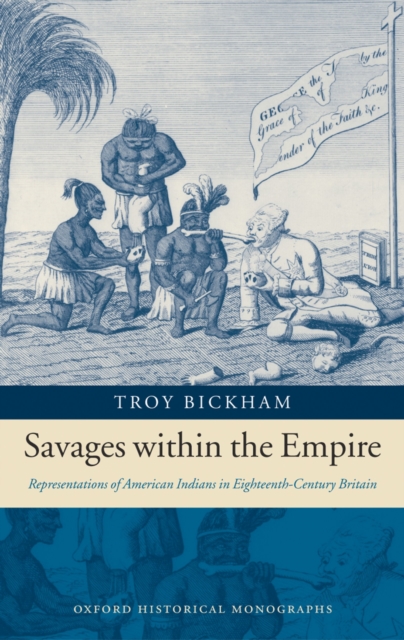
Savages within the empire : representations of American Indians in eighteenth-century Britain
In 1720s London, a well-known band of young ruffians gave themselves crescent tattoos and adorned turbans in honour of their so-called 'mohamattan [Muslim]' Indian namesakes, the Mohawk. Few Britons noticed the gang's mistaken muddling of North American and Indian subcontinent geographies and cultures. Even fewer cared in an age in which 'Indian' was a catch-all term applied to theatre characters, philosophies, and objects whose only common characteristic often was that they were not European. Yet just thirty years later, when the North American empire had entered centre stage, Londoners bought Iroquois tomahawks at auctions; provincial newspapers debated Cherokee politics; women shopkeepers read aloud newspaper accounts of frontier battles as their husbands counted the takings; church congregations listened to the sermons of American Indian converts; families toured museum exhibits of American Indian artefacts; and Oxford dons wagered their bottles of port on the outcome of American wars. Focusing on the question, 'How did the British who remained in Britain perceive American Indians, and how did these perceptions reflect and affect British culture?', Savages within the Empire explores both how Britons engaged with the peripheries of their Atlantic empire without leaving home, and, equally important, how their forged understanding significantly affected the British and their rapidly expanding world. It draws from a wide range of evidence to consider an array of eighteenth-century contexts, including material culture, print culture, imperial government policy, the Church of England's missionary endeavours, the Scottish Enlightenment, and the public outcry over the use of American Indians as allies during the American War of Independence. By chronicling and exploring discussions and representations of American Indians in these contexts, Troy Bickham reveals the proliferation of empire-related subjects in eighteenth-century British culture as well as the prevailing pragmatism with which Britons approached them.
eBook

Sympathizing with Sedition? George Washington, the British Press, and British Attitudes during the American War of Independence
Throughout the American Revolution, the press in Britain portrayed the commander of the rebel army as a model of citizen virtue and an ideal military leader. George Washington was seen as the American Cincinnatus.
Journal Article

\A Conviction of the Reality of Things\: Material Culture, North American Indians and Empire in Eighteenth-Century Britain
This article explores how eighteenth-century Britons use material culture to engage, explain and justify their empire. Focusing primarily on North American Indian-related objects, it examines both how Britons exhibited these sorts of ethnographic materials in museums, coffeehouses, and auctions and how audiences interacted with the displays. Material displays reached audiences outside the social parameters of the much-explored imperial discourse in print culture, such as families and children, and their popularity further indicates that interest in the wider world was a practice and not merely a prescription. Such public material exhibitions ultimately assisted in the formation of an increasingly imperial, globally-minded society by fostering a set of acceptable, shared views of alien cultures and their relationships with Britain.
Journal Article


Conciliation—Compulsion—Conversion: British Attitudes towards Indigenous Peoples, 1763–1814
Bickham reviews Conciliation--Compulsion--Conversion: British Attitudes towards Indigenous Peoples, 1763-1814 by Merete Falck Borch.
Book Review