
Catalogue Search | MBRL


Are you sure you want to remove the book from the shelf?

{{itemTitle}}
5
result(s) for
"Bisang, Walter, editor"
Sort by:
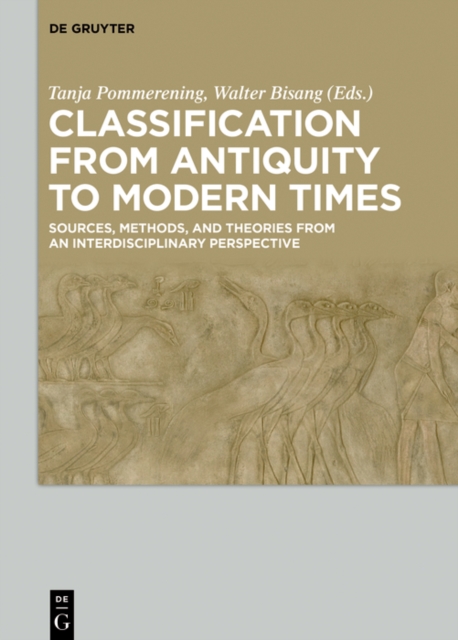
Classification from Antiquity to Modern Times
The volume presents phenomena of classification and categorisation in ancient and modern cultures and provides an overview of how cultural practices and cognitive systems interact when individuals or larger groups conceptually organize their world. Scientists of antiquity studies, anthropologists, linguists etc. will find methods to reconstruct early concepts of men and nature from a synchronic and diachronic comparative perspective.
eBook
Paradigm change : in the Transeurasian languages and beyond
The paper reviews the data concerning the nominal inflectional morphology in the chain of languages comprising Uralic, Turkic, Mongolic, Tungusic, Koreanic and Japonic, collectively termed \"Ural-Altaic\". Although nominal morphology has traditionally been quoted in support of the hypothesis concerning the genetic relationship of these languages, a more detailed survey of the data shows that the extant parallels are in various ways secondary and/or accidental. This suggests that Ural-Altaic is an areal and typological complex of languages, but not a genetic entity. On the other hand, it is also evident that much of the synchronically observed nominal morphology in the languages of this complex is relatively recent. The only examples of potentially relevant inter-family morphological parallels can be found between Mongolic and Tungusic.
eBook
What makes Grammaticalization?
The status of grammaticalization has been the subject of many controversial discussions. The contributions to What makes Grammaticalization? approach the prevalent phenomenon from the angle of language structure and focus on the interrelation between the levels of phonology, pragmatics (inference), discourse and the lexicon and some of them try to integrate the areal perspective. A wealth of data from Slavonic languages as well as from languages of other genetic and areal affiliation is discussed. The book is of interest to linguists specializing in grammaticalization, lexicalization and morphological typology, to language typologists as well as to functional, historical and cognitive linguists.
eBook
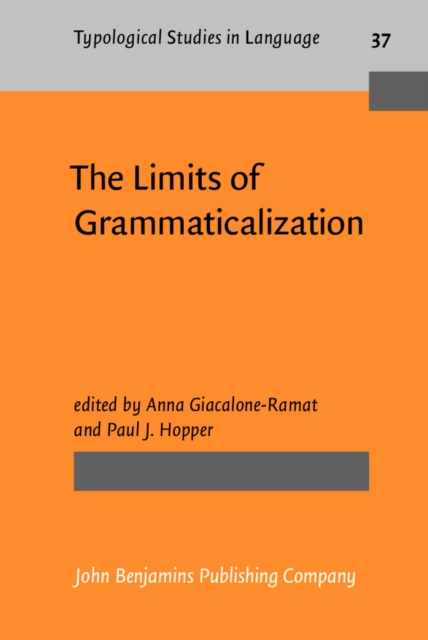
The Limits of Grammaticalization
The earliest use of the term \"grammaticalization\" was to refer to the process whereby lexical words of a language (such as English keep in \"he keeps bees\") become grammatical forms (such as the auxiliary in \"he keeps looking at me\"). Changes of this kind, which involve semantic fading and a downshift from a major to a minor category, have generally been agreed to come under the heading of grammaticalization. But other changes that equally contribute to new grammatical forms do not involve this kind of fading. In recent years, a debate has arisen over how to constrain the term theoretically. Is grammaticalization to be distinguished from \"lexicalization\", the creation and fixing of new words out of older patterns of compounding? If so, how is the line to be drawn between a form that is grammatical and one that is lexical? Should the term \"grammaticalization\" be extended to the study of the origins of grammatical constructions in general? If so, it will have to include broader issues such as word order change and the reanalysis of phrases. What principles govern these processes? Is grammaticalization a unidirectional event, or can change occur in the reverse direction? The authors of the papers in this volume approach these important questions from a variety of data types, including historical texts, creoles, and a typologically broad sample of modern and ancient languages.
eBook