
Catalogue Search | MBRL


Are you sure you want to remove the book from the shelf?

{{itemTitle}}
1,008
result(s) for
"Board, Space Studies"
Sort by:

Vision and Voyages for Planetary Science in the Decade 2013-2022
In recent years, planetary science has seen a tremendous growth in new knowledge. Deposits of water ice exist at the Moon's poles. Discoveries on the surface of Mars point to an early warm wet climate, and perhaps conditions under which life could have emerged. Liquid methane rain falls on Saturn's moon Titan, creating rivers, lakes, and geologic landscapes with uncanny resemblances to Earth's.
Vision and Voyages for Planetary Science in the Decade 2013-2022 surveys the current state of knowledge of the solar system and recommends a suite of planetary science flagship missions for the decade 2013-2022 that could provide a steady stream of important new discoveries about the solar system. Research priorities defined in the report were selected through a rigorous review that included input from five expert panels. NASA's highest priority large mission should be the Mars Astrobiology Explorer Cacher (MAX-C), a mission to Mars that could help determine whether the planet ever supported life and could also help answer questions about its geologic and climatic history. Other projects should include a mission to Jupiter's icy moon Europa and its subsurface ocean, and the Uranus Orbiter and Probe mission to investigate that planet's interior structure, atmosphere, and composition. For medium-size missions, Vision and Voyages for Planetary Science in the Decade 2013-2022 recommends that NASA select two new missions to be included in its New Frontiers program, which explores the solar system with frequent, mid-size spacecraft missions. If NASA cannot stay within budget for any of these proposed flagship projects, it should focus on smaller, less expensive missions first.
Vision and Voyages for Planetary Science in the Decade 2013-2022 suggests that the National Science Foundation expand its funding for existing laboratories and establish new facilities as needed. It also recommends that the program enlist the participation of international partners. This report is a vital resource for government agencies supporting space science, the planetary science community, and the public.
eBook

Solar and Space Physics
From the interior of the Sun, to the upper atmosphere and near-space environment of Earth, and outward to a region far beyond Pluto where the Sun's influence wanes, advances during the past decade in space physics and solar physics-the disciplines NASA refers to as heliophysics-have yielded spectacular insights into the phenomena that affect our home in space.
Solar and Space Physics , from the National Research Council's (NRC's) Committee for a Decadal Strategy in Solar and Space Physics, is the second NRC decadal survey in heliophysics. Building on the research accomplishments realized during the past decade, the report presents a program of basic and applied research for the period 2013-2022 that will improve scientific understanding of the mechanisms that drive the Sun's activity and the fundamental physical processes underlying near-Earth plasma dynamics, determine the physical interactions of Earth's atmospheric layers in the context of the connected Sun-Earth system, and enhance greatly the capability to provide realistic and specific forecasts of Earth's space environment that will better serve the needs of society.
Although the recommended program is directed primarily at NASA and the National Science Foundation for action, the report also recommends actions by other federal agencies, especially the parts of the National Oceanic and Atmospheric Administration charged with the day-to-day (operational) forecast of space weather. In addition to the recommendations included in this summary, related recommendations are presented in this report.
eBook
Technical Evaluation of the NASA Model for Cancer Risk to Astronauts Due to Space Radiation
NASA's current missions to the International Space Station (ISS) and potential future exploration missions involving extended stays by astronauts on the lunar surface, as well as the possibility of near- Earth object (NEO) or Mars missions, present challenges in protecting astronauts from radiation risks. These risks arise from a number of sources, including solar particle events (SPEs), galactic cosmic rays (GCRs), secondary radiation from surface impacts, and even the nuclear isotope power sources transported with the astronauts. The serious early and late radiation health effects potentially posed by these exposures are equally varied, ranging from early signs of radiation sickness to cancer induction. Other possible effects include central nervous system damage, cataracts, cardiovascular damage, heritable effects, impaired wound healing, and infertility.
Recent research, much of which has been sponsored by NASA, has focused on understanding and quantifying the radiation health risks posed by space radiation environments. Although many aspects of the space radiation environments are now relatively well characterized, important uncertainties still exist regarding biological effects and thus regarding the level and types of risks faced by astronauts.
This report presents an evaluation of NASA's proposed space radiation cancer risk assessment model, which is described in the 2011 NASA report, Space Radiation Cancer Risk Projections and Uncertainties-2010 . The evaluation in Technical Evaluation of the NASA Model for Cancer Risk to Astronauts Due to Space Radiation considers the model components, input data (for the radiation types, estimated doses, and epidemiology), and the associated uncertainties. This report also identifies gaps in NASA's current research strategy for reducing the uncertainties in cancer induction risks.
eBook
The Space Science Decadal Surveys
The National Research Council has conducted 11 decadal surveys in the Earth and space sciences since 1964 and released the latest four surveys in the past 8 years. The decadal surveys are notable in their ability to sample thoroughly the research interest, aspirations, and needs of a scientific community. Through a rigorous process, a primary survey committee and thematic panels of community members construct a prioritized program of science goals and objectives and define an executable strategy for achieving them. These reports play a critical role in defining the nation's agenda in that science area for the following 10 years, and often beyond.
The Space Science Decadal Surveys considers the lessons learned from previous surveys and presents options for possible changes and improvements to the process, including the statement of task, advanced preparation, organization, and execution. This report discusses valuable aspects of decadal surveys that could taken further, as well as some challenges future surveys are likely to face in searching for the richest areas of scientific endeavor, seeking community consensus of where to go next, and planning how to get there. The Space Science Decadal Surveys describes aspects in the decadal survey prioritization process, including balance in the science program and across the discipline; balance between the needs of current researchers and the development of the future workforce; and balance in mission scale - smaller, competed programs versus large strategic missions.
eBook
Lessons Learned in Decadal Planning in Space Science
The National Research Council (NRC) has been conducting decadal surveys in the Earth and space sciences since 1964, and released the latest five surveys in the past 5 years, four of which were only completed in the past 3 years. Lessons Learned in Decadal Planning in Space Science is the summary of a workshop held in response to unforseen challenges that arose in the implementation of the recommendations of the decadal surveys. This report takes a closer look at the decadal survey process and how to improve this essential tool for strategic planning in the Earth and space sciences. Workshop moderators, panelists, and participants lifted up the hood on the decadal survey process and scrutinized every element of the decadal surveys to determine what lessons can be gleaned from recent experiences and applied to the design and execution of future decadal surveys.
eBook
Lessons Learned in the Implementation of NASA's Earth Venture Class
The NASA Science Mission Directorate/Earth Science Division's (SMD/ESD's) Earth Venture (EV) is a program element within the Earth System Science Pathfinder Program. At the request of NASA, this report examines the Earth Venture Instrument (EV-I) and Earth Venture Mission (EV-M) elements of Earth Ventures and explores lessons learned in the more than 10 years since selection of the first EV mission, including a review of the foundational principles and approaches underlying the program.
eBook

Sharing the Adventure with the Student
On December 2-3, 2014, the Space Studies Board and the Board on Science Education of the National Research Council held a workshop on the NASA Science Mission Directorate (SMD) education program - \"Sharing the Adventure with the Student.\" The workshop brought together representatives of the space science and science education communities to discuss maximizing the effectiveness of the transfer of knowledge from the scientists supported by NASA's SMD to K-12 students directly and to teachers and informal educators. The workshop focused not only on the effectiveness of recent models for transferring science content and scientific practices to students, but also served as a venue for dialogue between education specialists, education staff from NASA and other agencies, space scientists and engineers, and science content generators. Workshop participants reviewed case studies of scientists or engineers who were able to successfully translate their research results and research experiences into formal and informal student science learning. Education specialists shared how science can be translated to education materials and directly to students, and teachers shared their experiences of space science in their classrooms. Sharing the Adventure with the Student is the summary of the presentation and discussions of the workshop.
eBook
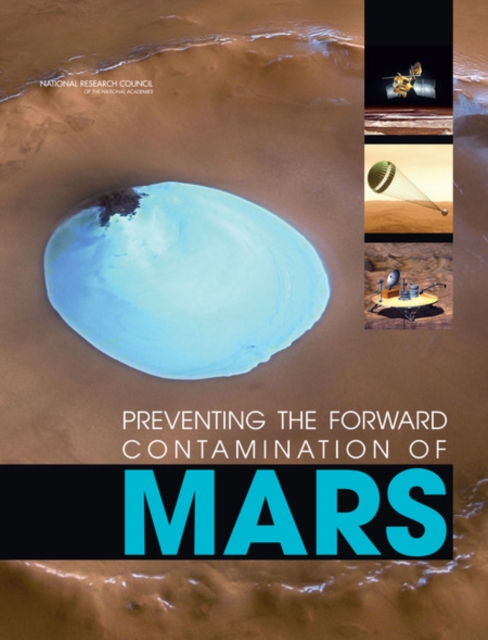
Preventing the Forward Contamination of Mars
Recent spacecraft and robotic probes to Mars have yielded data that are changing our understanding significantly about the possibility of existing or past life on that planet. Coupled with advances in biology and life-detection techniques, these developments place increasing importance on the need to protect Mars from contamination by Earth-borne organisms. To help with this effort, NASA requested that the NRC examine existing planetary protection measures for Mars and recommend changes and further research to improve such measures. This report discusses policies, requirements, and techniques to protect Mars from organisms originating on Earth that could interfere with scientific investigations. It provides recommendations on cleanliness and biological burden levels of Mars-bound spacecraft, methods to reach those levels, and research to reduce uncertainties in preventing forward contamination of Mars.
eBook
Open Source Software Policy Options for NASA Earth and Space Sciences
Modern science is ever more driven by computations and simulations. In particular, the state of the art in space and Earth science often arises from complex simulations of climate, space weather, and astronomical phenomena. At the same time, scientific work requires data processing, presentation, and analysis through broadly available proprietary and community software.1 Implicitly or explicitly, software is central to science. Scientific discovery, understanding, validation, and interpretation are all enhanced by access to the source code of the software used by scientists.
This report investigates and recommends options for NASA's Science Mission Directorate (SMD) as it considers how to establish a policy regarding open source software to complement its existing policy on open data. In particular, the report reviews existing data and software policies and the lessons learned from the implementation of those policies, summarizes community perspectives, and presents policy options and recommendations for implementing an open source software policy for NASA SMD.
eBook