
Catalogue Search | MBRL


Are you sure you want to remove the book from the shelf?

{{itemTitle}}
96
result(s) for
"Bobel, Chris"
Sort by:


New Blood
New Bloodoffers a fresh interdisciplinary look at feminism-in-flux. For over three decades, menstrual activists have questioned the safety and necessity of feminine care products while contesting menstruation as a deeply entrenched taboo. Chris Bobel shows how a little-known yet enduring force in the feminist health, environmental, and consumer rights movements lays bare tensions between second- and third-wave feminisms and reveals a complicated story of continuity and change within the women's movement.Through her critical ethnographic lens, Bobel focuses on debates central to feminist thought (including the utility of the category \"gender\") and challenges to building an inclusive feminist movement. Filled with personal narratives, playful visuals, and original humor,New Bloodreveals middle-aged progressives communing in Red Tents, urban punks and artists \"culture jamming\" commercial menstrual products in their zines and sketch comedy, queer anarchists practicing DIY health care, African American health educators espousing \"holistic womb health,\" and hopeful mothers refusing to pass on the shame to their pubescent daughters. With verve and conviction, Bobel illuminates today's feminism-on-the-ground--indisputably vibrant, contentious, and ever-dynamic.
eBook


Menstrual health: a definition for policy, practice, and research
The term \"menstrual health\" has seen increased use across advocacy, programming, policy, and research, but has lacked a consistent, self-contained definition. As a rapidly growing field of research and practice a comprehensive definition is needed to (1) ensure menstrual health is prioritised as a unified objective in global health, development, national policy, and funding frameworks, (2) elucidate the breadth of menstrual health, even where different needs may be prioritised in different sectors, and (3) facilitate a shared vocabulary through which stakeholders can communicate across silos to share learning. To achieve these aims, we present a definition of menstrual health developed by the Terminology Action Group of the Global Menstrual Collective. We describe the definition development process, drawing on existing research and terminology, related definitions of health, and consultation with a broad set of stakeholders. Further, we provide elaboration, based on current evidence, to support interpretation of the definition.
Journal Article

Body Battlegrounds
Body Battlegrounds explores the rich and complex lives of
society's body outlaws-individuals from myriad social locations who
oppose hegemonic norms, customs, and conventions about the body.
Original research chapters (based on textual analysis, qualitative
interviews, and participant observation) along with personal
narratives provide a window into the everyday lives of people
rewriting the norms of embodiment in sites like schools, sporting
events, and doctors' offices. Table of Contents
Introduction | Chris Bobel and Samantha Kwan Part I:
Going \"Natural\" • Body Hair Battlegrounds: The
Consequences, Reverberations, and Promises of Women Growing Their
Leg, Pubic, and Underarm Hair | Breanne Fahs • Radical
Doulas, Childbirth Activism, and the Politics of Embodiment |
Monica Basile • Caring for the Corpse: Embodied Transgression
and Transformation in Home Funeral Advocacy | Anne Esacove
Living Resistance: • Deconstructing Reconstructing: Challenging
Medical Advice Following Mastectomy | Joanna Rankin • My
Ten-Year Dreadlock Journey: Why I Love the \"Kink\" in My Hair . . .
Today | Cheryl Thompson • Living My Full Life: My
Rejecting Weight Loss as an Imperative for Recovery from Binge
Eating Disorder | Christina Fisanick • Pretty Brown:
Encounters with My Skin Color | Praveena Lakshmanan Part II:
Representing Resistance • Blood as Resistance:
Photography as Contemporary Menstrual Activism | Shayda Kafai
• Am I Pretty Enough for You Yet?: Resistance through Parody in
the Pretty or Ugly YouTube Trend | Katherine Phelps • The
Infidel in the Mirror: Mormon Women's Oppositional Embodiment
| Kelly Grove and Doug Schrock Living Resistance: • A Cystor's
Story: Polycystic Ovarian Syndrome and the Disruption of Normative
Femininity | Ledah McKellar • Old Bags Take a Stand: A
Face Off with Ageism in America | Faith Baum and Lori Petchers
• Making Up with My Body: Applying Cosmetics to Resist
Disembodiment | Haley Gentile • I Am a Person Now: Autism,
Indistinguishability, and (Non)optimal Outcome | Alyssa
Hillary Part III: Creating Community, Disrupting
Assumptions • Yelling and Pushing on the Bus: The
Complexity of Black Girls' Resistance | Stephanie D. Sears and
Maxine Leeds Craig • Big Gay Men's Performative Protest Against
Body Shaming: The Case of Girth and Mirth | Jason Whitesel
• \"What's Love Got to Do with It?\": The Embodied Activism of
Domestic Violence Survivors on Welfare | Sheila M. Katz Living
Resistance: • \"Your Signing Is So Beautiful!\": The Radical
Invisibility of ASL Interpreters in Public | Rachel Kolb •
Two Shakes | Rev. Adam Lawrence Dyer • \"Showing Our
Muslim\": Embracing the Hijab in the Era of Paradox | Sara
Rehman • \"Doing Out\": A Black Dandy Defies Gender Norms in the
Bronx | Mark Broomfield • Everybody: Making Fat Radio for
All of Us | Cat Pausé Part IV: Transforming Institutions
and Ideologies • Embodying Nonexistence: Encountering
Mono- and Cisnormativities in Everyday Life | J. E. Sumerau
• Freeing the Nipple: Encoding the Heterosexual Male Gaze into
Law | J. Shoshanna Ehrlich • Give Us a Twirl: Male Baton
Twirlers' Embodied Resistance in a Feminized Terrain | Trenton
M. Haltom • \"That Gentle Somebody\": Rethinking Black Female
Same-Sex Practices and Heteronormativity in Contemporary South
Africa | Taylor Riley Living Resistance:
eBook
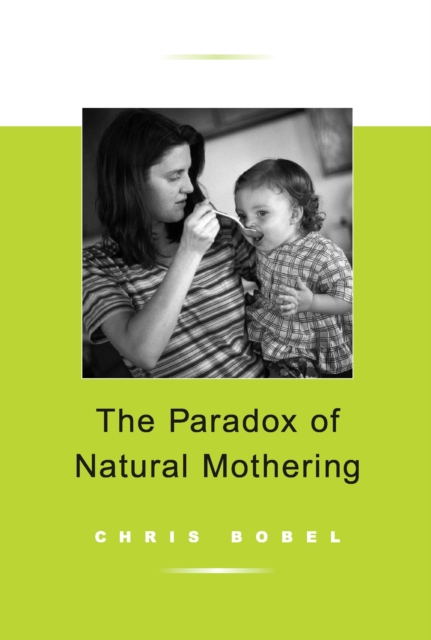
Paradox Of Natural Mothering
Single or married, working mothers are, if not the norm, no longer exceptional. These days, women who stay at home to raise their children seem to be making a radical lifestyle choice. Indeed, the women at the center of The Paradox of Natural Mothering have renounced consumerism and careerism in order to reclaim home and family. These natural mothers favor parenting practices that set them apart from the mainstream: home birth, extended breast feeding, home schooling and natural health care. Regarding themselves as part of a movement, natural mothers believe they are changing society one child, one family at a time.Author Chris Bobel profiles some thirty natural mothers, probing into their choices and asking whether they are reforming or conforming to women's traditional role. Bobel's subjects say that they have chosen to follow their nature rather than social imperatives. Embracing such lifestyle alternatives as voluntary simplicity and attachment parenting, they place family above status and personal achievement. Bobel illuminates the paradoxes of natural mothering, the ways in which these women resist the trappings of upward mobility but acquiesce to a kind of biological determinism and conventional gender scripts.
eBook

“Our Revolution Has Style”: Contemporary Menstrual Product Activists “Doing Feminism” in the Third Wave
An in-depth content analysis of five web sites and eight paper zines (self-produced and distributed magazines) was conducted to uncover the inspiration, content, and unique strategies associated with text -based contemporary menstrual product activism. Menstrual product activism is loosely defined as various attempts to expose the hazards of commercial \"feminine protection\" to both women's bodies and the environment and the promotion of healthier, less expensive, and less resource-intensive alternatives. This activism's discourse draws on many traditions to produce its resistance to mainstream menses management. The movement, first and foremost, is the legacy of several decades of related activism, dating to the mid-1970s. Contemporary menstrual product activism updates and modifies this tradition with the \"do it yourself\" ethic and anti-corporate philosophy of Punk culture and Third Wave feminist ideals of anti-essentialism, inclusion, humor, irony, and reappropriation. To date, this activist agenda has received little scholarly attention, yet it promises to yield meaningful insight into so called Third Wave feminist theory and practice and reveal the resilience of a woman-centered modern history of resistance. Adapted from the source document.
Journal Article


The paradox of natural mothering
Single or married, working mothers are, if not the norm, no longer exceptional. These days, women who stay at home to raise their children seem to be making a radical lifestyle choice. Indeed, the women at the center of The Paradox of Natural Mothering have renounced consumerism and careerism in order to reclaim home and family. These natural mothers favor parenting practices that set them apart from the mainstream: home birth, extended breast feeding, home schooling and natural health care. Regarding themselves as part of a movement, natural mothers believe they are changing society one child, one family at a time.
Author Chris Bobel profiles some thirty natural mothers, probing into their choices and asking whether they are reforming or conforming to women's traditional role. Bobel's subjects say that they have chosen to follow their nature rather than social imperatives. Embracing such lifestyle alternatives as voluntary simplicity and attachment parenting, they place family above status and personal achievement. Bobel illuminates the paradoxes of natural mothering, the ways in which these women resist the trappings of upward mobility but acquiesce to a kind of biological determinism and conventional gender scripts.
eBook
