
Catalogue Search | MBRL


Are you sure you want to remove the book from the shelf?

{{itemTitle}}
179
result(s) for
"Bogost, Ian"
Sort by:


Racing the Beam
The Atari Video Computer System dominated the home video game market so completely that \"Atari\" became the generic term for a video game console. The Atari VCS was affordable and offered the flexibility of changeable cartridges. Nearly a thousand of these were created, the most significant of which established new techniques, mechanics, and even entire genres. This book offers a detailed and accessible study of this influential video game console from both computational and cultural perspectives. Studies of digital media have rarely investigated platforms--the systems underlying computing. This book (the first in a series of Platform Studies) does so, developing a critical approach that examines the relationship between platforms and creative expression. Nick Montfort and Ian Bogost discuss the Atari VCS itself and examine in detail six game cartridges: Combat, Adventure, Pac-Man, Yars' Revenge, Pitfall!, and Star Wars: The Empire Strikes Back. They describe the technical constraints and affordances of the system and track developments in programming, gameplay, interface, and aesthetics. Adventure, for example, was the first game to represent a virtual space larger than the screen (anticipating the boundless virtual spaces of such later games as World of Warcraft and Grand Theft Auto), by allowing the player to walk off one side into another space; and Star Wars: The Empire Strikes Back was an early instance of interaction between media properties and video games. Montfort and Bogost show that the Atari VCS--often considered merely a retro fetish object--is an essential part of the history of video games.
eBook


How to Talk about Videogames
Videogames! Aren't they the medium of the twenty-first century? The new cinema? The apotheosis of art and entertainment, the realization of Wagnerian gesamtkunstwerk? The final victory of interaction over passivity? No, probably not. Games are part art and part appliance, part tableau and part toaster. InHow to Talk about Videogames, leading critic Ian Bogost explores this paradox more thoroughly than any other author to date.
Delving into popular, familiar games likeFlappy Bird, Mirror's Edge, Mario Kart, Scribblenauts, Ms. Pac-Man, FarmVille, Candy Crush Saga, Bully, Medal of Honor, Madden NFL, and more, Bogost posits that videogames are as much like appliances as they are like art and media. We don't watch or read games like we do films and novels and paintings, nor do we perform them like we might dance or play football or Frisbee. Rather, we do something in-between with games. Games are devices we operate, so game critique is both serious cultural currency and self-parody. It is about figuring out what it means that a game works the way it does and then treating the way it works as if it were reasonable, when we know it isn't.
Noting that the termgames criticismonce struck him as preposterous, Bogost observes that the idea, taken too seriously, risks balkanizing games writing from the rest of culture, severing it from the \"rivers and fields\" that sustain it. As essential as it is, he calls for its pursuit to unfold in this spirit: \"God save us from a future of games critics, gnawing on scraps like the zombies that fester in our objects of study.\"
eBook

Play anything : the pleasure of limits, the uses of boredom, and the secret of games
\"Life is boring: filled with meetings and traffic, errands and emails. Nothing we'd ever call fun. But what if we've gotten fun wrong? In Play Anything, visionary game designer and philosopher Ian Bogost shows how we can overcome our daily anxiety; transforming the boring, ordinary world around us into one of endless, playful possibilities. The key to this playful mindset lies in discovering the secret truth of fun and games. Play Anything, reveals that games appeal to us not because they are fun, but because they set limitations. Soccer wouldn't be soccer if it wasn't composed of two teams of eleven players using only their feet, heads, and torsos to get a ball into a goal; Tetris wouldn't be Tetris without falling pieces in characteristic shapes. Such rules seem needless, arbitrary, and difficult. Yet it is the limitations that make games enjoyable, just like it's the hard things in life that give it meaning. Play is what happens when we accept these limitations, narrow our focus, and, consequently, have fun. Which is also how to live a good life. Manipulating a soccer ball into a goal is no different than treating ordinary circumstances- like grocery shopping, lawn mowing, and making PowerPoints-as sources for meaning and joy. We can \"play anything\" by filling our days with attention and discipline, devotion and love for the world as it really is, beyond our desires and fears. Ranging from Internet culture to moral philosophy, ancient poetry to modern consumerism, Bogost shows us how today's chaotic world can only be tamed-and enjoyed-when we first impose boundaries on ourselves\"-- Provided by publisher.
Book

WHY GAMIFICATION IS BULLSHIT
In his tiny treatiseOn Bullshit, the moral philosopher Harry Frankfurt (2005) gives us a useful theory of bullshit. We normally think of bullshit as a synonym—albeit a somewhat vulgar one—for lies or deceit. But Frankfurt argues that bullshit has nothing to do with truth. Rather, bullshit is used to conceal, to impress, or to coerce. Unlike liars, bullshitters have no use for the truth. All that matters to them is hiding their ignorance or bringing about their own benefit.
In a short position statement presented at a small, invitation-only conference on gamification at the University of Pennsylvania’s
Book Chapter

Alien Phenomenology, or What It’s Like to Be a Thing
Humanity has sat at the center of philosophical thinking for too long. The recent advent of environmental philosophy and posthuman studies has widened our scope of inquiry to include ecosystems, animals, and artificial intelligence. Yet the vast majority of the stuff in our universe, and even in our lives, remains beyond serious philosophical concern.
InAlien Phenomenology, or What It's Like to Be a Thing, Ian Bogost develops an object-oriented ontology that puts things at the center of being-a philosophy in which nothing exists any more or less than anything else, in which humans are elements but not the sole or even primary elements of philosophical interest. And unlike experimental phenomenology or the philosophy of technology, Bogost's alien phenomenology takes for granted thatallbeings interact with and perceive one another. This experience, however, withdraws from human comprehension and becomes accessible only through a speculative philosophy based on metaphor.
Providing a new approach for understanding the experience of thingsasthings, Bogost also calls on philosophers to rethink their craft. Drawing on his own background as a videogame designer, Bogost encourages professional thinkers to become makers as well, engineers who construct things as much as they think and write about them.
eBook


Newsgames : journalism at play
How videogames offer a new way to do journalism.Journalism has embraced digital media in its struggle to survive. But most online journalism just translates existing practices to the Web: stories are written and edited as they are for print; video and audio features are produced as they would be for television and radio. The authors of Newsgames propose a new way of doing good journalism: videogames.Videogames are native to computers rather than a digitized form of prior media. Games simulate how things work by constructing interactive models; journalism as game involves more than just revisiting old forms of news production. Wired magazine's game Cutthroat Capitalism, for example, explains the economics of Somali piracy by putting the player in command of a pirate ship, offering choices for hostage negotiation strategies.Videogames do not offer a panacea for the ills of contemporary news organizations. But if the industry embraces them as a viable method of doing journalism-not just an occasional treat for online readers-newsgames can make a valuable contribution.
eBook
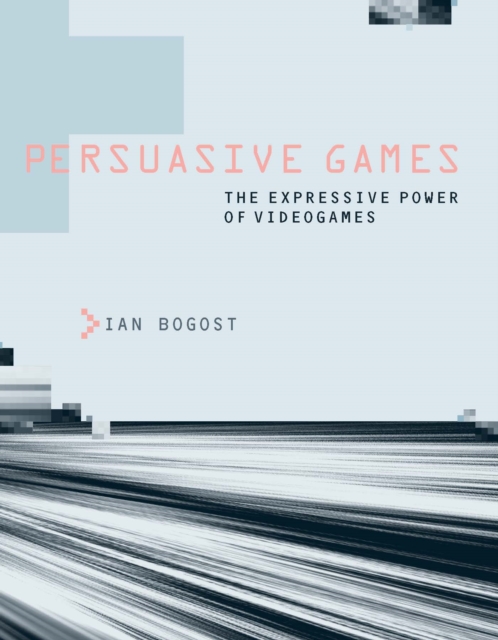
Persuasive Games
An exploration of the way videogames mount arguments and make expressive statements about the world that analyzes their unique persuasive power in terms of their computational properties.
Videogames are an expressive medium, and a persuasive medium; they represent how real and imagined systems work, and they invite players to interact with those systems and form judgments about them. In this innovative analysis, Ian Bogost examines the way videogames mount arguments and influence players. Drawing on the 2,500-year history of rhetoric, the study of persuasive expression, Bogost analyzes rhetoric's unique function in software in general and videogames in particular. The field of media studies already analyzes visual rhetoric, the art of using imagery and visual representation persuasively. Bogost argues that videogames, thanks to their basic representational mode of procedurality (rule-based representations and interactions), open a new domain for persuasion; they realize a new form of rhetoric. Bogost calls this new form \"procedural rhetoric,\" a type of rhetoric tied to the core affordances of computers: running processes and executing rule-based symbolic manipulation. He argues further that videogames have a unique persuasive power that goes beyond other forms of computational persuasion. Not only can videogames support existing social and cultural positions, but they can also disrupt and change these positions themselves, leading to potentially significant long-term social change. Bogost looks at three areas in which videogame persuasion has already taken form and shows considerable potential: politics, advertising, and learning.
eBook