Catalogue Search | MBRL


Are you sure you want to remove the book from the shelf?

{{itemTitle}}
277
result(s) for
"Booth, Marilyn"
Sort by:


Bitter orange tree : a novel
Bitter Orange Tree is a profound exploration of social status, wealth, desire, and female agency by Jokha Alharthi. It presents a mosaic portrait of one young woman's attempt to understand the roots she has grown from, and to envisage an adulthood in which her own power and happiness might find the freedom necessary to bear fruit and flourish. Zuhour, an Omani student at a British university, is caught between the past and the present. As she attempts to form friendships and assimilate in Britain, she can't help but ruminate on the relationships that have been central to her life. Most prominent is her strong emotional bond with Bint Amir, a woman she always thought of as her grandmother, who passed away just after Zuhour left the Arabian Peninsula. As the historical narrative of Bint Amir's challenged circumstances unfurls in captivating fragments, so too does Zuhour's isolated and unfulfilled present, one narrative segueing into another as time slips and dreams mingle with memories.-- From publisher's website.
Book

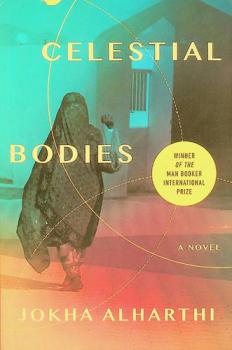
Celestial bodies : a novel
\"In the village of al-Awafi in Oman, we encounter three sisters: Mayya, who marries after a heartbreak; Asma, who marries from a sense of duty; and Khawla, who chooses to refuse all offers and await a reunion with the man she loves, who has emigrated to Canada. These three women and their families, their losses and loves, unspool ... against a backdrop of a rapidly changing Oman, a country evolving from a traditional, slave-owning society into its complex present\"-- Provided by publisher.
Book


Honey hunger
\"Azzan is a beekeeper in a rural community in Oman. Devoted to tending his bees and searching for wild hives, he encounters Thamna, a lone shepherd woman, on a mountain slope and is captivated by her and her honey-colored eyes. Across the breathtaking vistas of Oman's remote mountains and plains, Azzan's troubled past and present unfold. A disappointment to his family, he turns to drink, and ultimately discovers the healing power of his beekeeping, before an accident in which he loses all. Zahran Alqasmi's masterful novel thrums forward with a subtle momentum. His lucid, poetic writing conveys a visceral sense of time and place, of the fragile ecologies inhabited by both bees and humans alike, in this intense and compelling novel of loss and hope\"-- Provided by publisher.
BOOK

Zaynab Fawwāz's Feminist Locutions
Abstract
Lebanese-Egyptian Zaynab Fawwāz (ca. 1850-1914) was an unusual presence in 1890s Egypt: an immigrant from Shīʿī south Lebanon, without major family support, she created an intellectual place for herself in the Cairo press, generating a forthright voice on women's needs as distinct from \"the nation's.\" Like most Arabophone writers on \"the Woman Question,\" Fawwāz addressed girls' education, but she focused less on domestic training than on work and income, gender-defined dependency, and exploitation. She highlighted gender-prejudiced uses of religious knowledge to further masculine privilege. Framing her arguments within terms of engagement defined by Islamic sharīʿah, she appropriated and redefined keywords for an indigenous feminism. She repurposed the Islamic-Arabic genre of biographical writing for feminist-inflected history writing. I consider how Fawwāz deployed terminology and genre to contest patriarchal readings of Islamic practice sustained by assumptions of masculinist authority. Fawwāz's writings remind us that secularism was never inherent in Arabophone feminist theorizing, nor were the earliest Arab feminisms Western derivatives. Historical assemblages shaped by Islamic (and Christian) worldviews yielded creative syntheses that were firmly indigenous.
Journal Article