
Catalogue Search | MBRL


Are you sure you want to remove the book from the shelf?

{{itemTitle}}
7
result(s) for
"Botz-Bornstein, Thorsten, author"
Sort by:


Veils, Nudity, and Tattoos
At first sight, tattoos, nudity, and veils do not seem to have much in common except for the fact that all three have become more frequent, more visible, and more dominant in connection with aesthetic presentations of women over the past thirty years. No longer restricted to biker and sailor culture, tattoos have been sanctioned by the mainstream of liberal societies. Nudity has become more visible than ever on European beaches or on the internet. The increased use of the veil by women in Muslim and non-Muslim countries has developed in parallel with the aforementioned phenomena and is just as striking.
Through the means of conceptual analysis, Veils, Nudity, and Tattoos: The New Feminine Aesthetics reveals that these three phenomena can be both private and public, humiliating and empowering, and backward and progressive. This unorthodox approach is traced by the three's similar social and psychological patterns, and by doing so, Veils, Nudity, and Tattoos hopes to sketch the image of a woman who is not only sexually emancipated and confident, but also more and more aware of her cultural heritage.
eBook

Organic cinema
The \"organic\" is by now a venerable concept within aesthetics, architecture, and art history, but what might such a term mean within the spatialities and temporalities of film? By way of an answer, this concise and innovative study locates organicity in the work of Béla Tarr, the renowned Hungarian filmmaker and pioneer of the \"slow cinema\" movement. Through a wholly original analysis of the long take and other signature features of Tarr's work, author Thorsten Botz-Bornstein establishes compelling links between the seemingly remote spheres of film and architecture, revealing shared organic principles that emphasize the transcendence of boundaries.
eBook

The Political Aesthetics of ISIS and Italian Futurism
Through empirical analysis and theoretical reflection, this book shows that the aesthetics and politics of the Islamic State is \"futurist.\" ISIS overcomes postmodern pessimism and joins the modern, techno-oriented, and optimistic attitude propagated by Italian Futurism in the early twentieth century.
eBook

Vasily Sesemann
Born in Vyborg in 1884 by parents of German descent, Vasily (Wilhelm) Sesemann grew up and studied in St. Petersburg. A close friend of Viktor Zhirmunsky and Lev P. Karsavin, Sesemann taught from the early 1920s until his death in 1963 at the universities of Kaunas and Vilnius in Lithuania (interrupted only by his internment in a Siberian labor camp from 1950 to 1956). Botz-Bornstein's study takes up Sesemann's idea of experience as a dynamic, constantly self-reflective, ungraspable phenomenon that cannot be objectified. Through various studies, the author shows how Sesemann develops an outstanding idea of experience by reflecting it against empathy, Erkenntnistheorie (theory of knowledge), Formalism, Neo-Kantianism, Freudian psychoanalysis, and Bergson's philosophy. Sesemann's thought establishes a link between Formalist thoughts about dynamics and a concept of Being reminiscent of Heidegger. The book contains also translations of two essays by Sesemann as well as of an essay by Karsavin.
eBook
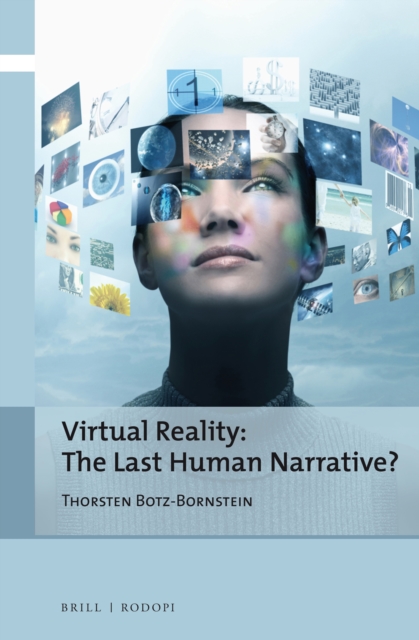
Virtual Reality: The Last Human Narrative?
Is virtual reality the latest grand narrative that humanity has produced? Our civilization is determined by a shift from an \"original event\" to a virtual \"narrative\". This concerns not only virtual reality but also psychoanalysis, gene-technology, and globalization. Psychoanalysis transforms the dream into a narrative and is able to spell out the dream's symbols. Gene-technology narrates dynamic, self-evolving evolution as a \"gene code\". Discourses on \"globalization\" let the globe appear as once more globalized because reproduced through narrative. Finally, reality itself has come to be narrated in the form of a second reality that is called \"virtual\". This book attempts to disentangle the characteristics of human reality and posthuman virtual reality and asks whether it is possible to reconcile both.
eBook

The cool-kawaii
At the turn of the millennium, international youth culture is dominated by mainly two types of aesthetics: the African American cool, which, propelled by Hip-Hop music, has become the world's favorite youth culture; and the Japanese aesthetics of kawaii or cute, that is distributed internationally by Japan's powerful anime industry. The USA and Japan are cultural superpowers and global trendsetters because they make use of two particular concepts that hide complex structures under their simple surfaces and are difficult to define, but continue to fascinate the world: cool and kawaii. The Cool-Kawaii: Afro-Japanese Aesthetics and New World Modernity, by Thorsten Botz-Bornstein, analyzes these attitudes and explains the intrinsic powers that are leading to a fusion of both aesthetics. Cool and kawaii are expressions set against the oppressive homogenizations that occur within official modern cultures, but they are also catalysts of modernity. Cool and kawaii do not refer us back to a pre-modern ethnic past. Just like the cool African American man has almost no relationship with traditional African ideas about masculinity, the kawaii shôjo is not the personification of the traditional Japanese ideal of the feminine, but signifies an ideological institution of women based on Japanese modernity in the Meiji period, that is, a feminine image based on westernization. At the same time, cool and kawaii do not transport us into a futuristic, impersonal world of hypermodernity based on assumptions of constant modernization. Cool and kawaii stand for another type of modernity, which is not technocratic, but rather \"Dandyist\" and closely related to the search for human dignity and liberation.
eBook