
Catalogue Search | MBRL


Are you sure you want to remove the book from the shelf?

{{itemTitle}}
9
result(s) for
"Brands, Hal, 1983- author"
Sort by:


The Twilight Struggle
A leading historian's guide to great-power competition, as
told through America's successes and failures in the Cold
War \"If you want to know how America can win
today's rivalries with Russia and China, read this book about how
it triumphed in another twilight struggle: the Cold War.\"- Stephen
J. Hadley, national security adviser to President George W.
Bush The United States is entering an era of great-power
competition with China and Russia. Such global struggles happen in
a geopolitical twilight, between the sunshine of peace and the
darkness of war. In this innovative and illuminating book, Hal
Brands, a leading historian and former Pentagon adviser, argues
that America should look to the history of the Cold War for lessons
in how to succeed in great-power rivalry today. Although the threat
posed by authoritarian powers is growing, America's muscle memory
for dealing with dangerous foes has atrophied in the thirty years
since the Cold War ended. In long-term competitions where the
diplomatic jockeying is intense and the threat of violence is
omnipresent, the United States will need all the historical insight
it can get. Exploring how America won a previous twilight struggle
is the starting point for determining how America can successfully
prosecute another high-stakes rivalry today.
eBook
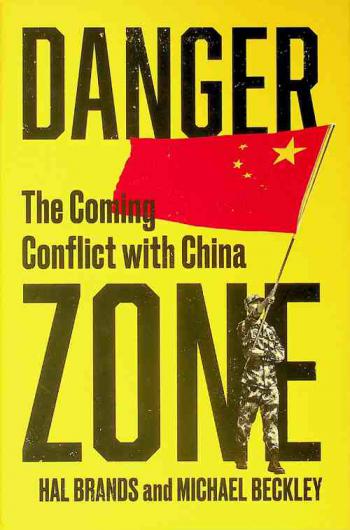
Danger zone : the coming conflict with China
\"A provocative and urgent analysis of the U.S.-China rivalry. It has become conventional wisdom that America and China are running a \"superpower marathon\" that may last a century. Yet Hal Brands and Michael Beckley pose a counterintuitive question: What if the sharpest phase of that competition is more like a decade-long sprint? The Sino-American contest is driven by clashing geopolitical interests and a stark ideological dispute over whether authoritarianism or democracy will dominate the 21st century. But both history and China's current trajectory suggest that this rivalry will reach its moment of maximum danger in the 2020s. China is at a perilous moment: strong enough to violently challenge the existing order, yet losing confidence that time is on its side. Numerous examples from antiquity to the present show that rising powers become most aggressive when their fortunes fade, their difficulties multiply, and they realize they must achieve their ambitions now or miss the chance to do so forever. China has already started down this path. Witness its aggression toward Taiwan, its record-breaking military buildup, and its efforts to dominate the critical technologies that will shape the world's future. Over the long run, the Chinese challenge will most likely prove more manageable than many pessimists currently believe-but during the 2020s, the pace of Sino-American conflict will accelerate, and the prospect of war will be frighteningly real. America, Brands and Beckley argue, will still need a sustainable approach to winning a protracted global competition. But first, it needs a near-term strategy for navigating the danger zone ahead\"-- Provided by publisher.

American Grand Strategy in the Age of Trump
Looking beyond the headlines to address the enduring grand strategic questions facing the United States today
American foreign policy is in a state of upheaval. The rise of Donald Trump and his \"America First\" platform have created more uncertainty about America's role in the world than at any time in recent decades. From the South China Sea, to the Middle East, to the Baltics and Eastern Europe, the geopolitical challenges to U.S. power and influence seem increasingly severe-and America's responses to those challenges seem increasingly unsure. Questions that once had widely accepted answers are now up for debate. What role should the United States play in the world? Can, and should, America continue to pursue an engaged an assertive strategy in global affairs?
In this book, a leading scholar of grand strategy helps to make sense of the headlines and the upheaval by providing sharp yet nuanced assessments of the most critical issues in American grand strategy today. Hal Brands asks, and answers, such questions as: Has America really blundered aimlessly in the world since the end of the Cold War, or has its grand strategy actually been mostly sensible and effective? Is America in terminal decline, or can it maintain its edge in a harsher and more competitive environment? Did the Obama administration pursue a policy of disastrous retrenchment, or did it execute a shrewd grand strategy focused on maximizing U.S. power for the long term? Does Donald Trump's presidency mean that American internationalism is dead? What type of grand strategy might America pursue in the age of Trump and after? What would happen if the United States radically pulled back from the world, as many leading academics-and, at certain moments, the current president-have advocated? How much military power does America need in the current international environment?
Grappling with these kinds of issues is essential to understanding the state of America's foreign relations today and what path the country might take in the years ahead. At a time when American grand strategy often seems consumed by crisis, this collection of essays provides an invaluable guide to thinking about both the recent past and the future of America's role in the world.
eBook

The lessons of tragedy : statecraft and world order
The ancient Greeks hard-wired a tragic sensibility into their culture. By looking disaster squarely in the face, by understanding just how badly things could spiral out of control, they sought to create a communal sense of responsibility and courage--to spur citizens and their leaders to take the difficult actions necessary to avert such a fate. Today, after more than seventy years of great-power peace and a quarter-century of unrivaled global leadership, Americans have lost their sense of tragedy. They have forgotten that the descent into violence and war has been all too common throughout human history. This amnesia has become most pronounced just as Americans and the global order they created are coming under graver threat than at any time in decades. In a forceful argument that brims with historical sensibility and policy insights, two distinguished historians argue that a tragic sensibility is necessary if America and its allies are to address the dangers that menace the international order today. Tragedy may be commonplace, Brands and Edel argue, but it is not inevitable-so long as we regain an appreciation of the world's tragic nature before it is too late.--Book jacket.
BOOK

What Good Is Grand Strategy?
Grand strategy is one of the most widely used and abused concepts in the foreign policy lexicon. In this important book, Hal Brands explains why grand strategy is a concept that is so alluring-and so elusive-to those who make American statecraft. He explores what grand strategy is, why it is so essential, and why it is so hard to get right amid the turbulence of global affairs and the chaos of domestic politics. At a time when \"grand strategy\" is very much in vogue, Brands critically appraises just how feasible that endeavor really is.
Brands takes a historical approach to this subject, examining how four presidential administrations, from that of Harry S. Truman to that of George W. Bush, sought to \"do\" grand strategy at key inflection points in the history of modern U.S. foreign policy. As examples ranging from the early Cold War to the Reagan years to the War on Terror demonstrate, grand strategy can be an immensely rewarding undertaking-but also one that is full of potential pitfalls on the long road between conception and implementation. Brands concludes by offering valuable suggestions for how American leaders might approach the challenges of grand strategy in the years to come.
eBook

Making the Unipolar Moment
In the late 1970s, the United States often seemed to be a superpower in decline. Battered by crises and setbacks around the globe, its post-World War II international leadership appeared to be draining steadily away. Yet just over a decade later, by the early 1990s, America's global primacy had been reasserted in dramatic fashion. The Cold War had ended with Washington and its allies triumphant; democracy and free markets were spreading like never before. The United States was now enjoying its \"unipolar moment\"-an era in which Washington faced no near-term rivals for global power and influence, and one in which the defining feature of international politics was American dominance. How did this remarkable turnaround occur, and what role did U.S. foreign policy play in causing it? In this important book, Hal Brands uses recently declassified archival materials to tell the story of American resurgence.Brands weaves together the key threads of global change and U.S. policy from the late 1970s through the early 1990s, examining the Cold War struggle with Moscow, the rise of a more integrated and globalized world economy, the rapid advance of human rights and democracy, and the emergence of new global challenges like Islamic extremism and international terrorism. Brands reveals how deep structural changes in the international system interacted with strategies pursued by Jimmy Carter, Ronald Reagan, and George H. W. Bush to usher in an era of reinvigorated and in many ways unprecedented American primacy.Making the Unipolar Momentprovides an indispensable account of how the post-Cold War order that we still inhabit came to be.
In the late 1970s, the United States often seemed to be a superpower in decline. Battered by crises and setbacks around the globe, its post-World War II international leadership appeared to be draining steadily away. Yet just over a decade later, by the early 1990s, America's global primacy had been reasserted in dramatic fashion. The Cold War had ended with Washington and its allies triumphant; democracy and free markets were spreading like never before. The United States was now enjoying its \"unipolar moment\"-an era in which Washington faced no near-term rivals for global power and influence, and one in which the defining feature of international politics was American dominance. How did this remarkable turnaround occur, and what role did U.S. foreign policy play in causing it? In this important book, Hal Brands uses recently declassified archival materials to tell the story of American resurgence.
Brands weaves together the key threads of global change and U.S. policy from the late 1970s through the early 1990s, examining the Cold War struggle with Moscow, the rise of a more integrated and globalized world economy, the rapid advance of human rights and democracy, and the emergence of new global challenges like Islamic extremism and international terrorism. Brands reveals how deep structural changes in the international system interacted with strategies pursued by Jimmy Carter, Ronald Reagan, and George H. W. Bush to usher in an era of reinvigorated and in many ways unprecedented American primacy.Making the Unipolar Momentprovides an indispensable account of how the post-Cold War order that we still inhabit came to be.
eBook


Latin America’s Cold War
For Latin America, the Cold War was anything but cold. Nor was it the so-called “long peace\" afforded the world’s superpowers by their nuclear standoff. In this book, the first to take an international perspective on the postwar decades in the region, Hal Brands sets out to explain what exactly happened in Latin America during the Cold War, and why it was so traumatic.
eBook