
Catalogue Search | MBRL


Are you sure you want to remove the book from the shelf?

{{itemTitle}}
31
result(s) for
"Breitmeier, Helmut"
Sort by:

Aligned Sustainability Understandings? Global Inter-Institutional Arrangements and the Implementation of SDG 2
This article asks whether inter-institutional arrangements (IIAs) can facilitate norm understandings of sustainability in the global food regime complex to ensure the implementation of SDG 2. It refers to theories of norm implementation and regime complexes and focuses on two explanatory factors: non-material resources (authority and knowledge) and interplay management (participation and interaction). The article deals with three case studies: The Codex Alimentarius Commission, the Sustainable Food Systems Programme, and the Standards and Trade Development Facility. Qualitative empirical analysis is based on documents and expert interviews. The article assumes that both explanatory factors are beneficial for the development of an aligned sustainability understanding. The findings indicate that IIAs serve as discursive fora for institutional exchange and can, thus, facilitate the development of aligned sustainability understandings in the global food regime complex. However, the article also identifies some structural factors that provide more scope for certain actors to enforce their normative views and interests, which ultimately hampers the implementation of SDG2.
Journal Article

The Effectiveness of International Environmental Regimes: Comparing and Contrasting Findings from Quantitative Research
This article uses quantitative methods to deepen and broaden our understanding of the factors that determine the effectiveness of international regimes. To do so, we compare and contrast the findings resulting from two major projects: the Oslo-Seattle Project and the International Regimes Database Project. The evidence from these projects sheds considerable light on the determinants of regime effectiveness in the environmental realm. Clearly, regimes do make a difference. By combining models and data from the two projects, we are able to move beyond this general proposition to explore the significance of a number individual determinants of effectiveness, including the distribution of power, the roles of pushers and laggards, the effects of decision rules, the depth and density of regime rules, and the extent of knowledge of the relevant problem. We show how important insights emerge not only from the use of statistical procedures to separate the effects of individual variables but also from the application of alternative techniques, such as Qualitative Comparative Analysis (QCA), designed to identify combinations of factors that operate together to determine the effectiveness of regimes. We use our results to identify a number of opportunities for additional research featuring quantitative analyses of regime effectiveness. Our goal is not to displace traditional qualitative methods in this field of study. Rather, we seek to sharpen a set of quantitative tools that can be joined together with the extensive body of qualitative studies of environmental regimes to strengthen our ability both to identify patterns in regime effectiveness and to explore the causal mechanisms that give rise to these patterns.
Journal Article
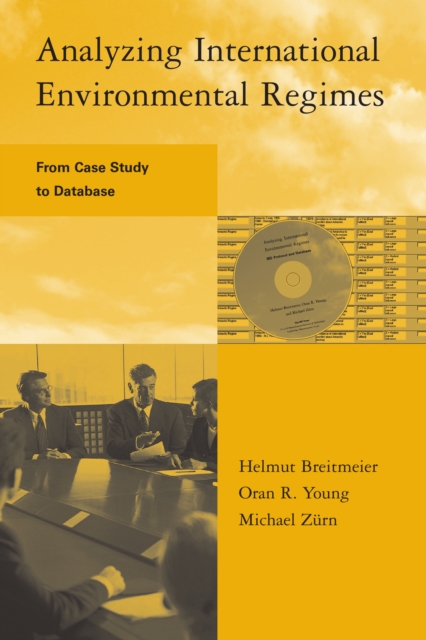
Analyzing international environmental regimes : from case study to database
Introducing the International Regimes Database (IRD) - an important methodological innovation that allows scholars to adopt a quantitative approach to the study of international regimes - this book describes the database and discusses methodological, technical, and architectural issues.
eBook

Climate Change and Violent Conflict: Uncertain Knowledge about Causal Connection and the Necessity for Adaptation Measures and the Prevention of Violence
The research program on 'environmental security' is still lacking evidence about the existence of a direct or indirect causal link between environmental depletion and violent conflict management. The knowledge about the impact of climate change on the evolution of new causes of conflict is just as much incomplete as information about factors which contribute to peaceful or violent conflict management. Peace and conflict studies will have to analyze the possible influence of climate change on the evolution of causes of conflict. In addition, the view of research must be directed on adaptation measures and the prevention of violent conflicts. The fragility of statehood and state failure are phenomena which are particularly affecting the ability of developing countries to adapt to climate change and to develop measures for the prevention of violent conflict. Many developing countries will have to develop such measures on the domestic or international level as they are particularly vulnerable to climate change. Adapted from the source document.
Journal Article
The Effectiveness of International Environmental Regimes: Comparing and Contrasting Findings from Quantitative Research1
Breitmeier, Helmut, Arild Underdal, and Oran R. Young. (2011) The Effectiveness of International Environmental Regimes: Comparing and Contrasting Findings from Quantitative Research. International Studies Review , doi: 10.1111/j.1468-2486.2011.01045.x This article uses quantitative methods to deepen and broaden our understanding of the factors that determine the effectiveness of international regimes. To do so, we compare and contrast the findings resulting from two major projects: the Oslo-Seattle Project and the International Regimes Database Project. The evidence from these projects sheds considerable light on the determinants of regime effectiveness in the environmental realm. Clearly, regimes do make a difference. By combining models and data from the two projects, we are able to move beyond this general proposition to explore the significance of a number individual determinants of effectiveness, including the distribution of power, the roles of pushers and laggards, the effects of decision rules, the depth and density of regime rules, and the extent of knowledge of the relevant problem. We show how important insights emerge not only from the use of statistical procedures to separate the effects of individual variables but also from the application of alternative techniques, such as Qualitative Comparative Analysis (QCA), designed to identify combinations of factors that operate together to determine the effectiveness of regimes. We use our results to identify a number of opportunities for additional research featuring quantitative analyses of regime effectiveness. Our goal is not to displace traditional qualitative methods in this field of study. Rather, we seek to sharpen a set of quantitative tools that can be joined together with the extensive body of qualitative studies of environmental regimes to strengthen our ability both to identify patterns in regime effectiveness and to explore the causal mechanisms that give rise to these patterns.
Journal Article

The Output-Oriented Legitimacy of International Regimes. Empirical Findings from the Quantitative Study of International Environmental Regimes
The article focuses on the output-oriented legitimacy of global governance & develops specific performance expectations which are addressed to international institutions. The willingness to obey the politics of international regimes depends on whether these institutions can improve consensual knowledge, promote compliance with norms & rules, contribute to problem-solving, & produce an adequate distribution of costs & benefits. The contribution of regimes to the fulfillment of these requirements is measured with data from the international regimes database. This database includes data on 23 international environmental regimes. The international regimes database represents a tool which can be used for testing hypotheses about the creation & consequences of international regimes. The historical-comparative investigation of the effects which have occurred in the 23 issue areas & causal analysis of the impact of regime factors illustrate that international institutions can actually make an independent contribution to the effective management of complex issues in world politics. Tables, References. Adapted from the source document.
Journal Article
Klimawandel und Gewaltkonflikte: Das unsichere Wissen über den Kausalzusammenhang und die Notwendigkeit von Maßnahmen zur Anpassung und Gewaltprävention
Das Forschungsprogramm über ‚ökologische Sicherheit’ hat bisher keine eindeutigen Befunde darüber bereitgestellt, welchen direkten beziehungsweise indirekten kausalen Beitrag die Umweltzerstörung zum gewaltsamen Konfliktaustrag leistet. Unsicher ist auch die Wissensbasis darüber, welche Konfliktursachen durch den Klimawandel erzeugt werden und unter welchen Bedingungen klimabedingte Konflikte eher gewaltsam oder friedlich bearbeitet werden. Die Friedens- und Konfliktforschung muss den Blick auf die Analyse des möglichen Einflusses des Klimawandels auf Konfliktursachen und auf die Entwicklung von Maßnahmen zur Anpassung und Gewaltprävention richten. Die fragile Staatlichkeit beziehungsweise der Staatszerfall, der in vielen Entwicklungsländern zu beobachten ist, schwächt die Fähigkeit dieser Länder zur Anpassung an den Klimawandel und zur Gewaltprävention. Für viele dieser Länder besteht die Notwendigkeit, dass auf inner- beziehungsweise zwischenstaatlicher Ebene rechtzeitig Maßnahmen ergriffen werden, die eine Anpassung an den Klimawandel ermöglichen und eine friedliche Konfliktbearbeitung gewährleisten.
Journal Article

Analyzing international environmental regimes : from case study to database / Helmut Breitmeier, Oran R. Young, and Michael Zürn
\"Regime theory has become an increasingly influential approach to the analysis of international relations, particularly in the areas of international political economy and international environmental politics. The conceptual appeal of the idea of \"governance without government\"--In which a combination of different organizations and institutions supply governance to address specific problems--reflects a world in which the demand for governance is great but the familiar mechanisms for supplying it are weak. Most research on international regimes employs qualitative methods, often using case studies to develop larger theoretical arguments; but a lack of standardization makes comparative analysis difficult. Analyzing International Environmental Regimes introduces the International Regimes Database (IRD), an important methodological innovation that allows scholars to adopt a quantitative approach to the study of international regimes. The IRD is a relational database that makes it possible to compare records on specific aspects of a number of international environmental regimes that are coded using a single, well-defined set of concepts, definitions, and scales. The book first describes the database and discusses a number of methodological, technical, and architectural issues. It then illustrates the use of the IRD as an analytic tool, drawing on the database for descriptive statistics to evaluate theoretical ideas about compliance, decision rules, and the role of knowledge. A CD containing the full IRD data protocol and all the data currently in the database accompanies the book.\"--Publisher's website.
eBook