
Catalogue Search | MBRL


Are you sure you want to remove the book from the shelf?

{{itemTitle}}
47
result(s) for
"Brian Ford-Lloyd"
Sort by:

Gap analysis: a tool for complementary genetic conservation assessment
Gap analysis is a well-established conservation technique that identifies areas in which selected elements of biodiversity are represented and through comparison with existing in situ protected area networks identifies habitats or ecosystems that need additional protection. We aim to demonstrate that gap analysis may be extended to encompass both in situ and ex situ genetic diversity conservation strategies. Global, with exemplar case study from sub-Saharan Africa. An extended methodology of gap analysis is proposed that involves the following steps: (1) circumscription of target taxon and target area; (2) assessment of natural diversity through a review of intrinsic taxonomic, genetic and ecogeographical diversity combined with threat assessment; (3) assessment of current complementary in situ and ex situ conservation strategies; and (4) reformulation of the conservation strategy through analysis of the differences between the pattern of natural, intrinsic diversity and the elements of that diversity already effectively represented by existing in situ and ex situ conservation actions. To illustrate the gap analysis approach proposed, the methodology was applied to the conservation of African Vigna species (cowpea Vigna unguiculata (L.) Walp. and its wild relatives) and indicated: (1) genetic reserves should be established at the southern tip of Lake Tanganyika, the coastal area of Sierra Leone and between Lake Victoria and the other Great Lakes, and (2) 14 taxa and several countries should be targeted for further seed collection. The robust nature of the extended methodology for gap analysis has been demonstrated and indicates that its scope as an effective conservation tool may be expanded to fully address the need for a more comprehensive and complementary conservation strategy that encompasses both in situ and ex situ applications. However, it should be stressed that the methodology is applicable for any form of biodiversity (wild or cultivated), where the conservation of genetic diversity is the prime goal.
Journal Article

Toward the Systematic Conservation of Global Crop Wild Relative Diversity
Growing concern over the potentially devastating impacts of climate change on biodiversity and food security, considered together with the growing world population, means that taking action to conserve crop wild relative (CWR) diversity is no longer an option--it is an urgent priority. Crop wild relatives are species closely related to crops, including their progenitors, which have the potential to contribute beneficial traits for crop improvement, such as biotic and abiotic resistances, leading to improved yield and stability. Having already made major contributions to crop improvement in the 20th century, CWR are recognized as a critical resource to sustain global food security; therefore, their systematic conservation is imperative. However, extending their conservation and promoting more systematic exploitation is hindered by a lack of understanding of their current and potential value, their diversity, and practically how they might be conserved. Therefore, the aim of this paper is to (i) demonstrate the current and potential use of CWR in crop improvement, (ii) estimate how many CWR species exist and how many are a global priority for active conservation, and (iii) describe how a global network for the in situ conservation of CWR might be established that could help to underpin future food security.
Journal Article

Defining and identifying crop landraces
Awareness of the need for biodiversity conservation is now universally accepted, but most often recent conservation activities have focused on wild species. Crop species and the diversity between and within them has significant socioeconomic as well as heritage value. The bulk of genetic diversity in domesticated species is located in traditional varieties maintained by traditional farming systems. These traditional varieties, commonly referred to as landraces, are severely threatened by genetic extinction primarily due to their replacement by modern genetically uniform varieties. The conservation of landrace diversity has been hindered in part by the lack of an accepted definition to define the entity universally recognized as landraces. Without a definition it would be impossible to prepare an inventory and without an inventory changes in landrace constituency could not be recognized over time. Therefore, based on a literature review, workshop discussion and interviews with key informants, common characteristics of landraces were identified, such as: historical origin, high genetic diversity, local genetic adaptation, recognizable identity, lack of formal genetic improvement, and whether associated with traditional farming systems. However, although these characteristics are commonly present they are not always all present for any individual landrace; several crop-specific exceptions were noted relating to crop propagation method (sexual or asexual), breeding system (self-fertilized or cross-fertilized species), length of formal crop improvement, seed management (selection or random propagation) and use. This paper discusses the characteristics that generally constitute a landrace, reviews the exceptions to these characteristics and provides a working definition of a landrace. The working definition proposed is as follows: ‘a landrace is a dynamic population(s) of a cultivated plant that has historical origin, distinct identity and lacks formal crop improvement, as well as often being genetically diverse, locally adapted and associated with traditional farming systems’.
Journal Article

Towards a definition of a crop wild relative
Issue Title: Themed Issue: Human Exploitation and Biodiversity Conservation Crop wild relatives are an important socio-economic resource that is currently being eroded or even extinguished through careless human activities. If the Conference of the Parties (COP) to the CBD 2010 Biodiversity Target of achieving a significant reduction in the current rate of loss is to be achieved, we must first define what crop wild relatives are and how their conservation might be prioritised. A definition of a crop wild relative is proposed and illustrated in the light of previous Gene Pool concept theory. Where crossing and genetic diversity information is unavailable, the Taxon Group concept is introduced to assist recognition of the degree of crop wild relative relatedness by using the existing taxonomic hierarchy.[PUBLICATION ABSTRACT]
Journal Article

Enhancing the Conservation of Crop Wild Relatives in England
Humans require resilient, rapidly renewable and sustainable supplies of food and many other plant-derived supplies. However, the combined effects of climate change and population growth compromise the provision of these supplies particularly in respect to global food security. Crop wild relatives (CWR) contain higher genetic diversity than crops and harbour traits that can improve crop resilience and yield through plant breeding. However, in common with most countries, CWR are poorly conserved in England. There is currently no provision for long-term CWR conservation in situ, and comprehensive ex situ collection and storage of CWR is also lacking. However, there is a commitment to achieve their conservation in England's Biodiversity Strategy and the UK has international commitments to do so as part of the Global Plant Conservation Strategy. Here, we identify a series of measures that could enhance the conservation of English CWR, thereby supporting the achievement of these national and international objectives. We provide an inventory of 148 priority English CWR, highlight hotspots of CWR diversity in sites including The Lizard Peninsula, the Dorset coast and Cambridgeshire and suggest appropriate sites for the establishment of a complementary network of genetic reserves. We also identify individual in situ and ex situ priorities for each English CWR. Based on these analyses, we make recommendations whose implementation could provide effective, long-term conservation of English CWR whilst facilitating their use in crop improvement.
Journal Article
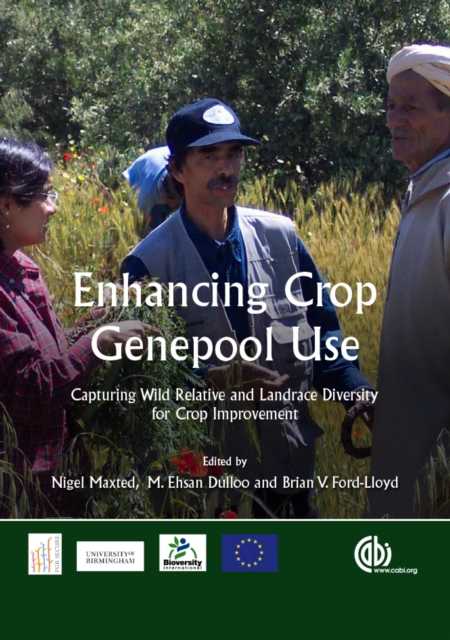
Enhancing crop genepool use: capturing wild relative and landrace diversity for crop improvement
Maintaining food security in the face of human population increase and climate change is one of the critical challenges facing us in the 21st Century. Utilisation of the full range of agrobiodiversity will be a necessary tool in addressing this challenge. In this book a team of international contributors review all aspects of utilization and conservation of crop wild relative (CWR) and landrace (LR) diversity as a basis for crop improvement and future food security.Enhancing Crop Genepool Use covers four key areas:· Characterization techniques - novel 'omics' techniques and predictive tools that can be used to identify adaptive traits and expedite plant breeding.· Conservation strategies - how to develop national, regional and global CWR and LR conservation strategies, how better to target conservation to meet the needs of the plant breeding community, and how to integrate CWR and LR diversity into existing biodiversity conservation programmes.· Facilitating CWR and LR use - pre-breeding using 'exotic' germplasm, meeting breeders' needs, integrating the conservation and user communities, and policy enhancement.· Informatics development - improving characterization, trait and conservation data management and accessibility, and inter-information system operability.This book will appeal to a wide array of specialists and postgraduate students, such as those working in the fields of agrobiodiversity conservation and use, conservation, ecology, botany, genetics, plant breeding and agriculture.
eBook
Brown Planthopper (N. lugens Stal) Feeding Behaviour on Rice Germplasm as an Indicator of Resistance
The brown planthopper (BPH) Nilaparvata lugens (Stal) is a serious pest of rice in Asia. Development of novel control strategies can be facilitated by comparison of BPH feeding behaviour on varieties exhibiting natural genetic variation, and then elucidation of the underlying mechanisms of resistance.
BPH feeding behaviour was compared on 12 rice varieties over a 12 h period using the electrical penetration graph (EPG) and honeydew clocks. Seven feeding behaviours (waveforms) were identified and could be classified into two phases. The first phase involved patterns of sieve element location including non penetration (NP), pathway (N1+N2+N3), xylem (N5) [21] and two new feeding waveforms, derailed stylet mechanics (N6) and cell penetration (N7). The second feeding phase consisted of salivation into the sieve element (N4-a) and sieve element sap ingestion (N4-b). Production of honeydew drops correlated with N4-b waveform patterns providing independent confirmation of this feeding behaviour.
Overall variation in feeding behaviour was highly correlated with previously published field resistance or susceptibility of the different rice varieties: BPH produced lower numbers of honeydew drops and had a shorter period of phloem feeding on resistant rice varieties, but there was no significant difference in the time to the first salivation (N4-b). These qualitative differences in behaviour suggest that resistance is caused by differences in sustained phloem ingestion, not by phloem location. Cluster analysis of the feeding and honeydew data split the 12 rice varieties into three groups: susceptible, moderately resistant and highly resistant. The screening methods that we have described uncover novel aspects of the resistance mechanism (or mechanisms) of rice to BPH and will in combination with molecular approaches allow identification and development of new control strategies.
Journal Article

Differentiation and distribution of indica and japonica rice varieties along the altitude gradients in Yunnan Province of China as revealed by InDel molecular markers
Indica-japonica variation represents the most significant genetic differentiation in Asian cultivated rice (Oryza sativa L. subsp. indica Kato or subsp. japonica Kato). Understanding the differentiation and distribution patterns of cultivated rice along altitude gradients will facilitate strategic utilization and conservation of rice germplasm from mountainous regions. In this study, we analyzed 203 varieties and 14 wild accessions of rice collected from localities across an altitude gradient between 450 and 2,350 m above sea level in Yunnan, China, applying the “InDel molecular index” developed recently. Results from PCA of the InDel data demonstrated significant genetic differentiation of rice varieties from Yunnan into indica and japonica types. A few cultivars and nearly all wild rice accessions showed only moderate or no differentiation. Further analyses demonstrated a clear distribution pattern of the rice varieties in the mountainous region: indica varieties were grown across the entire altitude gradient in the sampling areas, but most japonica varieties were found above 1,400 m. These results clearly indicated that indica rice could be cultivated in areas at much higher altitudes than those categorized by the traditional methods. The knowledge opens a new dimension for introducing indica rice varieties to mountainous regions at higher altitudes and for selecting rice germplasm in these regions. In addition, the pattern of significant indica-japonica differentiation in rice varieties from Yunnan suggested the exotic origin of cultivated rice, which did not support the hypothesis that Yunnan is a part of the center of origin of rice, although it is certainly one of the centers of genetic diversity for rice.
Journal Article
New approaches for establishing conservation priorities for socio-economically important plant species
The establishment of priorities among species is a crucial step in any conservation strategy since financial resources are generally limited. Traditionally, priorities for conservation of plant species have been focused on endemicity, rarity and particularly on their threatened status. Crop wild relatives (CWR) and wild harvested plants (WHP) are important elements of biodiversity with actual or potential socio-economic value. In this study, eight prioritisation criteria were used along with different prioritisation systems and applied to the Portuguese CWR and WHP. The top 50 species obtained by each of these methods were identified. The final top CWR were those that occurred as a priority in most methods. Twenty CWR were identified as the highest priorities for conservation in Portugal and they include wild relatives of the crop genera Allium, Daucus, Dianthus, Epilobium, Festuca, Herniaria, Narcissus, Quercus, Plantago, Trifolium, and Vicia. Eighteen WHP were recognised as priorities for conservation and include several Narcissus and Thymus species, among others. The advantages, limitations and level of subjectivity of each of the methods used in this exercise are discussed.
Journal Article

Trait Specific Expression Profiling of Salt Stress Responsive Genes in Diverse Rice Genotypes as Determined by Modified Significance Analysis of Microarrays
Stress responsive gene expression is commonly profiled in a comparative manner involving different stress conditions or genotypes with contrasting reputation of tolerance/resistance. In contrast, this research exploited a wide natural variation in terms of taxonomy, origin and salt sensitivity in eight genotypes of rice to identify the trait specific patterns of gene expression under salt stress. Genome wide transcptomic responses were interrogated by the weighted continuous morpho-physiological trait responses using modified Significance Analysis of Microarrays. More number of genes was found to be differentially expressed under salt stressed compared to that of under unstressed conditions. Higher numbers of genes were observed to be differentially expressed for the traits shoot Na(+)/K(+), shoot Na(+), root K(+), biomass and shoot Cl(-), respectively. The results identified around 60 genes to be involved in Na(+), K(+), and anion homeostasis, transport, and transmembrane activity under stressed conditions. Gene Ontology (GO) enrichment analysis identified 1.36% (578 genes) of the entire transcriptome to be involved in the major molecular functions such as signal transduction (>150 genes), transcription factor (81 genes), and translation factor activity (62 genes) etc., under salt stress. Chromosomal mapping of the genes suggests that majority of the genes are located on chromosomes 1, 2, 3, 6, and 7. The gene network analysis showed that the transcription factors and translation initiation factors formed the major gene networks and are mostly active in nucleus, cytoplasm and mitochondria whereas the membrane and vesicle bound proteins formed a secondary network active in plasma membrane and vacuoles. The novel genes and the genes with unknown functions thus identified provide picture of a synergistic salinity response representing the potentially fundamental mechanisms that are active in the wide natural genetic background of rice and will be of greater use once their roles are functionally verified.
Journal Article