
Catalogue Search | MBRL


Are you sure you want to remove the book from the shelf?

{{itemTitle}}
6
result(s) for
"Broeck, Sabine, editor"
Sort by:


Audre Lorde's Transnational Legacies
Among the most influential and insightful thinkers of her generation, Audre Lorde (1934--1992) inspired readers and activists through her poetry, autobiography, essays, and her political action. Most scholars have situated her work within the context of the women's, gay and lesbian, and black civil rights movements within the United States. However, Lorde forged coalitions with women in Europe, the Caribbean, Canada, Australia, New Zealand, and Africa, and twenty years after her passing, these alliances remain largely undocumented and unexplored.
Audre Lorde's Transnational Legacies is the first book to systematically document and thoroughly investigate Lorde's influence beyond the United States. Arranged in three thematically interrelated sections -- Archives, Connections, and Work -- the volume brings together scholarly essays, interviews, Lorde's unpublished speech about Europe, and personal reflections and testimonials from key figures throughout the world. Using a range of interdisciplinary approaches, contributors assess the reception, translation, and circulation of Lorde's writing and activism within different communities, audiences, and circles. They also shed new light on the work Lorde inspired across disciplinary borders.
In addition the volume editors, contributors include Sarah Cefai, Cassandra Ellerbe-Dueck, Paul M. Farber, Tiffany N. Florvil, Katharina Gerund, Alexis Pauline Gumbs, Gloria Joseph, Jackie Kay, Marion Kraft, Christiana Lambrinidis, Zeedah Meierhofer-Mangeli, Rina Nissim, Chantal Oakes, Lester C. Olson, Pratibha Parmar, Peggy Piesche, Dagmar Schultz, Tamara Lea Spira, and Gloria Wekker.
eBook
Black knowledges/black struggles
Black Knowledges/Black Struggles: Essays in Critical Epistemology explores the central but often critically neglected role of knowledge and epistemic formations within social movements for Black “freedom” and emancipation. The collection examines the structural subjugation and condemnation of Black African and Afro-mixed descent peoples globally within the past 500 years of trans-Atlantic societies of Western modernity, doing so in connection to the population’s dehumanization and/or invisibilization within various epistemic formations of the West. In turn, the collection foregrounds the extent to which the ending of this imposed subjugation/condemnation has necessarily entailed critiques of, challenges to, and counter-formulations against and beyond knowledge and epistemic formations that have worked to “naturalize” this condition within the West’s various socio-human formations. The chapters in the collection engage primarily with knowledge formations and practices generated from within the discourse of “race,” but also doing so in relation to other intersectional socio-human discourses of Western modernity. They engage as well the critiques, challenges, and counter-formulations put forth by specific individuals, schools, movements, and/or institutions – historic and contemporary – of the Black world. Through these examinations, the contributors either implicitly point towards, or explicitly take part in, the formation of a new kind of critical – but also emancipatory – epistemology. What emerges is a novel and more comprehensive view of what it means to be human, a formulation that can aid in the unlocking and fashioning of species-oriented ways of “knowing” and “being” much-needed within the context of ending the continued overall global subjugation/condemnation of Black peoples, as a central part of ending the “global problematique” that confronts humankind as a whole.
eBook

Black intersectionalities
Black Intersectionalities: A Critique for the 21st Century explores the complex interrelationships between race, gender, and sex as these are conceptualised within contemporary thought. Markers of identity are too often isolated and presented as definitive, then examined and theorised, a process that further naturalises their absoluteness; thus socially generated constructs become socialising categories that assume coercive power. The resulting set of oppositions isolate and delimit: male or female, black or white, straight or gay. A new kind of intervention is needed, an intervention that recognises the validity of the researcher’s own self-reflexivity. Focusing on the way identity is both constructed and constructive, the collection examines the frameworks and practices that deny transgressive possibilities. It seeks to engage in a consciousness raising exercise that documents the damaging nature of assigned social positions and either/or identity constructions. It seeks to progress beyond the socially prescribed categories of race, gender and sex, recognising the need to combine intellectualization and feeling, rationality and affectivity, abstraction and emotion, consciousness and desire. It seeks to develop new types of transdisciplinary frameworks where subjective and political spaces can be universalized while remaining particular, leaving texts open so that identity remains imagined, plural, and continuously shifting. Such an approach restores the complexity of what it means to be human.
eBook

Black Intersectionalities
Black Intersectionalities: A Critique for the 21st Century explores the complex interrelationships between race, gender, and sex as these are conceptualised within contemporary thought. Markers of identity are too often isolated and presented as definitive, then examined and theorised, a process that further naturalises their absoluteness; thus socially generated constructs become socialising categories that assume coercive power. The resulting set of oppositions isolate and delimit: male or female, black or white, straight or gay. A new kind of intervention is needed, an intervention that recognises the validity of the researcher’s own self-reflexivity. Focusing on the way identity is both constructed and constructive, the collection examines the frameworks and practices that deny transgressive possibilities. It seeks to engage in a consciousness raising exercise that documents the damaging nature of assigned social positions and either/or identity constructions. It seeks to progress beyond the socially prescribed categories of race, gender and sex, recognising the need to combine intellectualization and feeling, rationality and affectivity, abstraction and emotion, consciousness and desire. It seeks to develop new types of transdisciplinary frameworks where subjective and political spaces can be universalized while remaining particular, leaving texts open so that identity remains imagined, plural, and continuously shifting. Such an approach restores the complexity of what it means to be human.
An important collection which explores the complex interrelationships between race, gender, and sex as these are conceptualised within contemporary thought.
eBook
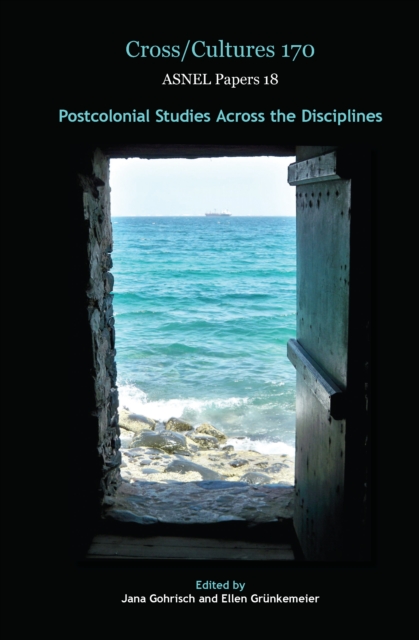
Postcolonial Studies Across the Disciplines
Bringing together contributions from various disciplines and academic fields, this collection engages in interdisciplinary dialogue on postcolonial issues. Covering African, anglophone, Romance, and New-World themes, linguistic, literary, and cultural studies, and historiography, music, art history, and textile studies, the volume raises questions of (inter)disciplinarity, methodology, and entangled histories. The essays focus on the representation of slavery in the transatlantic world (the USA, Jamaica, Haiti, and the wider Caribbean, West Africa, and the UK). Drawing on a range of historical sources, material objects, and representations, they study Jamaican Creole, African masks, knitted objects, patchwork sculpture, newspapers, films, popular music, and literature of different genres from the Caribbean, West and South Africa, India, and Britain. At the same time, they reflect on theoretical problems such as intertextuality, intermediality, and cultural exchange, and explore intersections - postcolonial literature and transatlantic history; postcolonial and African-American studies; postcolonial literary and cultural studies. The final section keys in with the overall aim of challenging established disciplinary modes of knowledge production: exploring schools and universities as locations of postcolonial studies. Teachers investigate the possibilities and limits of their respective institutions and probe new ways of engaging with postcolonial concerns. With its integrative, interdisciplinary focus, this collection addresses readers interested in understanding how colonization and globalization have influenced societies and cultures around the world. Contributors: Anja Bandau, Sabine Broeck, Sarah Fekadu, Matthias Galler, Janou Glencross, Jana Gohrisch, Ellen Grünkemeier, Jessica Hemmings, Jan Hüsgen, Johannes Salim Ismaiel-Wendt, Ursula
Kluwick, Henning Marquardt, Dennis Mischke, Timo Müller, Mala Pandurang, Carl Plasa, Elinor Jane Pohl, Brigitte Reinwald, Steffen Runkel, Andrea Sand, Cecile Sandten, Frank Schulze-Engler, Melanie Ulz, Reinhold Wandel, Tim Watson.
eBook