
Catalogue Search | MBRL


Are you sure you want to remove the book from the shelf?

{{itemTitle}}
100
result(s) for
"Broude, Norma"
Sort by:

Diane Burko : Seeing climate change
Painter, photographer and climate activist Diane Burko has long been a prominent advocate in addressing climate change. While continuing to engage the traditions of landscape painting, her increasingly abstract and large-scale images are layered with visual and scientific information about the urgent challenges posed to the planet. This volume presents Burko's large-scale paintings and serial groupings, including her never-before-exhibited, 56-foot-long World Map series, which addresses glacier and coral reef changes across the globe. Also featured are Burko's videos and Lenticulars, which employ melting and flowing imagery to express the concept of climate change over time. The book features more than 120 color illustrations; a new statement by the artist on the evolving nature of her studio practice; essays by each of the curators, distinguished art historians Mary D. Garrard and Norma Broude; and an essay by the environmental author and activist Bill McKibben.
Book
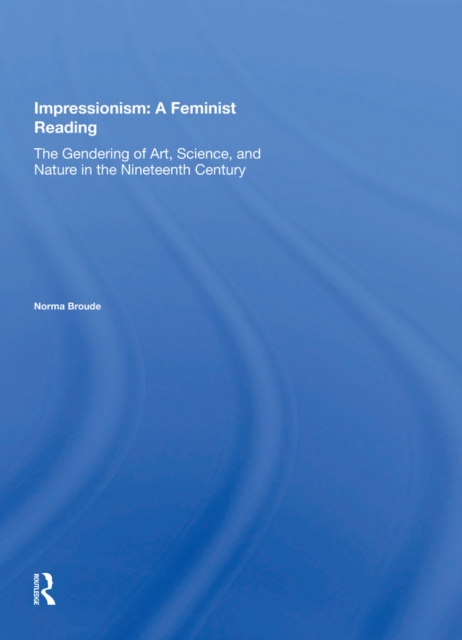
Impressionism
An original interpretation of Impressionism and nineteenth-century art and culture by a noted feminist art historian. This book is a pioneering reading of Impressionism from a feminist perspective by a noted art historian. Norma Broude analyzes the philosophical underpinnings of landscape painting in the late nineteenth century discussing the crit
eBook

Impressionism
This book is a pioneering reading of Impressionism from a feminist perspective by a noted art historian. Norma Broude analyzes the philosophical underpinnings of landscape painting in the late nineteenth century discussing the critical misconceptions attached to Impressionism, in particular the work of Monet.
eBook

Exhibition review: Royalists to Romantics: Women Artists from the Louvre, Versailles, and Other French National Collections
Review of exhibition on French women artists from 1750 to 1850 at the National Museum of Women in the Arts, Washington D.C. In many ways a revelation, \"Royalists to Romantics\" is an excellent starting point for further research into little-known artists whose works, despite recent scholarly effort, still remain unjustly hidden from history. The catalogue essays show how women were able to have artistic careers outside the official institutions from which they were excluded, but do not analyse the new opportunities available in the first half of the 19C from which half of the works in the exhibition come. The catalogue's alphabetical arrangement of the 35 women artists represented is less helpful than the exhibition's thematic arrangement by genre. These artists brought to contemporary and historical subjects an iconoclastic female gaze and presented women as active and creative agents outside of the domestic realm. Their portraits of women have a particular intensity; in one case what the catalogue describes as a \"touching scene of female companionship\" is in fact a new homo-social model of female friendship and bonding that appears in the work of women artists in the 18C. More could have said about these artists' political activism, their engagement with one another and with the intellectual and public spheres. (Quotes from original text)
Journal Article

Appreciations : Miriam Schapiro (1923-2015)
Miriam Schapiro, known to her many friends as Mimi, died on june 20, 2015, at the age of 91. She was a giant of modern art history, a pioneer of the Feminist art movement in America in the 1970s and 1980s. OA
Journal Article

G. B. Tiepolo at Valmarana : gender ideology in a patrician villa of the settecento
The Villa Falmarana ai Nani, located on the outskirts of Vicenza, Italy, is the site of a program of wall decorations carried out by Giambattista Tiepolo in about 1757. It features a consistent and pervasive cycle of imagery that focuses on women as compliant victims, evil sorceresses, and abandoned temptresses, while their male counterparts are presented as warrior heroes who are carnally tempted but able to overcome temptation for a higher purpose. Broude proposes that the Valmarana cycle reflected and embodied social norms and a conservative societal backlash in the middle of the 18th century, and that its messages can be fully understood only against the backdrop of changing conditions in the domestic and public lives of women and men in the Veneto during this era.
Journal Article

Linda Nochlin
An obituary for art historian Linda Nochlin, who died in 2017 at the age of 86, is presented. Her seminal 1971 essay Why Have There Been No Great Women Artists helped launch the Feminist Art Movement, and her many influential accomplishments and publications addressed feminist subjects as well as 19th and 20th century art and culture.
Journal Article
G. B. Tiepolo at Valmarana: Gender Ideology in a Patrician Villa of the Settecento
The frescoes by Giambattista Tiepolo for the palazzina of the Villa Valmarana are commonly and benignly described in the art historical literature as taking for their theme \"stories of love.\" The political dynamics of gender, which inform their subjects, intentions, production, and reception, have never been recognized, let alone contextually probed. I argue here that the program for these frescoes embodied reactionary social norms and a conservative societal backlash in the mid-eighteenth century, engendered by the threat of dramatically changing conditions in the domestic and public lives of both women and men in the Veneto during this era.
Journal Article