
Catalogue Search | MBRL


Are you sure you want to remove the book from the shelf?

{{itemTitle}}
36
result(s) for
"Bucknor, Michael A."
Sort by:
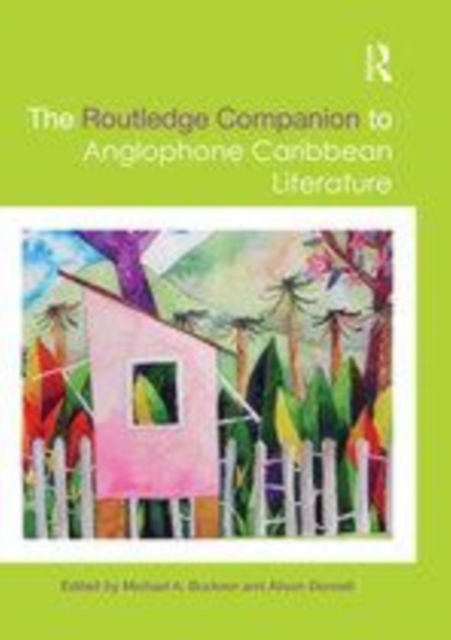
The Routledge Companion to Anglophone Caribbean Literature
The Routledge Companion to Anglophone Caribbean Literature offers a comprehensive, critically engaging overview of this increasingly significant body of work.
The volume is divided into six sections that consider:
the foremost figures of the Anglophone Caribbean literary tradition and a history of literary critical debate
textual turning points, identifying key moments in both literary and critical history and bringing lesser known works into context
fresh perspectives on enduring and contentious critical issues including the canon, nation, race, gender, popular culture and migration
new directions for literary criticism and theory, such as eco-criticism, psychoanalysis and queer studies
the material dissemination of Anglophone Caribbean literature and generic interfaces with film and visual art
This volume is an essential text that brings together sixty-nine entries from scholars across three generations of Caribbean literary studies, ranging from foundational critical voices to emergent scholars in the field.
The volume's reach of subject and clarity of writing provide an excellent resource and springboard to further research for those working in literature and cultural studies, postcolonial and diaspora studies as well as Caribbean studies, history and geography.
eBook

Conceptual Residues of Imperialist Ruination
The necessary confrontation with the epistemological legacy of imperialism is one of the main interventions of postcolonial criticism.1 For postcolonial ecocritic Elizabeth DeLoughrey, imperialism led to, among other things, conceptual corrosion: the \"erasure of indigenous knowledges\" (and knowledge systems) and the \"erection of a hierarchy of species\" (\"Ecocriticism\" 265). The idea of the Caribbean woman as 'miracle worker' is suggested in the ability to \"make something from nothing,\" but it also calls up the biblical Creation story, whereby the world was created from nothing.3 In this regard, there is not only a creative impulse associated with 'making do,' as expressed in the description of \"cutting, carving and contriving,\" but also a transformative imagination to see value where others saw nothingness or worthlessness. In Black Sand, Baugh ironically begins with \"End Poem,\" in which, as I have argued before,4 he \"signals the importance of using poetry to shine light on the left-behind-life's detritus, 'the rubbish heap of history,' if you may, on which Caribbean creative endeavour thrives-making 'rubble' and 'weed' 'central tropes of creative expression'\" (Bucknor). The diction here in the phrase \"strike music\" connotatively implies 'striking gold,' more in line with Walcott's idea of the \"Adamic elation\" of a creative breakthrough, as opposed to a Christopher Columbus colonial mode of discovery (\"Muse\" 36-37): [A]nd when that daring song tower falls, may goats and children know delight poking round each rubble height and sunlight strike bright music from shards of weed-grown walls.
Journal Article

Imagining the Unbounded Grounds of Caribbean Canadian Consciousness
The “Introduction” to this Special Issue on “Recognition and Recovery of Caribbean Canadian Cultural Production” surveys the multiple creative directions and critical orientations of Caribbean Canadian cultural production and raises key questions about the grounds on which Caribbean Canadian cultural production is recognized, especially in Canada. The guest editors also explore the productive, but sometimes problematic, relationship between Caribbean Canadian archives and the nation, Blackness, Indigeneity, queerness, publishing, popular culture, and settler colonialism. Even so, the writers see the possibilities of communities of relations as well as political alliances between different constituencies in both Canada and the Caribbean in confronting racial capitalism and the many afterlives of colonialism. Re-conceptualizing Caribbean Canadian cultural production as an archive, rather than a field of study, allows the guest editors to recognize the importance of certain commitments and values: an investment in an ethically conscious methodology, a refusal of reductive and essentializing conceptualizations of race, gender, sexuality, as well as the modern human, and a desire to build collectivities of political alliances. The unbounded and sometimes ungrounded nature of the Caribbean Canadian inspires an openness to new ways of thinking about the politics of cultural production in Canada and beyond.
Journal Article
Velma Pollard, Leaving Traces: A Tribute
Velma Pollard This note was handcrafted with her own photograph of the Hibiscus rosa-sinensis flower on the front cover and her stamp, Velart, on the back (fig. 1). After Velma's retirement, she found more time to indulge her native curiosity and interest in all things literary and in all the opportunities for intellectual reflection: book launches, readings, seminars, conferences, literary festivals. When she stopped driving, I was pleased to provide her a ride home from an event at UWI or to pick her up to attend a dinner party at Victor's. On my Christmas visit to Jamaica in December 2023, she regretted not being able to attend Eddie Baugh's celebration service because of a trip abroad, but on her return, she invited my family, along with Olive Senior, for lunch on December 30.
Journal Article

\Cock Mouth Kill Cock\: Language, Power and Sexual Intimacy in Constructions of Caribbean Masculinities
since Foucault's association of language and power or his connection of dominant discourse with social privilege, we have become more sensitive to the ways in which the disciplining of unruly bodies as a means of asserting one's authority and power position has incorporated control of symbolic meaning. Not surprisingly, patriarchy's fear of women's (and some men's) ability to challenge gender norms is performed in the theatre of sexual intimacies. Because of the recognition of the possibilities of transgression, women's bodies and their expressions of sexual intimacy have been heavily policed by anxious men. In Miller's discussion of the joke about measuring penises, he exposes the importance of excessive public display as a way of shoring up heteronormative masculine subjectivities where the tattooed penis, in its claim to representational prominence for the nation, the black race and the masculine gender, reinforces often impossible requirements that lead to psychological and physical damage. [...]Miller, like Hutton, suggests that this excess might also be linked to a colonial history of racial hegemony: (103-4) Using literary texts, popular music (soca and dancehall), social media videos, art works and poetry,6 newspaper reports and letters, this special issue raises important questions about the role of excess in the construction of Caribbean masculinities and the way that postcolonial intimacies provide a lens to recognise a queer unconscious, often disavowed, that has implications for how to create a Caribbean community where all bodies matter.
Journal Article
\People Encountering People\ and \The Comfort of Making\: An Interview with Pamela Mordecai about Sandberry Press and More
What she often passes on as a \"whim\" or a crazy idea has provided publishing space for a number of poets and initiated her role as distributor, which helped to make Canadian-published books available in the Caribbean and Caribbean books in Canada and beyond. Because we never planned to leave. Books that were [from] Caribbean publishers like KPH [Kingston Publishing House], [and] I think maybe a couple other people. 3 They had a bookstore [Third World Books and Crafts].
Journal Article
Dangerous Crossings: Caribbean Masculinities and the Politics of Challenging Gendered Borderlines
According to Bost's reading of O'Brien Dennis's queer memoir, in the context of the violent policing of same-sex relations and the criminalization of buggery, \"Jamaican men and boys do not report rape because it always already means coming out as a homosexual\" (105). [...]the 'recognition\" concept \"calls attention to a complex matrix of relations negotiated between embodiment, signification and reception that facilitates the naturalization of certain gender norms and performances but also conversely makes others visible\" (138). [...]the contributors have asked us to consider the value of such concepts as intimacy, interstitiality, liminality and gaps (silences, absences, omissions) to our understanding of Caribbean masculinities. [...]the critical and conceptual crosses between literary and cultural studies that have developed in these pages would suggest that popular culture can provide significant conceptual tools for unpacking gender.
Journal Article
Introduction - \Leaving Traces\: Decolonial Hauntings and Affective Ecologies
[...]our focus on hauntings is neither solely motivated by the \"desires of a more hopeful future\" nor preoccupied \"with an 'idealized past'\" (Davis 19-20). To us, haunting is both a heuristic concept and a cosmology, a framework through which the binaries of past and present are complicated and questioned, and a way of looking at and being in the world, a way of life itself. Since coloniality threatens Indigenous cosmologies, we find it supremely pertinent to hold on to the particular, local indigeneities within our conceptualization of haunting, those emerging from local Indigenous histories, spaces, and communities. [...]the period after the formal end of slavery, Nies reminds us, is not \"innocent\" of the legacies of slavery: \"the underlying problems of murder and corruption\" in the so-called postcolonial post-slavery time of now \"trace back to the historical backbone of the region, namely, slavery, conquest, genocide, and indentured servitude\" (16). Criminality in the present, she rightly suggests, needs to be traced back to colonialism: \"From the original colonial crime of violence and murder-which were then legal (stealing land, killing in warfare and enslavement, and the suppression of economic advancement)- emerge historical effects, as individuals search for safety and security in an insecure environment\" (17).
Journal Article

Sounding Off: Performing Ritual Revolt in Olive Senior's \Meditation on Yellow\
In this essay, attention to Olive Senior's \"sound portraits\" encourages the expansion of our critical preoccupation with verbal reference to include verbal rhythm. Her \"curse\" poem \"Meditation on Yellow\" demonstrates the value of this critical approach to illustrating the guerrilla potential of Afro-Caribbean-Canadian embodied cultural retention.
Journal Article
Introduction: \Authorial Self-fashioning, Political Denials and Artistic Distinctiveness: The Queer Poetics of Marlon James\
In the early summer of 2017, we attended an afternoon workshop on Marlon James at the University of the West Indies. Two academics from the United Kingdom led the conversation, explaining their work and the centrality of James' Brief History to their projects. They were taking care, as academics do, to understand the many facets of the text. Coming to terms with its reception in Jamaica among Jamaicans was important, and so we answered their questions and they took notes. We must have looked like a strange class to people walking by. Not one, but two foreign-appearing teachers, a motley gathering of old and young, literary types and those more generally interested in the arts, graduate students and the hoary headed. All in all, we were all from a class leisurely enough to be gathered at 1:00pm on a Monday afternoon to talk about a novel. After the session, between the shadows of the ficus trees and the administrative offices of the faculty of arts, with Marcus Garvey looking on, we talked about a regional reckoning with James's work and his fame. This issue of the JWIL is, in a kind of way, the special fruit our conversation bore.
Journal Article