
Catalogue Search | MBRL


Are you sure you want to remove the book from the shelf?

{{itemTitle}}
116
result(s) for
"Budhwar, Pawan"
Sort by:

Handbook of human resource management in the Middle East
\"The Handbook of Human Resource Management in the Middle East provides evidence-based information regarding the dynamics of human resource management (HRM) in this important region. This systematic analysis highlights the main forces determining HRM systems in the region. Its 23 chapters move from a general overview of HRM in the Middle East to a research-based presentation and discussion of the current status, role and strategic importance of the HR function in a wide range of settings, before highlighting emerging themes in HRM models and discussing future challenges for research, policy and practice. This book is invaluable reading for academics and students alike, especially those interested in international and comparative human resource management. Practitioners with interest in the Middle East will appreciate its up-to-date analysis and contextualisation of HRM issues.\"--Back cover.
Book

The state of HRM in the Middle East: Challenges and future research agenda
Based on a robust structured literature analysis, this paper highlights the key developments in the field of human resource management (HRM) in the Middle East. Utilizing the institutional perspective, the analysis contributes to the literature on HRM in the Middle East by focusing on four key themes. First, it highlights the topical need to analyze the context-specific nature of HRM in the region. Second, via the adoption of a systematic review, it highlights state of development in HRM in the research analysis set-up. Third, the analysis also helps to reveal the challenges facing the HRM function in the Middle East. Fourth, it presents an agenda for future research in the form of research directions. While doing the above, it revisits the notions of “universalistic” and “best practice” HRM (convergence) versus “best-fit” or context distinctive (divergence) and also alternate models/diffusion of HRM (crossvergence) in the Middle Eastern context. The analysis, based on the framework of cross-national HRM comparisons, helps to make both theoretical and practical implications.
Journal Article
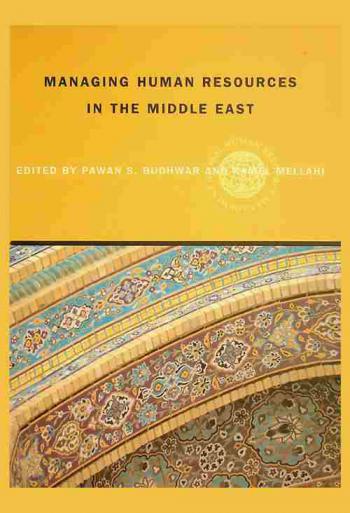
Managing human resources in the Middle East
This text presents the HRM scenario in a number of countries in the Middle East, highlighting the growth of the HR function in these countries, their dominant HRM systems, the influence of different factors and the challenges faced.
Book

Impact of technology-based knowledge sharing on employee outcomes: moderation effects of training, support and leadership
Purpose
The purpose of this paper is to focus on how adopting technologies impacts employees’ job performance and well-being. One such new job demand is the use of technology-based knowledge sharing (TBKS), which has the potential to influence employees’ job performance and well-being. Therefore, human resource managers must provide resources that facilitate the adoption of TBKS to improve job performance while minimising mental health effects.
Design/methodology/approach
Guided by social capital theory, social exchange theory and the job demands-resources model, the authors analyse survey data from 281 Vietnamese employees.
Findings
The results of this paper show that TBKS influences employee mental health and directly and indirectly affects job performance. The authors examine the moderating effects of training, transformational leadership and organisational resources on the relationship between the new job demands of TBKS on job performance and mental health outcomes.
Practical implications
TBKS platform developers should offer user-friendly interface functions and extend critical features. HRM should communicate more with employees, care about their well-being and consider their goals and values. HRM needs to provide training to help employees adapt to organisational changes. Leadership also needs to make employees perceive that organisational success is closely related to the success of TBKS.
Originality/value
This paper draws upon the three fundamental tenets of three theories as a triangular base to examine the relationship between TBKS and its outcomes. This paper contributes to the knowledge management literature by delivering a comprehensive understanding and demonstrating how the inclusion of technology in knowledge sharing and human resource practices can impact employee performance and well-being.
Journal Article


Social networking sites and employer branding: a qualitative study of Indian organizations
As social network services recently enjoyed significant popularity, social networking sites (SNS) appear as an attractive vehicle to increase an organization’s brand effectiveness. Even though there has been a significant influence of SNS on employees’ lives, there is limited focus on their application in the HRM discipline. Building on social networking theory, this study supplements an understanding of the growing utilization of SNS, specifically for employer branding in organizations. In an in-depth study comprising 54 interviews of HR professionals representing organizations operating in India, the empirical findings suggest that firms leverage large, widespread, and high-performing SNS to foster their employer branding strategies in numerous ways. This study also describes the advantages derived from the use of SNS for employer branding in organizations and elucidates the intricacies of utilizing SNS as an employer branding strategy. In doing so, we contribute to the extant literature in two ways: (1) address the need for research on SNS in relation to employer branding and (2) highlight the importance of online or virtual means in the context of employer branding. We are also responding to the calls for research that advances more interdisciplinary discussions on ‘doing business in India’, especially approaches that consider employer branding strategies and SNS.
Journal Article

Mentorship-driven Talent Management
Evidence suggests that research on mentorship has been dominated by the West, and little is known about the cultural variations of the mentoring phenomenon. This book aims to provide a deeper understanding of the contextual interpretation of mentoring by focusing on the Asian experience in countries such as China, India, Korea and Taiwan.
eBook

To Buy or Not to Buy? Exploring Ethical Consumerism in an Emerging Market—India
This article reports the findings of a field study conducted on the purchasing intentions of ethical consumers in India. We explored how the involvement of ethical consumers with social networking sites (SNSs such as Facebook, Twitter, Instagram, Snapchat, LinkedIn, and others) affects their intentions to buy ethical products. Applying an extended theoretical lens of theory of planned behavior and social capital, we present an analysis of a rich qualitative data. We identify and describe 7 dimensions, representing the 19 factors and manifesting the informational, relational, and valuation usage of SNSs that explain their impact on the purchase intention of ethical consumers in India. We conclude by highlighting the decision-making role played by the ethical knowledge and price sensitivity of ethical consumers, reflecting the peculiarities and dynamics of ethical consumption in India.
Journal Article

Pay-for-performance, procedural justice, OCB and job performance: a sequential mediation model
PurposeBuilding on the arguments of expectancy theory and social exchange theory, the present study provides insights into the process by which pay-for-performance (PFP) impacts employee job performance.Design/methodology/approachBased on a sample size of 226 employees working in a technology company in India, the study examines the relationships between PFP, procedural justice, organizational citizenship behavior (OCB) and employee job performance. Data on perceptions of PFP and procedural justice were collected from the employees, data on OCB were collected from the supervisors and the data on employee job performance were collected from organizational appraisal records.FindingsThe study found support for the positive relationship between PFP and job performance and for the sequential mediation of the relationship between PFP and job performance via procedural justice and OCB. Further, procedural justice was found to mediate the relationship between PFP and OCB.Research limitations/implicationsThe study was cross-sectional, so inferences about causality are limited.Practical implicationsThe study tests the relationship between PFP and employee job performance in the Indian work context. The study shows that the existence of PFP is positively related to procedural justice which, in turn, is positively related to OCB. The study found support for the sequential mediation of PFP-job performance relationship via procedural justice and OCB.Originality/valueThe study provides an insight into the underlying process through which PFP is related to employee job performance. To the best of our knowledge, such a study is the first of its kind undertaken in an organizational context.
Journal Article
Unlocking the relationship between ambidextrous leadership style and HRM practices in knowledge-intensive SMES
PurposeThis paper aims to explore the relationship between owner-manager or leader’s ambidextrous leadership style and its effect on human resource management (HRM) practices, contextual ambidexterity and knowledge-intensive small- and medium-enterprises (SMEs) strategic agility.Design/methodology/approachThis study presents an in-depth qualitative case study analysis of two knowledge-intensive SMEs from India’s information technology and health-care products industry serving a range of global clients. Using the theoretical lenses of empowerment-focused HRM practices, ambidextrous leaders, contextual ambidexterity and strategic agility, semi-structured interview data of leaders, managers and employees of the case organizations were analysed. Through a two-staged analytical process, we abductively developed a novel conceptual framework at the intersection of the above theoretical lenses.FindingsThe findings suggest that the knowledge-intensive SME’s strategic agility, ambidexterity and empowerment-focussed HRM approach was influenced by the owner-manager or leader’s ambidextrous leadership style and their philosophy towards managing people and had a positive impact in creating a culture of trust, participation, risk-taking and openness, and led to delivering innovative products and services as well as several positive employee-level outcomes.Originality/valueRecent literature reviews on HRM In SMEs highlight several gaps, including the impact of owner-manager or leader’s philosophy of managing people in shaping HRM practices and employee outcomes. This paper thus adds to the existing literature on HRM and knowledge-intensive SMEs.
Journal Article