
Catalogue Search | MBRL


Are you sure you want to remove the book from the shelf?

{{itemTitle}}
70
result(s) for
"Bulthuis, Kyle T"
Sort by:


The Difference Denominations Made
Scholars of African-American religious history have recently debated the significance of the black church in American history. Those that have, pro and con, have often considered the black church as a singular entity, despite the fact that African Americans affiliated with a number of different religious traditions under the umbrella of the black church. This article posits that it is useful to consider denominational and theological developments within different African-American churches. Doing so acknowledges plural creations and developments of black churches, rather than a singular black church, which better accounts for the historical experience of black religion. In this piece, I analyze four different denominational and theological traditions that blacks followed in the early Republic: the Anglican–Episcopalian, the Calvinist (Congregational–Presbyterian), the Methodist, and the Baptist. Each offered a unique ecclesiastical structure and set of theological assumptions within which black clergy and laity operated. Each required different levels of interaction with white coreligionists, and, although some tended to offer more direct opportunities for reform and resistance, all groups suffered differing constraints that limited such action. I argue that the two bodies connected to formalist traditions, the Episcopalian and Calvinist, were initially better developed despite their smaller size, and thus disproportionately shaped black community and reform efforts in the antebellum United States.
Journal Article


Four Steeples over the City Streets
Tells the diverse story of four congregations in New
York City as they navigated the social and political changes of the
late eighteenth and mid-nineteenth centuries. In the fifty
years after the Constitution was signed in 1787, New York City grew
from a port town of 30,000 to a metropolis of over half a million
residents. This rapid development transformed a once tightknit
community and its religious experience. Including four churches
belonging in various forms to the Church of England, that in some
form still thrive today. Rapid urban and social change connected
these believers in unity in the late colonial era. As the city grew
larger, more impersonal, and socially divided, churches reformed
around race and class-based neighborhoods. In Four Steeples over
the City Streets, Kyle T. Bulthuis examines the intertwining of
these four famous institutions-Trinity Episcopal, John Street
Methodist, Mother Zion African Methodist, and St. Philip's
(African) Episcopal-to uncover the lived experience of these
historical subjects, and just how religious experience and social
change connected in the dynamic setting of early Republic New York.
Drawing on a wide range of sources including congregational records
and the unique histories of some of the churches leaders, Four
Steeples over the City Streets reveals how these city churches
responded to these transformations from colonial times to the
mid-nineteenth century. Bulthuis also adds new dynamics to the
stories of well-known New Yorkers such as John Jay, James Harper,
and Sojourner Truth. More importantly, Four Steeples over the City
Streets connects issues of race, class, and gender, urban studies,
and religious experience, revealing how the city shaped these
churches, and how their respective religious traditions shaped the
way they reacted to the city. This book is a critical addition to
the study and history of African American activism and life in the
ever-changing metropolis of New York City.
eBook

Oceanic Barriers
As a distinct generation, the first authors of the British black Atlantic – writers of African descent writing in English in the last half of the eighteenth century – bridged differing worlds. The authors shared common experiences, with most having suffered in the slave trade and having celebrated evangelical religious conversions.While scholars have tended to focus on the transoceanic connections of these authors, the political schism between Britain and the United States in the 1780s divided those authors who lived in what became the United States and those who remained within the British Empire. This article explores that division, first by separating the authors into two groups, those labelled American for remaining in the United States, and those called British for residing in the British Isles or imperial possessions at their lives’ end. Second, the article explores the different experiences of each group, and the themes or approaches both groups took in their works. Black American writers generally de-emphasised political issues, forged local patronage connections, and offered a personal piety that minimised the issue of slavery. Black British writers, by contrast, would stress their African or international identity, embraced a piety that was more socially active, and focused more on issues of political rights and antislavery. The contrasts reflect different life experiences of the two groups, in part because they adapted to being governed under different polities. The larger global context of the American Revolution helps account for differences in narrative and experience among this literary generation.
Journal Article

Preacher Politics and People Power: Congregational Conflicts in New York City, 1810–1830
The 1812 Methodist Episcopal Church general conference in New York City proved contentious. In his journal entry of May 17, Bishop Francis Asbury recorded that the conference participants hotly debated the power of the denomination's bishops, particularly regarding their unchecked right to appoint lesser ministers to positions of authority. While spirited, the disagreements did not deeply divide the contestants. That evening Asbury ate dinner with seventeen ministers, many of whom had fought on opposite sites. Asbury commented, “We should thank God we are not at war with each other, as are the Episcopalians, with the pen and the press as their weapons of warfare.”
Journal Article

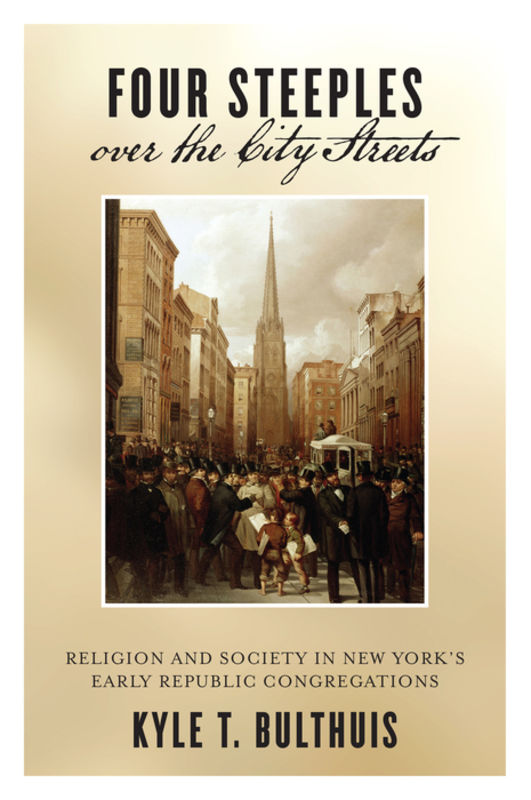
Four Steeples over the City Streets
Tells the diverse story of four congregations in New York City as they navigated the social and political changes of the late eighteenth and mid-nineteenth centuries. In the fifty years after the Constitution was signed in 1787, New York City grew from a port town of 30,000 to a metropolis of over half a million residents. This rapid development transformed a once tightknit community and its religious experience. Including four churches belonging in various forms to the Church of England, that in some form still thrive today. Rapid urban and social change connected these believers in unity in the late colonial era. As the city grew larger, more impersonal, and socially divided, churches reformed around race and class-based neighborhoods. In Four Steeples over the City Streets, Kyle T. Bulthuis examines the intertwining of these four famous institutions—Trinity Episcopal, John Street Methodist, Mother Zion African Methodist, and St. Philip’s (African) Episcopal—to uncover the lived experience of these historical subjects, and just how religious experience and social change connected in the dynamic setting of early Republic New York. Drawing on a wide range of sources including congregational records and the unique histories of some of the churches leaders, Four Steeples over the City Streets reveals how these city churches responded to these transformations from colonial times to the mid-nineteenth century. Bulthuis also adds new dynamics to the stories of well-known New Yorkers such as John Jay, James Harper, and Sojourner Truth. More importantly, Four Steeples over the City Streets connects issues of race, class, and gender, urban studies, and religious experience, revealing how the city shaped these churches, and how their respective religious traditions shaped the way they reacted to the city. This book is a critical addition to the study and history of African American activism and life in the ever-changing metropolis of New York City.
eBook