
Catalogue Search | MBRL


Are you sure you want to remove the book from the shelf?

{{itemTitle}}
807
result(s) for
"Burnett, Charles"
Sort by:


Béziers as an Astronomical Center for Jews and Christians in the Mid-Twelfth Century
The third and last of Abraham Ibn Ezra's three Hebrew treatises on the astrolabe was composed in Béziers in 1148. In 1144 or soon after, a Christian scholar, Rudolph of Bruges, composed a Latin work the construction of an astrolabe, referring to an observation he had made in the same city on April 24 of that year. The present article assembles the evidence that Béziers was a place where Jews and Christians were working together to write about and practice the science of the stars; it also proposes the identification of a certain “John David” as a patron of this activity.
Journal Article

Fame
Passions will be tested and young hearts will be broken. Ultimately, talent, dedication and hard work will triumph. Centers around a group of dancers, singers, musicians and actors at the New York City High School of Performing Arts, and their spirited drive to live out their dreams of stardom. In an incredibly competitive atmosphere, each student must shine amidst the tumult of school work, deep friendships, budding romance and self-discovery.
DVD

Al-Birūnī: An outstanding polymath of eleventh-century Islam
Abū al-Rayhān Muhammad ibn Ahmad al-Bīrūnī (973-1048) is generally regarded as a polymath within the Islamic world, considering the range and volume of his writings, his knowledge of languages and his attitude towards scientific research. This paper touches upon some aspects of his scientific endeavour and his tolerance towards other people’s ideas.
Journal Article
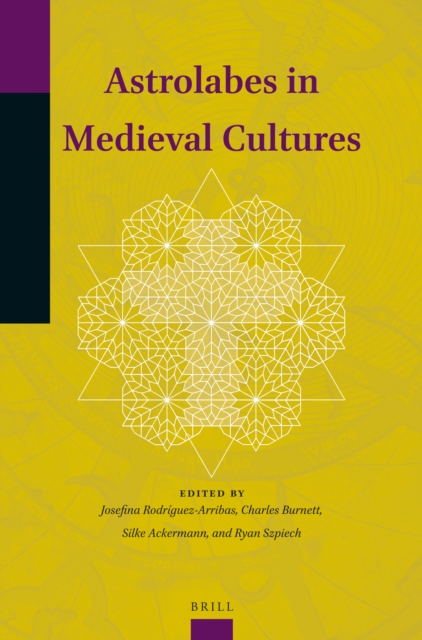
Astrolabes in Medieval Cultures
Astrolabes in Medieval Cultures brings together fifteen studies on the astrolabe in the Middle Ages. By considering sources and instruments from Muslim, Christian, and Jewish contexts, this volume provides state-of-the-art research on the history and use of the astrolabe.
eBook

Why translate science? : documents from antiquity to the 16th century in the historical West (Bactria to the Atlantic)
From antiquity to the 16th century, translation united culturally the peoples in the historical West (from Bactria to the shores of the Atlantic) and fueled the production and circulation of knowledge. The Hellenic scientific and philosophical curriculum was translated from and into, to mention the most prevalent languages, Greek, Syriac, Middle Persian, Arabic, Hebrew, and Latin.To fill a lack in existing scholarship, this volume collects the documents that present the insider evidence provided in contemporary accounts of the motivations and purposes of translation given in the personal statements by the agents in this process, the translators, scholars, and historians of each society. Presented in the original languages with an English translation and introductory essays, these documents offer material for the study of the historical contextualization of the translations, the social history of science and philosophy in their interplay with traditional beliefs, and the cultural policies and ideological underpinnings of these societies.ContributorsMichael Angold, Pieter Beullens, Charles Burnett, David Cohen, Gad Freudenthal, Dag Nikolaus Hasse, Anthony Kaldellis, Daniel King, Felix Mundt, Ignacio Sánchez, Isabel Toral, Uwe Vagelpohl, and Mohsen Zakeri.
eBook

Individual history of winning and hierarchy landscape influence stress susceptibility in mice
Social hierarchy formation is strongly evolutionarily conserved. Across species, rank within social hierarchy has large effects on health and behavior. To investigate the relationship between social rank and stress susceptibility, we exposed ranked male and female mice to social and non-social stressors and manipulated social hierarchy position. We found that rank predicts same sex social stress outcomes: dominance in males and females confers resilience while subordination confers susceptibility. Pre-existing rank does not predict non-social stress outcomes in females and weakly does so in males, but rank emerging under stress conditions reveals social interaction deficits in male and female subordinates. Both history of winning and rank of cage mates affect stress susceptibility in males: rising to the top rank through high mobility confers resilience and mice that lose dominance lose stress resilience, although gaining dominance over a subordinate animal does not confer resilience. Overall, we have demonstrated a relationship between social status and stress susceptibility, particularly when taking into account individual history of winning and the overall hierarchy landscape in male and female mice.
Journal Article

The Great Introduction to Astrology by Abū Maʿsar (2 Vols. )
These volumes present the text of Abū Ma'͑sar's Great Introduction to Astrology in Arabic (with an English translation) and Greek and the divergences in the Latin translations. It provides a fully-comprehensive account of traditional astrological doctrine and its philosophical bases.
eBook
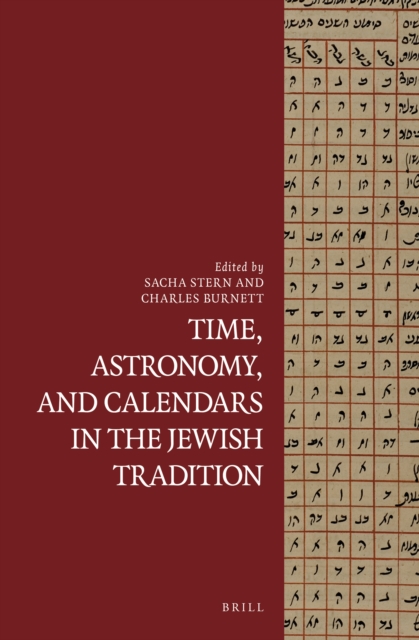
Time, Astronomy, and Calendars in the Jewish Tradition
Time Astronomy, and Calendars in the Jewish Tradition, edited by Sacha Stern and Charles Burnett, presents a wide selection of original research in the multi-disciplinary field of astronomy and calendars, from Antiquity to the late Middle Ages.
eBook

Agency and Effect in the Astrology of Abū Maʿshar of Balkh (Albumasar)
Abstract
The aim of this paper is to show how the ninth-century astrologer, Abū Maʿshar Jaʿfar b. Muḥammad b. ʿUmar al-Balkhī, accounted for generation, corruption and change in the sublunary world. He sides with the philosophers against the astrologers and takes as his principal source the Peripatetic tradition. He shows that it is the movements of the heavenly bodies, rather than their elemental qualities, that are responsible for all elemental changes, and that these changes 'result from,' or follow naturally from, those movements rather than are caused by them.
Journal Article