
Catalogue Search | MBRL


Are you sure you want to remove the book from the shelf?

{{itemTitle}}
5
result(s) for
"Bushkovitch, Paul, author"
Sort by:

Peter the Great
\"Now in a new edition, this penetrating study by noted Yale historian Paul Bushkovitch casts new light on the profound impact of Peter the Great, one of the most revered and enigmatic leaders in world history, whose influence ultimately paved the way for liberalism, Western-style nationalism, and communism in Russia\"-- Provided by publisher.
Book
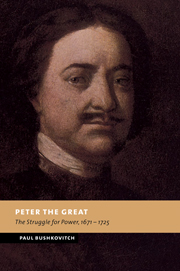
Peter the Great
A narrative of the fifty years of political struggles at the Russian court, 1671–1725. This book shows how Peter the Great was not the all-powerful tsar working alone to reform Russia, but that he colluded with powerful and contentious aristocrats in order to achieve his goals. After the early victory of Peter's boyar supporters in the 1690s, Peter turned against them and tried to rule through favourites - an experiment which ended in the establishment of a decentralized 'aristocratic' administration, followed by an equally aristocratic Senate in 1711. The aristocrats' hegemony came to an end in the wake of the affair of Peter's son, Tsarevich Aleksei, in 1718. After that moment Peter ruled through a complex group of favourites, a few aristocrats and appointees promoted through merit, and carried out his most long-lasting reforms. The outcome was a new balance of power at the centre and a new, European, conception of politics.
eBook
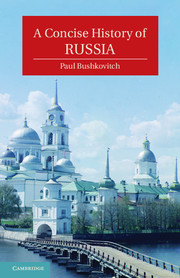
A Concise History of Russia
Accessible to students, tourists and general readers alike, this book provides a broad overview of Russian history since the ninth century. Paul Bushkovitch emphasizes the enormous changes in the understanding of Russian history resulting from the end of the Soviet Union in 1991. Since then, new material has come to light on the history of the Soviet era, providing new conceptions of Russia's pre-revolutionary past. The book traces not only the political history of Russia, but also developments in its literature, art and science. Bushkovitch describes well-known cultural figures, such as Chekhov, Tolstoy and Mendeleev, in their institutional and historical contexts. Though the 1917 revolution, the resulting Soviet system and the Cold War were a crucial part of Russian and world history, Bushkovitch presents earlier developments as more than just a prelude to Bolshevik power.
eBook


Letters from Heaven
Letters from Heavenfeatures an international group of scholars investigating the place and function of 'popular' religion in Eastern Slavic cultures. The contributors examine popular religious practices in Russia and Ukraine from the middle ages to the present, considering the cultural contexts of death rituals, miracles, sin and virtue, cults of the saints, and icons. The collection not only fills a void in religious scholarship, but also responds to current theoretical challenges.
Reflecting critically on the heuristic value of popular religion and on the concept of popular culture in general,Letters from Heavenis characterized by a shift of focus from churches, institutions, and theological discourse to the religious practices themselves and their interconnections with the culture, mentality, and social structures of the societies in question. An important contribution to the fields of religion and Eastern Slavic studies, this volume challenges readers to rethink old pieties and to reconsider the function of religion.
eBook