
Catalogue Search | MBRL


Are you sure you want to remove the book from the shelf?

{{itemTitle}}
155
result(s) for
"Butter, Michael"
Sort by:

From Panem to the Pandemic: An Introduction to Cultural Studies
Today, virtually all BA programs in English at German universities place a strong focus on Cultural Studies. However, textbooks that introduce first-year students to the subject are rare, and the few existing ones are too complicated or not comprehensive enough. By contrast, this textbook introduces the key theories and concepts of Cultural Studies systematically and thoroughly. It puts particular emphasis on their application, aiming to enable students to do their own analyses of cultural artefacts and practices. The author draws on many examples, mostly taken from American culture, but in each chapter, he applies the ideas introduced to The Hunger Games franchise and the coronavirus pandemic to show how different theories can lead to very different interpretations of the same phenomenon. Each chapter ends with exercises that allow students to apply what they have learned. With YouTube videos.
eBook


Conspiracy Theories in the United States and the Middle East
The linguae& litterae series, edited by Peter Auer, Gesa von Essen and Werner Frick, documents the research activities of the School of Languageand Literature of the Freiburg Institute for Advanced Studies (FRIAS). These research activities in literary studies and linguistics are characterized by an approach that is theoretically and methodologically \"state of the art\" and interdisciplinarily open. In linguistics the accent is on the corpus-based, quantitative and qualitative investigation of language; in literary studies the focus is on the comparative, transdisciplinary analysis of literary phenomena in their cultural contexts. At the same time the series deals with the productive interfaces and synergies between modern linguistics and literary studies (as well as the humanities, social and natural sciences with which they interact). It seeks a new, contemporary reformulation of the humanities research curriculum and its problem and concept orientation for the future. The series has a clear international orientation - each volume is multilingual, containing German, English and French contributions and, depending on the volume, articles in Italian or Spanish as well. Each individual volume is peer reviewed by an international editorial board. Each year 2-4 volumes are published.
eBook


Plots, Designs, and Schemes
Plots, Designs, and Schemes is the first study that investigates the long history of American conspiracy theories from the perspective of literary and cultural studies. Since research in these fields has so far almost exclusively focused on the contemporary period, the book concentrates on the time before 1960. Four detailed case studies offer close readings of the Salem witchcraft crisis of 1692, fears of Catholic invasion during the 1830s to 1850s, antebellum conspiracy theories about slavery, and anxieties about Communist subversion during the 1950s. The study primarily engages with factual texts, such as sermons, pamphlets, political speeches, and confessional narratives, but it also analyzes how fears of conspiracy were dramatized and negotiated in fictional texts, such as Nathaniel Hawthorne's Young Goodman Brown (1835) or Hermann Melville's Benito Cereno (1855). The book offers three central insights: 1. The American predilection for conspiracy theorizing can be traced back to the co-presence and persistence of a specific epistemological paradigm that relates all effects to intentional human action, the ideology of republicanism, and the Puritan heritage. 2. Until far into the twentieth century, conspiracy theories were considered a perfectly legitimate form of knowledge. As such, they shaped how many Americans, elites as well as \"common\" people, understood and reacted to historical events. The Revolutionary War and the Civil War would not have occurred without widespread conspiracy theories. 3. Although most extant research claims the opposite, conspiracy theories have never been as marginal and unimportant as in the past decades. Their disqualification as stigmatized knowledge only occurred around 1960, and coincided with a shift from theories that detect conspiracies directed against the government to conspiracies by the government.
eBook
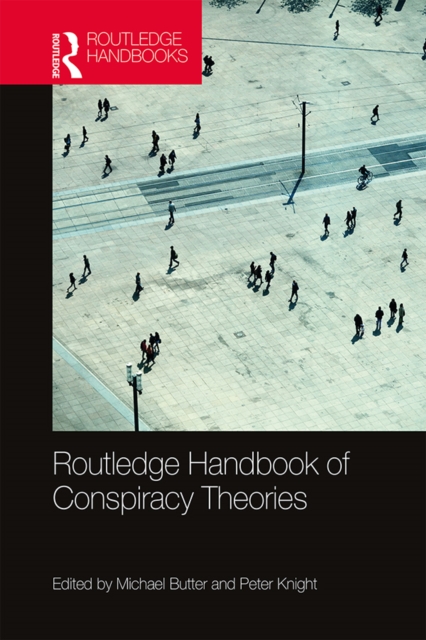
Routledge Handbook of Conspiracy Theories
Taking a global and interdisciplinary approach, the Routledge Handbook of
Conspiracy Theories provides a comprehensive overview of conspiracy
theories as an important social, cultural and political phenomenon in contemporary
life.
This handbook provides the most complete analysis of the phenomenon to date. It
analyses conspiracy theories from a variety of perspectives, using both qualitative
and quantitative methods. It maps out the key debates, and includes chapters on the
historical origins of conspiracy theories, as well as their political significance
in a broad range of countries and regions. Other chapters consider the psychology
and the sociology of conspiracy beliefs, in addition to their changing cultural
forms, functions and modes of transmission. This handbook examines where conspiracy
theories come from, who believes in them and what their consequences are.
This book presents an important resource for students and scholars from a range of
disciplines interested in the societal and political impact of conspiracy theories,
including Area Studies, Anthropology, History, Media and Cultural Studies, Political
Science, Psychology and Sociology.
eBook