
Catalogue Search | MBRL


Are you sure you want to remove the book from the shelf?

{{itemTitle}}
199
result(s) for
"Byram, Michael"
Sort by:
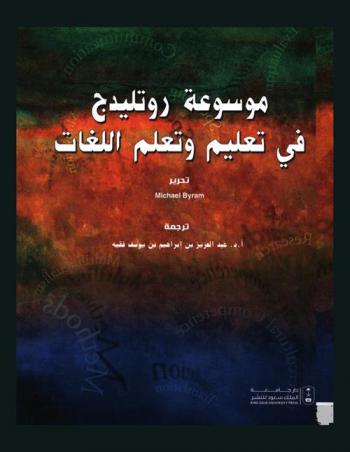
موسوعة روتليدج في تعليم وتعلم اللغات
موسوعة روتليدج لتعليم وتعلم اللغة تعتبر مصدرا علميا هاما في مجال تعليم وتعلم اللغة وهي مرجع رئيس للباحثين بشكل عام وطلاب الدراسات العليا على وجه الخصوص فالموسوعة تقدم مجموعة شاملة من المقالات حول تدريس اللغة المعاصرة وتاريخها تشمل : الطرق والمواد التقييم والاختبارات بيئات التعلم الشخصيات المؤثرة في تاريخ اللغويات علم النفس اللغوي والأنثروبولوجيا وعلم اللغة الاجتماعي كما تحتوي مقالات عن تعليم اللغات الحية منها العربية، وتتضمن 35 مقالة في قضايا التدريس التواصلي وتعلم اللغات مبكرا وتعليم المعلمين وتصميم المناهج الدراسية.
ENCYL

Teaching and Assessing Intercultural Communicative Competence
This revised edition of Michael Byram's classic 1997 book
updates the text in light of both recent research and critiques and
commentaries on the 1st edition. Beginning from the premise that
foreign and second language teaching should prepare learners to use
a language with fluency and accuracy, and also to speak with people
who have different cultural identities, social values and
behaviours, the book is an invaluable guide for teachers and
curriculum developers, taking them from a definition of
Intercultural Communicative Competence through planning for
teaching to assessment. This edition refines the definitions of the
five 'savoirs' of intercultural competence, and includes new
sections on issues such as moral relativism and human rights,
mediation, intercultural citizenship and teachers' ethical
responsibilities.
eBook


Linguistic and Cultural Education for Bildung and Citizenship
At the heart of theory and practice in foreign language teaching, as of education in general, is the need to clarify purposes. Given the number of books and articles on methods and techniques for the classroom, it might appear that it is methodology that is central. The dominant contemporary assumption is that the purpose of foreign language teaching is to develop communicative competence and discussion turns around \"communicative methodology\" in its various forms, but methodology is a second-order issue derived from the question of purposes. Here, Byram focuses on purposes--avoiding the narrowness of the terms \"aims and objectives\"--and suggests that a reappraisal of purposes with respect to the cultural dimension of foreign language teaching will lead to richer, more complex outcomes.
Journal Article

Making a difference: Language teaching for intercultural and international dialogue
Language teaching has long been associated with teaching in a country or countries where a target language is spoken, but this approach is inadequate. In the contemporary world, language teaching has a responsibility to prepare learners for interaction with people of other cultural backgrounds, teaching them skills and attitudes as well as knowledge. This article presents the main concepts involved in this view of language teaching: the notion of culture, the language‐culture nexus, and intercultural competence. It also explains the implications of the approach in terms of the skills, attitudes, and knowledge that should be taught. The article goes further: It argues that language teaching needs to be linked to other disciplines in order to develop an approach that integrates insights from citizenship education. All of this has implications for teachers’ professional identity and for cooperation across the curriculum. The Challenge Linguistic competence needs to be enriched with deep intercultural competence. How can world language educators help language learners to develop increasingly sophisticated linguistic and intercultural knowledge and skills and apply them in other courses and experiences so as to enact their intercultural citizenship in the here and now? Video & Discussion
Journal Article

Ethical Challenges in Intercultural Citizenship Education with ‘Difficult Topics’ in the World Language Classroom and Beyond
The purpose of this article is to examine the ethical challenges that arise in the world language classroom and beyond from using intercultural citizenship pedagogy. Intercultural citizenship is, in general, seen as a recent and positive development in intercultural language education for helping students engage with topics of social significance in the classroom. However, there are ethical challenges involved, for instance, related to the political or sensitive nature of such topics. We define and illustrate some of these ethical concerns and their implications for education by drawing on an intercultural citizenship project about COVID-19 carried out in two higher education contexts in 2020. The analysis of this example shows that these ethical concerns are unavoidable but can be minimised with an action research perspective and a combination of pedagogies of intercultural citizenship, discomfort, and the arts. We conclude with a discussion of the transferability of the example and its consequences for any language and intercultural communication teaching which deals with controversial and sensitive matters.
Journal Article

Beyond Teaching Languages for Communication—Humanistic Perspectives and Practices
Our purpose is to trace and explain theoretical and practical developments in foreign/world language teaching over the last decade or more. Language teaching in its modern form, from the Reform Movement of the late 19th century, has focused upon the need for learners to learn or acquire a foreign language in order to use it for communication. Other purposes involve language learning as an intellectual exercise, the development of a language faculty, and opening (young) people’s eyes to new worlds by introducing them to other countries. Here, we argue that these purposes are reasonable and enriching, but only if they are combined. We suggest that, by taking a humanistic perspective, language teaching can go beyond communication as a dominant purpose. This humanistic perspective is realised through two complementary developments. One is to emphasise that learners are members of various communities, including their local community, their national community, and a world community. The second is to pay attention to the fact that learners bring to the classroom their concerns and fears, especially in times of crisis. Language teachers, who are not only instructors in skills but educators of the whole person, should respond to their learners’ needs both as denizens of their society and as unique individuals. We first explain the theoretical framework and how it has evolved and then describe two experimental projects, one which focuses on the societal needs and one which adds to this a response to the affective needs of learners. We finally discuss how a recent controversy might be addressed in the language teaching class.
Journal Article

The common European framework of reference
A comparative study of the impact of the Common European Framework of Reference for Languages produced by the Council of Europe in 2001, this book asks writers in European countries and countries in the Americas and Asia to explain the influence of the CEFR. For each country there is a policy-maker and an academic perspective.
eBook

Education for intercultural citizenship
This book presents a vision of education for citizenship,
which takes as its starting point an account of what it means
to be intercultural. Theory and concepts of interculturality
are applied to citizenship education in order to extend its
meaning and significance within and beyond the nation state.
The book advances a concept of intercultural citizenship which
is sensitive to complexities of identity and diversity and,
through international case studies, analyses the degree to
which intercultural citizenship is present or emergent in
contemporary education systems It provides a statement of
‘axioms and characteristics’ of education for
intercultural citizenship to act both as a framework for
planning education for intercultural citizenship and as
criteria for evaluating the degree of intercultural citizenship
education already present in existing education systems. The
book will be of interest to those currently working in
intercultural education as well as those who work in education
for citizenship.
eBook
Teaching intercultural citizenship through intercultural service learning in world language education
Globalization and internationalization have created a need for dialog among people of different persuasions in our own societies and beyond. Language teachers can meet this challenge through the concepts of intercultural citizenship and intercultural service learning, renewing emphasis on educational and humanistic aims as well as instrumental. Students in an advanced Spanish course volunteered in a school and a legal center, interacting one‐on‐one with unaccompanied minors and immigrants fleeing Central America. The evaluation focused on the impact on learners’ understanding of the society in which they live, and perceptions of their own language learning during their work as active citizens. Data from students' academic blogs and diaries were analyzed thematically. They show a heightened awareness of language competence, as students use their knowledge of Spanish in their voluntary work, and increased intercultural competence in students' reports on their critical evaluation of perspectives and practices in their own culture and those of others. The Challenge It is not enough for education to be seen as preparation for future life in society when learners are already members of their society. We present and illustrate a methodology that enables language educators to increase linguistic and intercultural proficiency whilst enabling learners to be active in their society in the present.
Journal Article