
Catalogue Search | MBRL


Are you sure you want to remove the book from the shelf?

{{itemTitle}}
2,955
result(s) for
"C. G. Jung"
Sort by:


Synchronicity
Jung was intrigued from early in his career with coincidences, especially those surprising juxtapositions that scientific rationality could not adequately explain. He discussed these ideas with Albert Einstein before World War I, but first used the term \"synchronicity\" in a 1930 lecture, in reference to the unusual psychological insights generated from consulting the I Ching. A long correspondence and friendship with the Nobel Prize-winning physicist Wolfgang Pauli stimulated a final, mature statement of Jung's thinking on synchronicity, originally published in 1952 and reproduced here. Together with a wealth of historical and contemporary material, this essay describes an astrological experiment Jung conducted to test his theory. Synchronicity reveals the full extent of Jung's research into a wide range of psychic phenomena.
eBook


The transcendent function : Jung's model of psychological growth through dialogue with the unconscious
The transcendent function is the core of Carl Jung’s theory of psychological growth and the heart of what he called individuation, the process by which one is guided in a teleological way toward the person one is meant to be. This book thoroughly reviews the transcendent function, analyzing both the 1958 version of the seminal essay that bears its name and the original version written in 1916. It also provides a word-by-word comparison of the two, along with every reference Jung made to the transcendent function in his written works, his letters, and his public seminars.
eBook

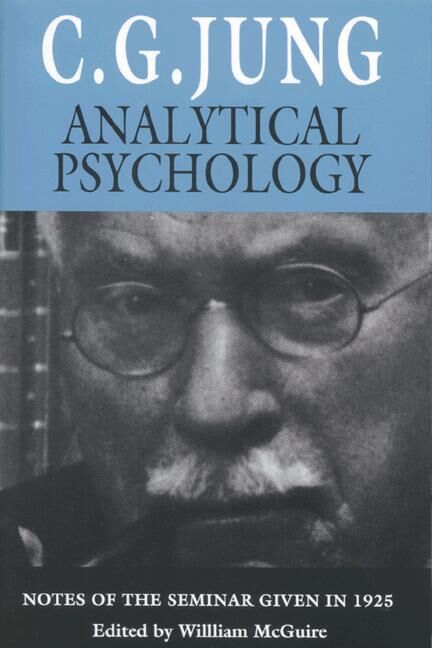
Analytical psychology
For C. G. Jung, 1925 was a watershed year. He turned fifty, visited the Pueblo Indians of New Mexico and the tribesmen of East Africa, published his first book on the principles of analytical psychology meant for the lay public, and gave the first of his formal seminars in English. The seminar, conducted in weekly meetings during the spring and summer, began with a notably personal account of the development of his thinking from 1896 up to his break with Freud in 1912. It moved on to discussions of the basic tenets of analytical psychology--the collective unconscious, typology, the archetypes, and the anima/animus theory. In the elucidation of that theory, Jung analyzed in detail the symbolism in Rider Haggard's She and other novels. Besides these literary paradigms, he made use of case material, examples in the fine arts, and diagrams.
eBook
علم النفس التحليلي 1 / 2
يعرض الكتاب مفاهيم يونغ الأساسية مثل اللاوعي الجمعي، الأنيما والأنيموس، الذات، والظل، ويوضح الفرق بين اللاشعور الشخصي واللاشعور الجمعي، يناقش دور الرموز والأحلام في فهم النفس، ويبرز أهمية التحليل الفردي في تحقيق التوازن النفسي، الكتاب يظهر كيف يسهم علم النفس التحليلي في فهم الشخصية والنمو الداخلي عبر الاندماج مع مكونات النفس غير الواعية.
BOOK
Answer to job (Bollingen series XX)
Considered one of Jung's most controversial works, Answer to Job also stands as Jung's most extensive commentary on a biblical text. Here, he confronts the story of the man who challenged God, the man who experienced hell on earth and still did not reject his faith. Job's journey parallels Jung's own experience--as reported in The Red Book: Liber Novus--of descending into the depths of his own unconscious, confronting and reconciling the rejected aspects of his soul.
eBook

The undiscovered self with symbols and the interpretation of dreams (Bollingen series XX)
These two essays, written late in Jung's life, reflect his responses to the shattering experience of World War II and the dawn of mass society. Among his most influential works, \"The Undiscovered Self\" is a plea for his generation--and those to come--to continue the individual work of self-discovery and not abandon needed psychological reflection for the easy ephemera of mass culture. Only individual awareness of both the conscious and unconscious aspects of the human psyche, Jung tells us, will allow the great work of human culture to continue and thrive.
Jung's reflections on self-knowledge and the exploration of the unconscious carry over into the second essay, \"Symbols and the Interpretation of Dreams,\" completed shortly before his death in 1961. Describing dreams as communications from the unconscious, Jung explains how the symbols that occur in dreams compensate for repressed emotions and intuitions. This essay brings together Jung's fully evolved thoughts on the analysis of dreams and the healing of the rift between consciousness and the unconscious, ideas that are central to his system of psychology.
This paperback edition of Jung's classic work includes a new foreword by Sonu Shamdasani, Philemon Professor of Jung History at University College London.
eBook