
Catalogue Search | MBRL


Are you sure you want to remove the book from the shelf?

{{itemTitle}}
1,516
result(s) for
"Cameron, Deborah"
Sort by:

Feminism : a brief introduction to the ideas, debates, and politics of the movement
A concise evaluation of modern feminism that examines its key ideas, theoretical approaches and political movements while sharing comprehensive, intellectual insights into the diversity of feminist thought. --Publisher
BOOK
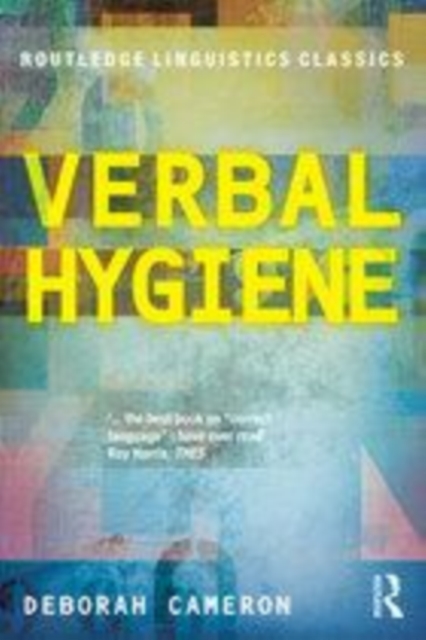
Verbal Hygiene
In Verbal Hygiene, Deborah Cameron takes a serious look at popular attitudes towards language and examines the practices by which people attempt to regulate its use. Instead of dismissing the practice of 'verbal hygiene', as a misguided and pernicious exercise, she argues that popular discourse about language values - good and bad, right and wrong - serves an important function for those engaged in it. A series of case studies deal with specific examples of verbal hygiene: the regulation of 'style' by editors, the teaching of English grammar in schools, the movements for and against so-called 'politically correct' language and the advice given to women on how they can speak more effectively.
This Routledge Linguistics Classic includes a new foreword which looks at how the issues covered in the case studies have developed over time and a new afterword which discusses new concerns which have emerged in the last 15 years, from the regimentation of language in the workplace to panics about immigration and terrorism, which are expressed in linguistic terms.
Addressed to linguists, to professional language-users of all kinds, and to anyone interested in language and culture, Verbal Hygiene calls for legitimate concerns about language and value to be discussed, by experts and lay-speakers alike, in a rational and critical spirit.
eBook


More Heat Than Light?
In the Sedgewick lecture for 2012, Professor Deborah Cameron investigates the age-old question of whether men and women are different kinds of beings, both physically and intellectually. She begins by noting that in the 19th century that most writers saw men as being intellectually superior to women in their use of language. But she also observes that this position was gradually modified in the 20th century, that is, until the 1990s, when there was a sudden resurgence of the essentialist idea, this time with many writers concluding that women were programmed to be the better language users. Cameron examines closely the claims of a number of popular self-help books on the subject, and then proceeds to show how many of the more supposedly scientific books rely on a form of \"neurobabble\" to make similar claims about the alleged hard-wired intellectual differences between men and women. The question then becomes, why is it that this essentialist view has caught on? Cameron suggests that it is in part a way of responding to the pervasive anxiety brought about by massive social changes in the roles of men and women. She also cautions that this new essentialism is having potentially drastic consequences on the theories and practice of how boys and girls, men and women, are educated.
eBook
العولمة وتدريس اللغة
هذا الكتاب مقسم إلى ثلاثة أبواب : يعرض الباب الأول لثلاثة نماذج لتدريس اللغة الأجنبية أو اللغة الثانية هي الأنموذج الياباني والأنموذج الكندي والأنموذج البريطاني، أما الباب الثاني فيتناول مدى إمكانية تحقيق التواصل الصحي بين ثقافات العالم في عصر العولمة ومستجداته من خلال تدريس مهارات الاتصال وطرق محو الأمية-المحلي منها والعالمي، ويتعرض الباب الثالث لقضايا محتوى مقررات اللغة والطرائق المختلفة لتدريسها، ويحمد للمحررين إدراج مقالات وأبحاث تعلي من شأن الجانب المحلي والإقليمي ثقافيا وأخلاقيا.
Book

Physical Examinations via Video for Patients With Heart Failure: Qualitative Study Using Conversation Analysis
Video consultations are increasingly seen as a possible replacement for face-to-face consultations. Direct physical examination of the patient is impossible; however, a limited examination may be undertaken via video (eg, using visual signals or asking a patient to press their lower legs and assess fluid retention). Little is currently known about what such video examinations involve.
This study aimed to explore the opportunities and challenges of remote physical examination of patients with heart failure using video-mediated communication technology.
We conducted a microanalysis of video examinations using conversation analysis (CA), an established approach for studying the details of communication and interaction. In all, seven video consultations (using FaceTime) between patients with heart failure and their community-based specialist nurses were video recorded with consent. We used CA to identify the challenges of remote physical examination over video and the verbal and nonverbal communication strategies used to address them.
Apart from a general visual overview, remote physical examination in patients with heart failure was restricted to assessing fluid retention (by the patient or relative feeling for leg edema), blood pressure with pulse rate and rhythm (using a self-inflating blood pressure monitor incorporating an irregular heartbeat indicator and put on by the patient or relative), and oxygen saturation (using a finger clip device). In all seven cases, one or more of these examinations were accomplished via video, generating accurate biometric data for assessment by the clinician. However, video examinations proved challenging for all involved. Participants (patients, clinicians, and, sometimes, relatives) needed to collaboratively negotiate three recurrent challenges: (1) adequate design of instructions to guide video examinations (with nurses required to explain tasks using lay language and to check instructions were followed), (2) accommodation of the patient's desire for autonomy (on the part of nurses and relatives) in light of opportunities for involvement in their own physical assessment, and (3) doing the physical examination while simultaneously making it visible to the nurse (with patients and relatives needing adequate technological knowledge to operate a device and make the examination visible to the nurse as well as basic biomedical knowledge to follow nurses' instructions). Nurses remained responsible for making a clinical judgment of the adequacy of the examination and the trustworthiness of the data. In sum, despite significant challenges, selected participants in heart failure consultations managed to successfully complete video examinations.
Video examinations are possible in the context of heart failure services. However, they are limited, time consuming, and challenging for all involved. Guidance and training are needed to support rollout of this new service model, along with research to understand if the challenges identified are relevant to different patients and conditions and how they can be successfully negotiated.
Journal Article
Video Consultations Between Patients and Clinicians in Diabetes, Cancer, and Heart Failure Services: Linguistic Ethnographic Study of Video-Mediated Interaction
Video-mediated clinical consultations offer potential benefits over conventional face-to-face in terms of access, convenience, and sometimes cost. The improved technical quality and dependability of video-mediated consultations has opened up the possibility for more widespread use. However, questions remain regarding clinical quality and safety. Video-mediated consultations are sometimes criticized for being not as good as face-to-face, but there has been little previous in-depth research on their interactional dynamics, and no agreement on what a good video consultation looks like.
Using conversation analysis, this study aimed to identify and analyze the communication strategies through which video-mediated consultations are accomplished and to produce recommendations for patients and clinicians to improve the communicative quality of such consultations.
We conducted an in-depth analysis of the clinician-patient interaction in a sample of video-mediated consultations and a comparison sample of face-to-face consultations drawn from 4 clinical settings across 2 trusts (1 community and 1 acute care) in the UK National Health Service. The video dataset consisted of 37 recordings of video-mediated consultations (with diabetes, antenatal diabetes, cancer, and heart failure patients), 28 matched audio recordings of face-to-face consultations, and fieldnotes from before and after each consultation. We also conducted 37 interviews with staff and 26 interviews with patients. Using linguistic ethnography (combining analysis of communication with an appreciation of the context in which it takes place), we examined in detail how video interaction was mediated by 2 software platforms (Skype and FaceTime).
Patients had been selected by their clinician as appropriate for video-mediated consultation. Most consultations in our sample were technically and clinically unproblematic. However, we identified 3 interactional challenges: (1) opening the video consultation, (2) dealing with disruption to conversational flow (eg, technical issues with audio and/or video), and (3) conducting an examination. Operational and technological issues were the exception rather than the norm. In all but 1 case, both clinicians and patients (deliberately or intuitively) used established communication strategies to successfully negotiate these challenges. Remote physical examinations required the patient (and, in some cases, a relative) to simultaneously follow instructions and manipulate technology (eg, camera) to make it possible for the clinician to see and hear adequately.
A remote video link alters how patients and clinicians interact and may adversely affect the flow of conversation. However, our data suggest that when such problems occur, clinicians and patients can work collaboratively to find ways to overcome them. There is potential for a limited physical examination to be undertaken remotely with some patients and in some conditions, but this appears to need complex interactional work by the patient and/or their relatives. We offer preliminary guidance for patients and clinicians on what is and is not feasible when consulting via a video link.
RR2-10.2196/10913.
Journal Article

Out there learning : critical reflections on off-campus study programs
\"Universities across North America and beyond are experiencing growing demand for off-campus, experiential learning. Exploring the foundations of what it means to learn \"out there,\" Out There Learning is an informed, critical investigation of the pedagogical philosophies and practices involved in short-term, off-campus programs or field courses. Bringing together contributors' individual research and experience teaching or administering off-campus study programs, Out There Learning examines and challenges common assumptions about pedagogy, place, and personal transformation, while also providing experience-based insights and advice for getting the most out of faculty-led field courses.\" --Provided by publisher.
Book

Good to talk? : living and working in a communication culture
`Good to Talk demonstrates powerfully why it is increasingly not so good to talk. Deborah Cameron details how talk is increasingly \"stylized\", codified, standardized, and the subject of surveillance. Just as Michel Foucault demonstrated in the case of sex in the Victorian era, Cameron shows that there is entirely too much talk about talk′ - George Ritzer, University of Maryland `This is what an academic book should be: cool, well informed, and entertaining; a thought-provoking and dismaying study of how our everyday sense of talk as a social pleasure is now under threat from the ideology of talk as therapeutic and occupational duty′ - Simon Frith, University of Stirling.
eBook