
Catalogue Search | MBRL


Are you sure you want to remove the book from the shelf?

{{itemTitle}}
4,700
result(s) for
"Campbell, J. B."
Sort by:


Rivers and the power of ancient Rome
Figuring in myth, religion, law, the military, commerce, and transportation, rivers were at the heart of Rome's increasing exploitation of the environment of the Mediterranean world. In Rivers and the Power of Ancient Rome, Brian Campbell explores the role and influence of rivers and their surrounding landscape on the society and culture of the Roman Empire. Examining artistic representations of rivers, related architecture, and the work of ancient geographers and topographers, as well as writers who describe rivers, Campbell reveals how Romans defined the geographical areas they conquered and how geography and natural surroundings related to their society and activities. In addition, he illuminates the prominence and value of rivers in the control and expansion of the Roman Empire — through the legal regulation of riverine activities, the exploitation of rivers in military tactics, and the use of rivers as routes of communication and movement. Campbell shows how a technological understanding of — and even mastery over — the forces of the river helped Rome rise to its central place in the ancient world.
eBook

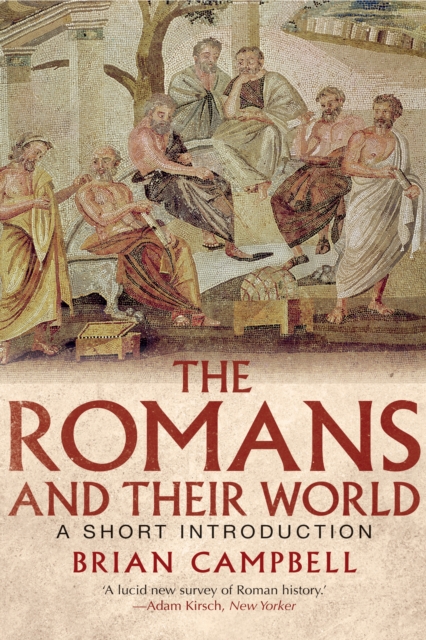
The Romans and their world
This one-volume history of the Roman world begins with the early years of the republic and carries the story nearly a thousand years forward to 476, when Romulus Augustus, the last Western Roman emperor, was deposed. Brian Campbell, respected scholar and teacher, presents a fascinating and wide-ranging introduction to Rome, drawing on an array of ancient sources and covering topics of interest to readers with little prior background in Roman history as well as those already familiar with the great civilization.Campbell explores several themes, including the fall of the republic, the impact of colorful and diverse emperors on imperial politics, the administrative structure of empire, and the Roman army and how warfare affected the Roman world. He also surveys cultural and social life, including religion and the rise of Christianity. Generously enhanced with maps and illustrations, this book is a rich and inspiring account of a mighty civilization and the citizens who made it so.
eBook


A generalised instantaneous non-active power theory for STATCOM
A generalised instantaneous non-active power theory is presented. Comprehensive definitions of instantaneous active and non-active currents, as well as instantaneous, average and apparent powers, are proposed. These definitions have flexible forms that are applicable to different power systems, such as single-phase or multi-phase, periodic or non-periodic and balanced or unbalanced systems. By changing the averaging interval and the reference voltage, various non-active power theories can be derived from this theory. The definitions of instantaneous active and non-active currents provide an algorithm for a STATCOM to calculate the non-active current in the load current. The theory is implemented by the STATCOM, and four cases (three-phase balanced RL load, three-phase unbalanced RL load, diode rectifier load and single-phase load) are tested. The experimental results show that the STATCOM can perform instantaneous non-active power compensation, and both the fundamental non-active component and the harmonics are eliminated from the utility, so that nearly unity power factor can be achieved. The STATCOM also has a fast dynamic response for transients.
Journal Article

The Oxford handbook of W.B. Yeats
A Handbook devoted to the poet W.B. Yeats (1865-1939) that examines how his work as a poet, playwright, critic, and public figure in the late 19th through the mid-20th century continues to influence writing in English, Irish, and worldwide Anglophone literatures.
Book

Technical note: Instantaneous sampling intervals validated from continuous video observation for behavioral recording of feedlot lambs
When considering methodologies for collecting behavioral data, continuous sampling provides the most complete and accurate data set whereas instantaneous sampling can provide similar results and also increase the efficiency of data collection. However, instantaneous time intervals require validation to ensure accurate estimation of the data. Therefore, the objective of this study was to validate scan sampling intervals for lambs housed in a feedlot environment. Feeding, lying, standing, drinking, locomotion, and oral manipulation were measured on 18 crossbred lambs housed in an indoor feedlot facility for 14 h (0600-2000 h). Data from continuous sampling were compared with data from instantaneous scan sampling intervals of 5, 10, 15, and 20 min using a linear regression analysis. Three criteria determined if a time interval accurately estimated behaviors: 1) ≥ 0.90, 2) slope not statistically different from 1 ( > 0.05), and 3) intercept not statistically different from 0 ( > 0.05). Estimations for lying behavior were accurate up to 20-min intervals, whereas feeding and standing behaviors were accurate only at 5-min intervals (i.e., met all 3 regression criteria). Drinking, locomotion, and oral manipulation demonstrated poor associations () for all tested intervals. The results from this study suggest that a 5-min instantaneous sampling interval will accurately estimate lying, feeding, and standing behaviors for lambs housed in a feedlot, whereas continuous sampling is recommended for the remaining behaviors. This methodology will contribute toward the efficiency, accuracy, and transparency of future behavioral data collection in lamb behavior research.
Journal Article

