
Catalogue Search | MBRL


Are you sure you want to remove the book from the shelf?

{{itemTitle}}
11,668
result(s) for
"Campbell, Neil"
Sort by:

Post-westerns : cinema, region, West
\"A study of post-1945 contemporary Western films within the social and cultural context of western studies\"-- Provided by publisher.
Book

High-charge electron beams from a laser-wakefield accelerator driven by a CO2 laser
Laser-wakefield accelerators (LWFAs) driven by widely available 100s TW-class near-infrared laser systems have been shown to produce GeV-level electron beams with 10s–100s pC charge in centimetre-scale plasma. As the strength of the ponderomotive force is proportional to the square of the laser wavelength, more efficient LWFAs could be realised using longer wavelength lasers. Here we present a numerical study showing that
10.6
μ
m
, sub-picosecond CO
2
lasers with peak powers of 100–800 TW can produce high-charge electron beams, exceeding that possible from LWFAs driven by femtosecond near-infrared lasers by up to three orders of magnitude. Depending on the laser and plasma parameters, electron beams with 10s MeV to GeV energy and 1–100 nC charge can be generated in 10–200 mm long plasma or gas media without requiring external guiding. The laser-to-electron energy conversion efficiency can be up to 70% and currents of 100s kA are achievable. A CO
2
laser driven LWFA could be useful for applications requiring compact and industrially robust accelerators and radiations sources.
Journal Article

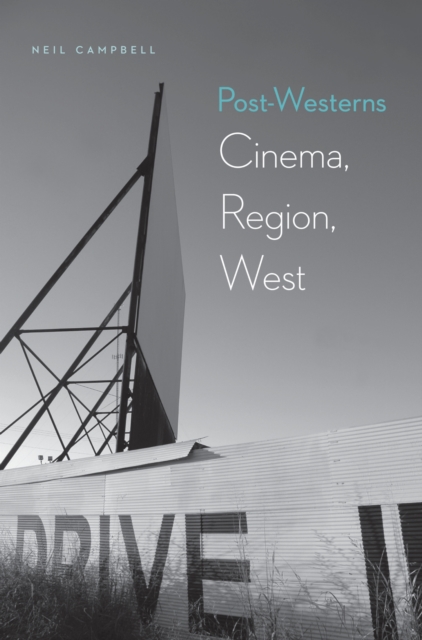
Post-Westerns: Cinema, Region, West
During the post-World War II period, the Western, like America's other great film genres, appeared to collapse as a result of revisionism and the emergence of new forms. Perhaps, however, as theorists like Gilles Deleuze suggest, it remains, simply \"maintaining its empty frame.\" Yet this frame is far from empty, as Post-Westerns shows us: rather than collapse, the Western instead found a new form through which to scrutinize and question the very assumptions on which the genre was based. Employing the ideas of critics such as Deleuze, Jacques Derrida, and Jacques Rancière, Neil Campbell examines the haunted inheritance of the Western in contemporary U.S. culture. His book reveals how close examination of certain postwar films-including Bad Day at Black Rock, The Misfits, Lone Star, Easy Rider, Gas Food Lodging, Down in the Valley, and No Country for Old Men-reconfigures our notions of region and nation, the Western, and indeed the West itself.Campbell suggests that post-Westerns are in fact \"ghost-Westerns,\" haunted by the earlier form's devices and styles in ways that at once acknowledge and call into question the West, both as such and in its persistent ideological framing of the national identity and values.
eBook


The Rhizomatic West
Is the American West in Sergio Leone's \"spaghetti westerns\" the same American West we find in Douglas Coupland'sGeneration X? In Jim Jarmusch's movies? In Calexico's music? Or is the American West, as this book tells us, a constantly moving, mutating idea within a complex global culture? And what, precisely (or better yet, imprecisely) does it mean?
Using Gilles Deleuze and Félix Guattari's concept of the rhizome, Neil Campbell shows how the West (or west-ness) continually breaks away from a mainstream notion of American \"rootedness\" and renews and transforms itself in various cultural forms. A region long traversed by various transient peoples (from tribes and conquerors to immigrants, traders, and trappers), the West reflects a mythic quest for settlement, permanence, and synthesis-even notions of a national or global identity-at odds with its rootless history, culture, and nature. Crossing the concept of \"roots\" with \"routes,\" this book shows how notions of the West-in representations ranging from literature and film to photography, music, and architectural theory-give expression to ideas about identity, nationhood, and belonging in a world increasingly defined by movement across time and borders.The Rhizomatic Westoffers a new vision of the American West as a hybrid, performative space, a staging place for myriad intersecting and constantly changing identities.
eBook


A repeatable scoring system for assessing Smartphone applications ability to identify herbaceous plants
The ubiquity of Smartphone applications that aim to identify organisms, including plants, make them potentially useful for increasing people’s engagement with the natural world. However, how well such applications actually identify plants has not been compressively investigated nor has an easily repeatable scoring system to compare across plant groups been developed. This study investigated the ability of six common Smartphone applications (Google Lens, iNaturalist, Leaf Snap, Plant Net, Plant Snap, Seek) to identify herbaceous plants and developed a repeatable scoring system to assess their success. Thirty-eight species of plant were photographed in their natural habitats using a standard Smartphone (Samsung Galaxy A50) and assessed in each app without image enhancement. All apps showed considerable variation across plant species and were better able to identify flowers than leaves. Plant Net and Leaf Snap outperformed the other apps. Even the higher preforming apps did not have an accuracy above ~88% and lower scoring apps were considerably below this. Smartphone apps present a clear opportunity to encourage people to engage more with plants. Their accuracy can be good, but should not be considered excellent or assumed to be correct, particularly if the species in question may be toxic or otherwise problematic.
Journal Article

Large spin–orbit torque in bismuthate-based heterostructures
The wider application of spintronic devices requires the development of new material platforms that can efficiently be used to manipulate spin. Bismuthate-based superconductors are centrosymmetric systems that are generally thought to offer weak spin–orbit coupling. Here we report a large spin–orbit torque driven by spin polarization generated in heterostructures based on the bismuthate BaPb
1−
x
Bi
x
O
3
(which is in a non-superconducting state). Using spin-torque ferromagnetic resonance and d.c. nonlinear Hall measurements, we measure a spin–orbit torque efficiency of around 2.7 and demonstrate current-driven magnetization switching at current densities of 4 × 10
5
A cm
−2
. We suggest that the unexpectedly large current-induced torques could be the result of an orbital Rashba effect associated with local inversion symmetry breaking in BaPb
1−
x
Bi
x
O
3
.
A spin–orbit torque efficiency of around 2.7 can be achieved in heterostructures based on the bismuthate BaPb
1−
x
Bi
x
O
3
, which can be used to drive magnetization switching at current densities of 4 × 10
5
A cm
−2
.
Journal Article