
Catalogue Search | MBRL


Are you sure you want to remove the book from the shelf?

{{itemTitle}}
235
result(s) for
"Capps, Donald"
Sort by:

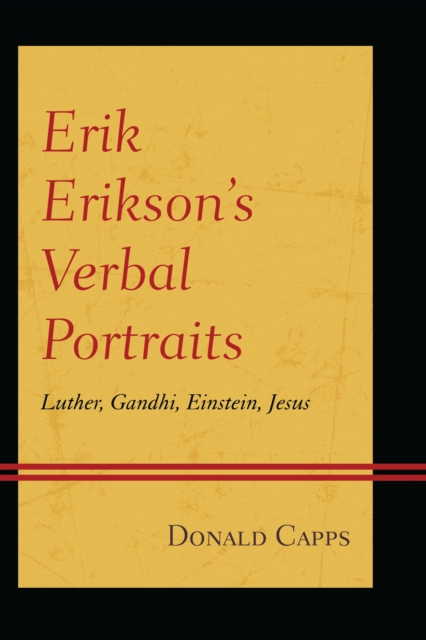
Erik Erikson's verbal portraits
In his late teens and early twenties Erik H.Erikson, the widely acclaimed psychoanalyst and developmental theorist, aspired to be an artist.In Erik Erikson's Verbal Portraits: Luther, Gandhi, Einstein, Jesus, Donald Cappscontends that Erikson's portraits of respective historical figures not only reflect his artistic gifts but also make a highly.
eBook

Erik H. Erikson’s Young Man Luther: A Classic Revisited
The plan to translate Erik H. Erikson’s
Young Man Luther
(Erikson
1958
) into Chinese (see Chen et al.,
Pastoral Psychology
61:641–654,
2012
) provides compelling evidence that this book is a classic in psychology of religion and related fields. In this article I focus on the professional circumstances that contributed to Erikson’s decision to write a book on Martin Luther; his rationale, based on his particular psychoanalytic orientation, for emphasizing Luther’s resourcefulness in emancipating himself from outworn religious beliefs and practices; and the fact that a new personal appreciation for religious expressions also played an important role in his decision to write the book. I also discuss the fact that I was initially attracted to the book because it drew attention to Luther’s redefinition of work and did so in a way that was personally meaningful to me and in later years I have found the topics and themes of melancholy and inner peace to be personally meaningful to me as well. Based on my own experiences with
Young Man Luther,
I conclude that books
become
classics because they invite their potential readers to enter into the text in a way that is personally meaningful to them and that they
remain
classics because their readers discover new ways over the course of their own lives in which the book is personally meaningful to them. I conclude the article with the proposal that
Young Man Luther
is a religious biography.
Journal Article
The Mortification of the Self: Erving Goffman’s Analysis of the Mental Hospital
In this article I summarize the main points in the first two essays in Erving Goffman’s
Asylums
, published in 1961, which is based on his field work at St. Elizabeths Hospital in Washington, D.C. in 1955–56. The first essay presents his concept of total institutions. The second focuses on the mortification of the self that one experiences during the pre-patient and patient phases. Although these essays reflect observations that were made some 60 years ago, his analysis of what happens to the mental patient in the hospital environment is still relevant, especially for seminary students whose CPE field work takes place in the mental hospital setting. This article also provides the basis for a follow-up article on William F. Lynch’s (1965)
Images of Hope
, which he wrote during his residence at St. Elizabeths Hospital in the early 1960s.
Journal Article
Striking Out: The Case of Mighty Casey
In
Striking Out
(Capps
2011a
), I explored two meanings of the phrase “striking out.” One means to begin, advance, or proceed, especially in a new way or direction. The other, associated with baseball, means an out by a batter charged with three strikes. The book focused more on the first than the second meaning. In this article I take up the second meaning by considering the mythical case of “mighty Casey,” whose strike out is portrayed in Ernest Thayer’s poem
Casey at the Bat
(Thayer
1888
). I suggest that at the time Thayer wrote the poem he identified personally with Casey’s failure. I also use my proposal in
Agents of Hope
(Capps
2001
) that failed hopes may engender a spirit of modesty to interpret the change in Casey’s own self-understanding as presented in certain sequels to the original poem written by other authors. In addition, I imagine a scenario in which a local pastor, in his role of agent of hope, helps Casey deal with his despair and accompanying depression in the wake of his failure and to recover his capacity to hope. I conclude that Ernest Thayer’s life also reflected a spirit of modesty.
Journal Article
Imagining Hope: William F. Lynch’s Psychology of Hope
This article is a follow-up to my recent article on Erving Goffman’s
Asylums
(
1961
), an analysis of the mental hospital environment. I focus here on William F. Lynch’s book
Images of Hope
(
1965
) which was written when Lynch was a scholar in residence at St. Elizabeths Hospital in Washington, D.C. in
1962
. I take particular note of the fact that Lynch perceived the book to be a venture into the psychology of hope, and that he based this psychology on the complementary relationship of hope and imagination. I also consider the relationship that he draws between hope and help; the dynamic of hope and hopelessness; the roles of wishing and waiting in the development of a mature sense of hope; and the imagination as an instrument of coping. I conclude that among the selves that comprise our composite Self, the hopeful self is essential to life itself.
Journal Article
Deliverance to the Captives: Karl Barth’s Prison Sermons
This article focuses on the sermons that Karl Barth preached in the prison at Basel between August 1954 and June 1959. It draws particular attention to Barth’s view that although his listeners are incarcerated for crimes that they have committed, we all, in effect, are living in prison houses of our own making and are in no less need of the liberating gospel promises based on the death and resurrection of Jesus Christ. Three sermons that express the various nuances and implications of this view are presented in some detail. In conclusion, I suggest that Barth’s prison sermons are reflective of the
experiential
model of theological diagnosis and that they are essentially congruent with the
wounded healer
pastoral model.
Journal Article
Resistance in the Local Church: A Psychoanalytic Perspective
This article focuses on Sigmund Freud’s presentation of the concept of resistance in
Introductory Lectures on Psycho
-
Analysis
(Freud
1989c
) and on James E. Dittes’s employment of this concept in
The Church in the Way
(Dittes
1967
). It takes particular note of Freud’s view that the patient’s resistance may contribute to the success of the therapeutic process if skillfully handled by the therapist, as well as Dittes’s view that instead of condemning laypersons’ expressions of resistance, the minister should recognize that they are a sign of vitality and testify to laypersons’ skills, sensitivity, and commitment to the church and its fundamental purposes. The article concludes with a brief consideration of the relationship between resistance and resourcefulness (Capps
2014
).
Journal Article
Erik H. Erikson’s Psychoanalytic Portrait of Martin Luther
In my article (Capps in
Pastoral Psychology
,
2013a
) I focused on the professional and personal reasons for Erik H. Erikson’s decision to write a book on Martin Luther (Erikson
1958
) and his rationale for emphasizing Luther’s resourcefulness in emancipating himself from outworn religious beliefs and practices. I also discussed the fact that this book has continued to be meaningful to me since the first time I read it in the early 1960s. In a previous article (Capps in
Journal of Religion & Health, 50
, 880–898,
2011
) I made the case that Erikson developed a form of psychoanalytic discourse—the verbal portrait—which, although not unprecedented, became a focal feature of his work and the testing ground for the cogency of his major contribution to psychoanalysis (the concept of identity). In this article, I provide a chapter-by-chapter summary of the book as a means to bring into focus Erikson’s “verbal portrait” of Martin Luther. Although a summary of the major points of each of the chapters cannot take the place of reading the book itself, it can help first-time readers to get their bearings. It can also help to dispel their anxieties on the one hand and their prejudgments on the other so that they may engage the book for what it is, namely, “a study in psychoanalysis and history.”
Journal Article
Method, Models, and Scholarly Types: Reflections on Thesis and Dissertation Writing in Pastoral Theology
This article concerns the methodological issues confronted by pastoral theology students in their writing of a master’s thesis or doctoral dissertation. I introduce H. Richard Niebuhr’s (
1951
) identification of five models (
rejection, accommodation, synthesis, dualism,
and
conversionist
) for relating the theological and psychological resources used in their writing. Then, by means of Rudolf Arnheim’s art theory (
1986
,
1988
,
1996
), I identify three additional models (
convergence, juxtaposition,
and
structural uniformity
) and note their affinities with and complications of three of Niebuhr’s models (
synthesis, dualism,
and
accommodation
). I argue that these complications can play a positive role in the writing of a thesis or dissertation as they promote a fuller engagement with the empirical reality that is the focus of study. I also note David W. Galenson’s (
2006
) view that his typology of artists as
conceptualists
and
experimentalists
is applicable to scholars and suggest that awareness of which type is most characteristic of oneself may enable one to minimize the frustrations that one is likely to experience in writing a thesis or dissertation. I conclude with a brief discussion of Erik H. Erikson’s consideration of Martin Luther’s redefinition of work in
Young Man Luther
(chapter 5) and suggest that it makes the case for understanding thesis and dissertation writing as an exercise in liberated craftsmanship.
Journal Article