
Catalogue Search | MBRL


Are you sure you want to remove the book from the shelf?

{{itemTitle}}
28
result(s) for
"Carruthers, David V."
Sort by:
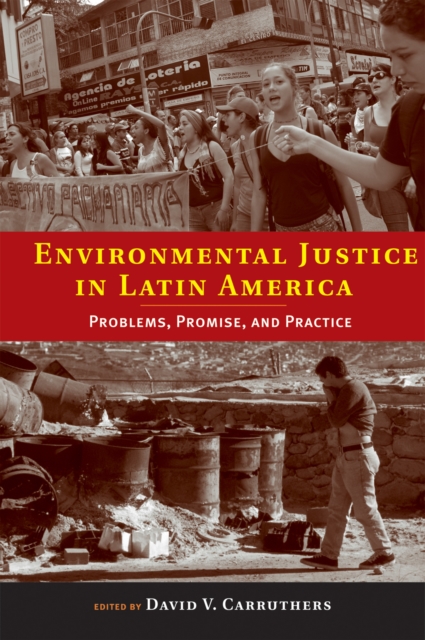
Environmental justice in Latin America : problems, promise, and practice
Scholars and activists investigate the emergence of a distinctively Latin American environmental justice movement, offering analysis and case studies that illustrate the connections between popular environmental mobilization and social justice in the region.
eBook

The Politics and Ecology of Indigenous Folk Art in Mexico
This paper explores the ecological promise and peril of Mexico's rich and diverse indigenous arts and crafts. In the quest for authentic sustainable development, the increased commercialization of folk art presents both opportunities and risks. Many indigenous art forms demonstrate characteristics associated with triumphs in agroecology, social forestry, and other rural initiatives—community revitalization, resource stewardship, traditional ecological knowledge, identity, biological and cultural diversity, and grassroots participation. However, field research in rural Michoacán and Oaxaca presents a sobering counterpoint, finding most peasant artisans entangled, both as agents and victims, in worrisome patterns of degradation, depletion, and exploitation. Global and domestic market failures, predatory bossism, embedded inequities, lack of cooperative success, and political exclusion largely undermine in practice the ecological potential of indigenous art. Still, in the face of forbidding barriers, there are encouraging signs of innovation and a fledgling national movement for a more ecological folk art.
Journal Article

Indigenous ecology and the politics of linkage in Mexican social movements
Analyses alliance formation between urban, educated, mostly middle class environmental groups, and the rural, marginalised, indigenous resistance movement in Mexico - linkages between seemingly unlikely partners who share the hope that traditional knowledge might provide a living model of sustainability. The alliance is characterised as 'indigenous ecology' and the analysis concludes with a discussion of the theoretical and political implications of indigenous ecology and its linkages.
Journal Article


Exporting Environmentalism: U.S. Multinational Chemical Corporations in Brazil and Mexico. By Ronie Garcia-Johnson. Cambridge, MA: MIT Press, 2000. 282p. $20.00
As toxic pollutants and hazardous production emerged across
the twentieth century, first-world states came to play a
guardian role, imposing constraints on capital to safeguard
their workers, communities, and environments. As we enter
the new century, vigorous protest and debate over the
character and conditions of neoliberal globalization center on
whether or how to reaffirm or extend such protections in an
era of free trade, capital mobility, privatization, and deregu-
lation. From Rio to Seattle, Kyoto to Prague, controversy
arises over where the locus of authority for codes of corpo-
rate conduct might rest. Can states be redeemed as guardians
and still avert a destructive \"race to the bottom\"? Can
existing supranational bodies or regimes be charged with
design and enforcement of global standards, or are new
international institutions imperative? Dare we trust multina-
tional corporations (MNCs) to police themselves? What is
the proper role of advocacy networks and civic organiza-
tions?
Journal Article

Courage Tastes of Blood: The Mapuche Community of Nicolás Ailío and the Chilean State, 1906-2001
( Hats off to the editorial board of Duke University Press. [...]there has been nothing like Florencia Mallon's superb La sangre del copihue: For more than a century afterward, state assimilationist policies and forced relocation projects broke the Mapuche hold on their ancestral lands, to the benefit of successive waves of Chilean and foreign settlers, local land barons, private concessionaires, and timber, farming, mining and other development interests. Non-Indian landowners and entrepreneurs, supported by judges, state officials, and police and military forces, acquired vast holdings through government-sponsored settlement programmes, manipulated land surveys, market power, and nefarious titling schemes.
Book Review
Exporting Environmentalism: U.S. Multinational Chemical Corporations in Brazil and Mexico
\"Exporting Environmentalism: U.S. Multinational Chemical Corporations in Brazil and Mexico\" by Ronie Garcia-Johnson is reviewed.
Book Review

SUSTAINABLE DEVELOPMENT IN MEXICO? THE INTERNATIONAL POLITICS OF CRISIS OR OPPORTUNITY
THE CHANGE FOR SUSTAINABLE INTERNATIONAL DEVELOPMENT DEPENDS ON THE OPTIONS THAT EMERGE IN MEXICAN AND IN U.S. POLITICS. THE MEXICAN CASE PROVIDES A CRUCIAL EXAMPLE OF THE OBSTACLES THAT MUST BE CONFRONTED ON THE ROAD TO INTERNATIONAL ENVIRONMENTAL SECURITY. THIS ARTICLE ARGUES THAT SO LONG AS MEXICO'S INTEGRATION INTO THE WORLD ECONOMY PROCEEDS ALONG ITS PRESENT PATH, EROSION OF THE HUMAN-AND NATURAL-RESOURCE FOUNDATION ON WHICH THE ECONOMY ULTIMATELY DEPENDS WILL ACCELERATE. ITS ATTEMPTS TO SHOW THAT THE REVITALIZATION OF PEASANT COMMUNITIES AND THE SOCIAL AND ECOLOGICIAL RECONSTRUCTION OF THE COUNTRYSIDE OFFER THE MOST PROMISING STRATEGY FOR REVERSING THE CYCLE OF POVERTY AND ECOLOGICAL DESTRUCTION, THUS TRANSFORMING CRISIS INTO OPORTUNITY.
Journal Article