
Catalogue Search | MBRL


Are you sure you want to remove the book from the shelf?

{{itemTitle}}
103
result(s) for
"Carruthers, Gerard"
Sort by:


Scottish literature
This guide combines detailed literary history with discussion of contemporary debates about Scottishness.The book considers the rise of Scottish Studies, the development of a national literature, and issues of cultural nationalism. Beginning in the medieval period during a time of nation building, the book goes on to focus on the 'Scots revival' of the eighteenth and nineteenth centuries before moving on to discuss the literary renaissance of the twentieth century. Debates concerning Celticism and Gaelic take place alongside discussion of key Scottish writers such as Robert Burns, Walter Scott, Thomas Carlyle, Hugh MacDiarmid, Alasdair Gray and Liz Lochhead. The book also considers émigré writers to Scotland; Scottish literature in relation to England, the United States and Ireland; and postcolonialism and other theories that shed fresh light on the current status and future of Scottish literature.
eBook


The international companion to John Galt
John Galt (1779–1839) was a contemporary of Sir Walter Scott and Jane Austen, and a friend and biographer of Lord Byron. Although a prolific writer, and much admired in his own lifetime, Galt has never achieved comparable levels of literary fame, and his works – poised between Enlightenment and Romanticism – are now often overlooked. Yet his reputation has been slowly growing, and he has attracted critical interest as both a political novelist and a chronicler of Scottish life. This International Companion builds on a steady stream of recent scholarship, and examines Galt’s writings in the social, economic, and religious contexts of their time.
eBook


The Cambridge Companion to Scottish Literature
Scotland's rich literary tradition is a product of its unique culture and landscape, as well as of its long history of inclusion and resistance to the United Kingdom. Scottish literature includes masterpieces in three languages - English, Scots and Gaelic - and global perspectives from the diaspora of Scots all over the world. This Companion offers a unique introduction, guide and reference work for students and readers of Scottish literature from the pre-medieval period to the post-devolution present. Essays focus on key periods and movements (the Scottish Enlightenment, Scottish Romanticism, the Scottish Renaissance), genres (the historical novel, Scottish Gothic, 'Tartan Noir') and major authors (Burns, Scott, Stevenson, MacDiarmid and Spark). A chronology and guides to further reading in each chapter make this an ideal overview of a national literature that continues to develop its own distinctive style.
eBook


English Romanticism and the Celtic World
English Romanticism and the Celtic World explores the way in which British Romantic writers responded to the national and cultural identities of the 'four nations' England, Ireland, Scotland and Wales. The essays collected here, by specialists in the field, interrogate the cultural centres as well as the peripheries of Romanticism, and the interactions between these. They underline 'Celticism' as an emergent strand of cultural ethnicity during the eighteenth century, examining the constructions of Celticness and Britishness in the Romantic period, including the ways in which the 'Celtic' countries viewed themselves in the light of Romanticism. Other topics include the development of Welsh antiquarianism, the Ossian controversy, Irish nationalism, Celtic landscapes, Romantic form and Orientalism. The collection covers writing by Blake, Wordsworth, Scott, Byron and Shelley, and will be of interest to scholars of Romanticism and Celtic studies.
eBook

The Cambridge companion to Scottish literature
\"Scotland's rich literary tradition is a product of its unique culture and landscape, as well as of its long history of inclusion and resistance to the United Kingdom. Scottish literature includes masterpieces in three languages - English, Scots and Gaelic - and global perspectives from the diaspora of Scots all over the world. This Companion offers a unique introduction, guide and reference work for students and readers of Scottish literature from the pre-medieval period to the post-devolution present. Essays focus on key periods and movements (the Scottish Enlightenment, Scottish Romanticism, the Scottish Renaissance), genres (the historical novel, Scottish Gothic, 'Tartan Noir') and major authors (Burns, Scott, Stevenson, MacDiarmid and Spark). A chronology and guides to further reading in each chapter make this an ideal overview of a national literature that continues to develop its own distinctive style\"-- Provided by publisher.
Book
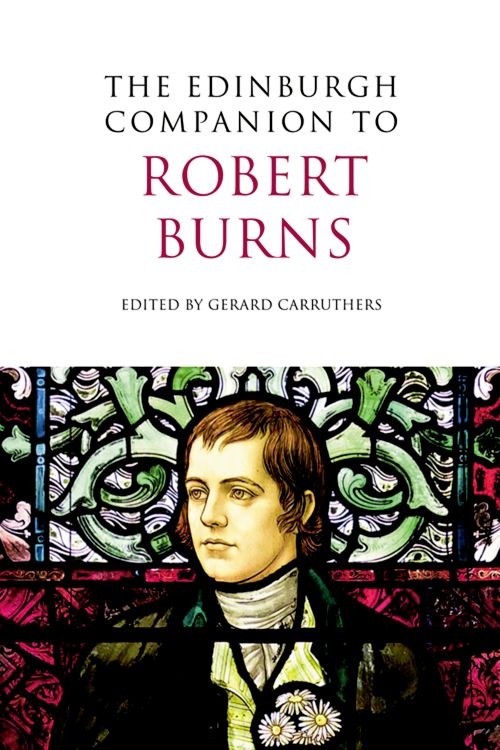
The Edinburgh Companion to Robert Burns
In this comprehensive introduction to Robert Burns detailed commentary on the artistry and critical contexts of his work is complemented by material on the cultural reception and afterlife of this most iconic of world writers.
eBook