
Catalogue Search | MBRL


Are you sure you want to remove the book from the shelf?

{{itemTitle}}
159
result(s) for
"Casillo, Robert"
Sort by:


The Italian in Modernity
In this study, Robert Casillo and John Paul Russo look at both Italy and Italian America to explore the paradoxical representation of Italy as the originator of modernity that has resisted many modern tendencies.
eBook

Gangster Priest
Bringing a wealth of scholarship and insight into Scorsese's work, Casillo's study will captivate readers interested in the director's magisterial artistry, the rich social history of Southern Italy, Italian American ethnicity, and the sociology and history of the Mafia in both Sicily and the United States.
eBook
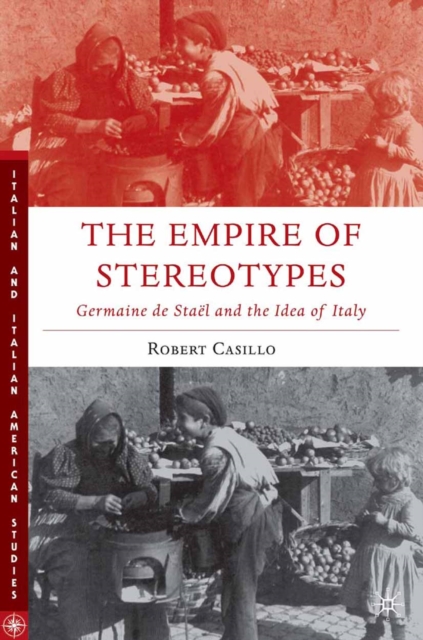
The empire of stereotypes : Germaine de Staël and the idea of Italy
This book places Germaine de Stael's influential novel, Corrine, or Italy (1807) in relation to preceding and subsequent stereotypes of Italy as seen in the works of Northern European and American travel writers since the Renaissance.
eBook

The Representation of Italian Americans in American Cinema
The representation of Italian Americans in American cinema from silent films into the early 1970s has largely been the history of the formation and recirculation of ethnic stereotypes, which most directors have employed unquestioningly, but to which the more talented, while acknowledging that ‘grain of truth’ stereotypes often contain, have applied strategies of irony and subversion. Although the encounter of native Americans with Italian immigrants helped to form these stereotypes, their deeper origins lie in the relations between Italy and the northern European world. They owe much to Renaissance narratives, not altogether imaginary, of an amorally sensual Italy abounding in
Book Chapter

Mobsters and Bluebloods
This chapter seeks to illuminate the common anthropological and other parallels which make Martin Scorsese's
The Age of Innocence
and his Italian‐American films inextricable components of a single, unified oeuvre. However remote such religious and anthropological concerns may seem from the polished civilities of Scorsese's
The Age of Innocence
, their pertinence will come gradually into focus. The resemblance between Mafia families and New York high society is more than superficial. In Scorsese's films, the major example of this mentality is Johnny Boy, the neighborhood ne'er‐do‐well in
Mean Streets
, whose life is consumed by compulsive transgression against the values of Manhattan's Little Italy. A typical response is to restore solidarity not only by closing ranks but by reaffirming traditional codes and rituals through expulsive violence. The differences between the forms of violence depicted in the Italian American films and
The Age of Innocence
are reflected at the stylistic level.
Book Chapter

Ezra Pound: The Marxist Anti-Semitic Zionist?
Tim Redman's interpretation of Ezra Pound as left-wing fascist, socialist and anti-Semitic Zionist is criticized. Redman's work is seriously flawed by over-documentation at the expense of ideological analysis and by omission of incriminating facts and lacks a theoretical grasp of fascist ideology.
Journal Article
The Immigrant Generations
Martin Scorsese was born in Flushing, Queens, on 17 November 1942 to Charles and Catherine Scorsese, both Italian Americans of Sicilian immigrant parentage. Martin’s paternal grandfather, Francesco Scorsese, was born in Polizzi Generosa, a town near Palermo, around 1880. His mother having died when he was six or seven, Francesco upon his father’s remarriage was sent to live with a local farmer who raised him. Unwilling to remain in Sicily, Francesco chose to emigrate to the United States. After his arrival in New York City in 1901, he married a young immigrant woman named Teresa who had arrived in the
Book Chapter
Scorsese as Third-Generation Italian American Artist
As a man and artist, Martin Scorsese belongs to the third generation of Italian Americans and exhibits many of the characteristic conflicts and ambivalences that come with external as well as internal pressures to resist or embrace acculturation and assimilation. Among the first to explore the problems of third-generation Italian Americans were Rudolph J. Vecoli and Richard Gambino. In Vecoli’s view, second-generation parents produced ambivalence in their third-generation children by requiring a commitment to both family values and hard work for the sake of upward mobility. The children thus received the contradictory message: ‘Get an education but don’t change.’ This
Book Chapter